

One of the biggest challenges for anyone learning Spanish is understanding grammatical gender. Unlike English, every Spanish noun is either masculine or feminine, and this affects the articles, adjectives and other words that accompany it.
While some nouns follow clear patterns, others can be confusing. One of the questions Spanish learners ask most often is: Is reloj masculine or feminine?
If you’ve ever searched for the answer, you’re in the right place. In this practical guide, you’ll learn the correct gender of reloj, discover why this word often causes confusion, and explore the most important rules for recognising whether a Spanish noun is masculine or feminine.
Although Spanish has several useful guidelines, there are also plenty of exceptions. The good news is that, with regular practice and exposure to the language, recognising grammatical gender gradually becomes much more intuitive.
Is reloj masculine or feminine?
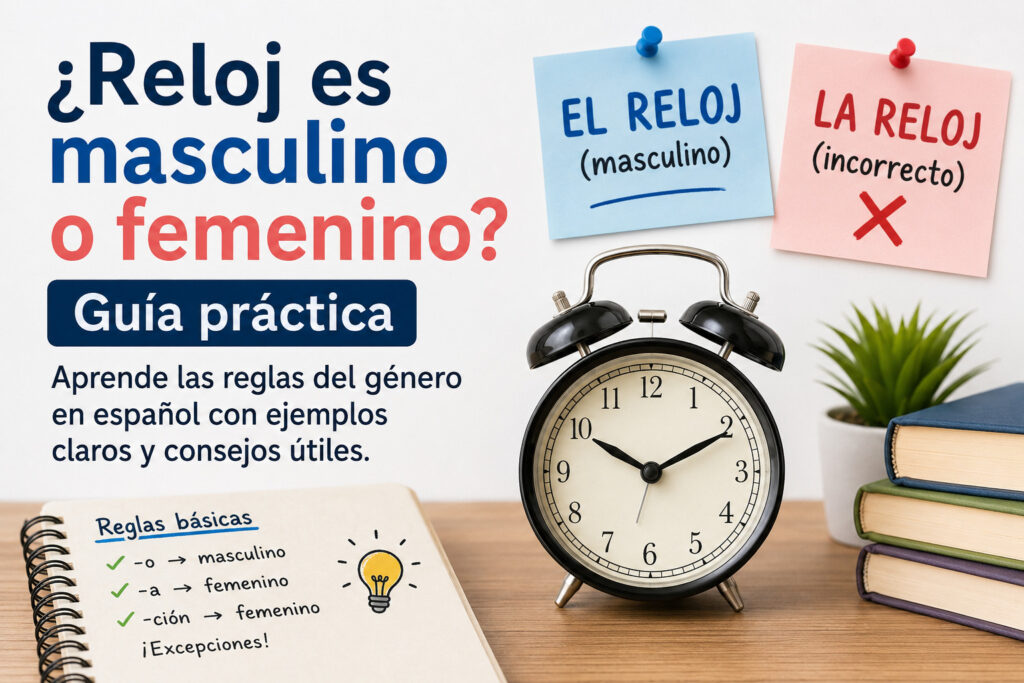
The answer is straightforward: The noun reloj is masculine.
That means you should always say:
- El reloj.
- Un reloj.
- Mi reloj.
- Ese reloj nuevo.
- El reloj de pared.
The following forms are incorrect:
- ❌ La reloj.
- ❌ Una reloj.
Examples in context
Here are some common examples:
- Mi reloj marca las ocho.
- He comprado un reloj nuevo.
- El reloj de la cocina funciona perfectamente.
- Este reloj es muy antiguo.
- ¿Dónde está el reloj?
Notice that every article, determiner and adjective agrees with the noun in the masculine form.
Why is reloj masculine?
Many learners expect there to be a logical reason why every Spanish noun is masculine or feminine. In reality, there usually isn’t.
A clock or watch has no biological sex. The fact that reloj is masculine is simply a grammatical feature of the Spanish language.
The same applies to thousands of other nouns, such as:
- el libro (book)
- el coche (car)
- el árbol (tree)
- el teléfono (phone)
- el ordenador (computer)
- el reloj (clock)
In other words, grammatical gender belongs to the word itself, not to the object it describes.
Why do so many learners get confused?
The question of whether reloj is masculine or feminine is common because students often rely on general spelling patterns.
For example:
- Many nouns ending in -a are feminine.
- Many nouns ending in -o are masculine.
However, reloj ends in -j, which gives no clue about its grammatical gender.
For this reason, it’s much more effective to learn nouns together with their definite article rather than memorising the noun on its own.
For example:
- el reloj (clock)
- la mesa (table)
- el problema (problem)
- la ciudad (city)
Learning vocabulary in this way helps grammatical gender become second nature.
How grammatical gender works in Spanish
Every Spanish noun has a grammatical gender.
In most cases, nouns are either:
- masculine
- feminine
This grammatical feature affects the entire sentence because articles, adjectives, pronouns and some participles must agree with the noun.
For example:
- El reloj nuevo. (masculine)
- La mesa nueva. (feminine)
Notice how the adjective changes according to the gender of the noun.
Rule 1: Words ending in -o are usually masculine
This is probably the easiest rule for beginners to remember.
Some common examples include:
- el libro (book)
- el perro (dog)
- el vaso (glass)
- el zapato (shoe)
- el bolso (handbag)
Like most grammar rules, however, there are exceptions.
For example:
- la mano (hand)
- la radio (when referring to the device)
- la foto (photo, short for fotografía)
Rule 2: Words ending in -a are usually feminine
This pattern is also very reliable.
Examples include:
- la casa (house)
- la mesa (table)
- la ventana (window)
- la silla (chair)
- la puerta (door)
Nevertheless, some masculine nouns also end in -a, including:
- el mapa (map)
- el planeta (planet)
- el día (day)
- el idioma (language)
These are among the most common exceptions learners encounter.
Rule 3: Words ending in -ción are generally feminine
Fortunately, this rule has very few exceptions.
Examples:
- la información (information)
- la conversación (conversation, talk)
- la educación (education)
- la estación (station)
- la canción (song)
Whenever you see a noun ending in -ción, you can usually assume it is feminine. Also those ending in -sión and -cción: la decisión (decision), la confesión (confession), la cocción (boiling), la calefacción (heating)…
Rule 4: Words ending in -dad are feminine
Examples include:
- la ciudad (city)
- la universidad (university)
- la libertad (liberty, freedom)
- la posibilidad (possibility)
- la realidad (reality)
This is one of the easiest gender patterns to remember.
Rule 5: Words ending in -tad are also feminine
Examples:
- la amistad (friendship)
- la voluntad (will)
- la dificultad (difficulty)
Rule 6: Words ending in -umbre are feminine
Examples:
- la costumbre (habit)
- la incertidumbre (uncertainty)
- la muchedumbre (crowd, mass)
Rule 7: Many nouns ending in a consonant are masculine
The noun reloj belongs to this group.
Other examples include:
- el papel (paper)
- el hotel (hotel)
- el ordenador (computer)
- el árbol (tree)
- el color (colour)
- el camión (truck, lorry)
- el avión (plane)
However, this is not a universal rule. Many nouns ending in a consonant are feminine, such as:
- la flor (flower)
- la sal (salt)
- la piel (skin)
- la pared (wall)
- la señal (signal, gesture)
Word endings don’t always determine grammatical gender
This is one of the most important points for Spanish learners to remember. Although word endings provide useful clues, they cannot guarantee whether a noun is masculine or feminine.
For that reason, experienced Spanish teachers recommend learning every noun together with its article.
For example:
- el reloj (clock)
- la ventana (window)
- el árbol (tree)
- la ciudad (city)
Instead of memorising individual words, memorise the complete noun phrase. This simple habit makes it much easier to use grammatical gender correctly when speaking and writing Spanish.
Nouns with natural gender
When Spanish nouns refer to people or animals, their grammatical gender often reflects their biological sex.
For example:
- el padre (father)
- la madre (mother)
- el abuelo (grandfather)
- la abuela (grandmother)
- el niño (child, boy)
- la niña (child, girl)
In these examples, changing the ending of the noun also changes its gender.
Nouns with a single grammatical form
Some Spanish nouns keep the same form.
For instance:
- la persona (person)
- la víctima (victim)
- el personaje (character)
This means you can say:
- La persona es un hombre.
- La persona es una mujer.
Although the person being described changes, the grammatical gender of the noun remains exactly the same.
When grammatical gender changes the meaning
In Spanish, there are a few nouns whose meaning depends on whether they are masculine or feminine.
Take these examples:
El capital = financial assets or wealth.
La capital = the capital city of a country or region.
Another pair is:
El cura = a priest.
La cura = a cure or medical treatment.
And another:
El cometa = a comet.
La cometa = a kite.
These words are not particularly common, but they’re useful to know because using the wrong article completely changes the meaning.
The special rule for feminine nouns beginning with a stressed a
One grammar point that often surprises learners concerns certain feminine nouns that begin with a stressed a sound. Although these nouns are feminine, they take the masculine singular article el to make pronunciation easier.
Examples include:
- el agua (water)
- el águila (eagle)
- el alma (soul)
- el arma (weapon)
Even so, they remain feminine nouns.
You can clearly see this because the adjectives stay feminine:
- el agua fría
- el águila blanca
- el alma buena
Once these nouns become plural, they return to the feminine article:
- las aguas
- las águilas
- las almas
How to work out the gender of a new Spanish noun
There isn’t a magic formula that works every time, but there are several strategies that can help you choose the correct gender more confidently.
1. Check the ending
In many cases, the ending provides a useful indication of whether a noun is masculine or feminine.
2. Learn the article as part of the vocabulary
Rather than memorising:
- reloj
learn:
- el reloj
Treat the article and noun as a single unit. This approach makes grammatical gender much easier to remember.
3. Read regularly
Reading exposes you to nouns in context, allowing you to become familiar with their correct articles naturally.
The more often you see a noun used correctly, the more likely you are to remember its gender.
4. Listen to authentic Spanish
Films, television programmes, podcasts and everyday conversations repeatedly expose you to expressions such as:
- el reloj
- la televisión
- el coche
- la puerta
After enough exposure, you’ll begin to recognise the correct gender instinctively rather than relying on grammar rules.
5. Check a reliable dictionary
Whenever you’re unsure, look the word up in a good Spanish dictionary.
You’ll usually find abbreviations such as m. (masculine) and f. (feminine), which indicate the noun’s grammatical gender.
Common mistakes learners make
Even advanced students occasionally make mistakes with grammatical gender. Here are some of the most frequent ones.
Mistake 1
❌ La reloj.
✔ El reloj.
Mistake 2
❌ La problema.
✔ El problema.
Mistake 3
❌ El mano.
✔ La mano.
Mistake 4
❌ La mapa.
✔ El mapa.
Mistake 5
❌ El foto.
✔ La foto. (La fotografía)
Making mistakes like these is perfectly normal while learning Spanish. They become less frequent with regular practice.
Test yourself
Can you identify the correct article for each noun? Write el if the word is masculine and la if it is feminine.
- reloj
- mesa
- árbol
- ciudad
- problema
- mano
- coche
- universidad
- planeta
- flor
- el reloj
- la mesa
- el árbol
- la ciudad
- el problema
- la mano
- el coche
- la universidad
- el planeta
- la flor
What’s the easiest way to remember noun gender?
One of the most effective techniques is to learn every noun together with its article.
Instead of memorising reloj, memorise el reloj.
Teachers of Spanish as a foreign language recommend this method because it strengthens memory and reduces common grammatical errors.
Practical tips for mastering grammatical gender
Many learners find grammatical gender difficult when they first begin studying Spanish, especially if their native language doesn’t use gendered nouns. Fortunately, it becomes much easier with continued exposure to the language.
To improve more quickly:
- Always learn nouns together with their articles.
- Look for common patterns in word endings.
- Remember that every rule has exceptions.
- Read Spanish texts appropriate for your level.
- Listen to native speakers whenever possible.
- Regularly revise nouns that you tend to confuse.
With time, choosing the correct grammatical gender will become increasingly automatic, allowing you to speak and write Spanish with greater confidence.
Conclusion
By now, the answer should be clear: reloj is a masculine noun, so the correct expression is always el reloj.
Although this article focuses on one particular word, the same principles apply to thousands of Spanish nouns. Learning how grammatical gender works is a key step towards becoming a more confident Spanish speaker. General rules based on word endings can be extremely helpful, but they won’t always give you the right answer. For that reason, it’s a good idea to learn every new noun together with its article.
Improving your understanding of grammatical gender takes time, but regular reading, listening and speaking practice will help you recognise the correct forms more naturally. Before long, expressions such as el reloj, la mesa, el problema and la universidad will become part of your active vocabulary without requiring conscious effort.
At our online Spanish academy, Zona de Español, we provide courses for learners of all levels, combining clear grammar explanations with practical communication activities. Our lessons are designed to help you understand how Spanish really works, so you can use the language confidently and accurately in everyday situations from your very first class.
Aprende español con nuestros cursos y clases
- CEFR online Spanish courses
Spanish Online Course for Beginners – Level A1.1
110,00€ Select options This product has multiple variants. The options may be chosen on the product page - CEFR online Spanish courses
Spanish Course Level A1.2
110,00€ Select options This product has multiple variants. The options may be chosen on the product page - CEFR online Spanish courses
Online Spanish Course Basic Level – A2.1
110,00€ Select options This product has multiple variants. The options may be chosen on the product page