

Speak Spanish fluently may seem challenging at first, especially when you already understand a lot but still struggle to express yourself naturally—something very common at A2 level or while working through early B1 content. Many learners spend years studying grammar yet still feel hesitant or insecure when it comes to speaking.
The good news is that fluency is absolutely achievable if you follow the right habits. Speaking smoothly doesn’t depend on talent or memorizing rules alone, but mainly on daily practice, consistent exposure, and actively using the language in real-life situations.
In this guide, you’ll discover how to speak fluently through 8 key habits used by advanced learners, travelers, professionals, and bilingual speakers to progress faster.
You’ll also learn practical strategies to improve your pronunciation, listening comprehension, vocabulary, and overall speaking confidence.
What fluency actually means
Before anything else, it’s important to clear up what “fluency” really is.
Many people think fluency means speaking perfectly, but that’s not true. Even native speakers make mistakes, pause, or forget words sometimes.
Being fluent means being able to communicate naturally, follow conversations, and express your thoughts without translating everything in your head.
A fluent speaker can typically:
- Hold everyday conversations
- Understand movies and podcasts
- Respond without long delays
- Think in the language directly
- Express opinions clearly
- Adapt to different contexts
Fluency doesn’t happen overnight, but it can be developed faster with the right habits. These are a few habits that may help you:
1. Listen to the language every day
One of the most powerful ways to learn how to speak fluently is through constant listening.
Our brain learns languages through repetition and exposure. The more you hear real conversations, the more naturally you’ll pick up pronunciation, rhythm, and common expressions.
How to build a listening habit
You can easily add this to your daily routine:
- Listen to podcasts while walking or commuting
- Watch YouTube, Instagram, or TikTok content
- Switch Netflix and similar platforms to the target language
- Listen to music and follow along with lyrics
- Explore news, interviews, audiobooks, etc.
At the beginning, you don’t need to understand everything. The goal is to get used to the sound of the language. Progress takes time, so patience is key.
What to listen to depending on your level
Beginner
- Slow, simple podcasts
- Educational videos
- Basic conversations
- Children’s series
Intermediate
- Interviews
- Regular podcasts
- Travel videos
- Series with subtitles
Advanced
- Movies without subtitles
- Debates
- Fast-paced news
- Casual conversations
Daily listening naturally improves pronunciation, comprehension, and vocabulary.
2. Speak even if you make mistakes
Many learners understand a lot but avoid speaking because they’re afraid of getting it wrong. This is one of the biggest barriers to fluency.
The truth is simple: nobody learns to speak without making mistakes. You just have to start, even if it feels imperfect—you’ll improve gradually.
Why speaking early matters
When you speak, you:
- Activate passive vocabulary
- Improve pronunciation
- Build confidence
- Think faster in the language
- Notice your weak points
Waiting until you’re “perfect” only slows your progress.
How to practice speaking daily
You don’t need to live abroad. You can:
- Talk with online tutors
- Use language exchange apps
- Join speaking groups
- Talk to yourself
- Read texts out loud
Even 15–20 minutes a day can make a big difference.
Focus on communication
Fluency develops when you stop obsessing over each word and start focusing on expressing ideas. It’s better to speak imperfectly than not speak at all.
3. Think directly in the language
Translating in your head is one of the biggest obstacles to fluency.
If you think in your native language first and then translate, conversations become slow and unnatural. The ideal is to think directly in the language you’re learning.
At first, it feels strange, but it becomes natural with practice.
How to start thinking in Spanish
Try simple mental exercises:
- Describe what you see around you
- Think about your daily plans
- Name objects in your environment
- Describe your emotions
- Make mental lists
Examples:
- “Necesito comprar comida.” (“I need to buy groceries.”)
- “Hoy hace mucho calor.” (“It’s really hot today.”)
- “Tengo que terminar este trabajo.” (“I have to finish this task.”).
At first it takes effort, but eventually it becomes automatic.
Benefits of thinking in the language
- You speak faster
- You pause less
- You sound more natural
- You strengthen active vocabulary
- You gain confidence
This habit significantly speeds up the learning process.
4. Learn full expressions instead of isolated words
A common mistake among language learners is trying to memorize long vocabulary lists and then struggling to form natural sentences. A far more effective approach is to learn complete expressions instead of individual words.
Why phrases work better
The brain stores language more effectively when it is learned in context.
For example, instead of only learning the verb “hacer,” it is more useful to learn how it appears in real expressions like:
- Hacer ejercicio
- Hacer una llamada
- Hacer una pregunta
- Hacer tiempo
This way, vocabulary, grammar, and pronunciation are developed together in a more natural and connected way.
Useful phrases to sound more fluent
- ¿Qué quieres decir? (What do you mean?)
- No estoy seguro. (I’m not sure.)
- Tiene sentido. (That makes sense).
- Estoy de acuerdo. (I agree.)
- Depende de la situación. (It depends on the situation.)
- En mi opinión. (In my opinion.)
- ¿Cómo se dice…? (How do you say…?)
Using ready-made expressions like these makes your speech sound smoother and more natural.
5. Improve pronunciation by listening and imitating
Clear pronunciation is essential for effective communication.
Even when learners understand the language well, they often feel hesitant to speak because they haven’t trained their ear and mouth with real native input. One of the most effective techniques for this is imitation.
What shadowing is
Shadowing is a method where you repeat what a native speaker says immediately after hearing it, almost in real time.
This technique helps you:
- Refine your accent
- Develop natural speech rhythm
- Increase speaking speed
- Improve intonation patterns
- Reduce hesitation while speaking
How to practice shadowing
- Pick a short audio clip
- Listen to one sentence
- Repeat it immediately
- Match rhythm and intonation as closely as possible
- Repeat the process multiple times
You can practice with:
- Podcasts
- Videos
- TV series
- Interviews
- Audiobooks
Don’t aim for perfection
Your goal is not to completely remove your accent. The priority is to communicate clearly and sound natural, not flawless.
6. Read on a daily basis
Reading is one of the easiest and most powerful ways to improve vocabulary, grammar, and comprehension naturally. It also helps you absorb real language structures without conscious effort.
If fluency is your goal, daily reading should become a habit. You can start with graded readers or simplified books, even from beginner levels.
What to read depending on your level
Beginner
- Children’s books
- Short stories
- Simple news articles
- Adapted texts
Intermediate
- Blogs
- Magazines
- Articles
- Easy novels
Advanced
- Literature
- Essays
- Newspapers
- Specialized texts
How to get more out of reading
Instead of translating everything word by word, try to:
- Understand meaning from context
- Collect useful phrases
- Read out loud
- Notice common sentence patterns
- Write down expressions you like
- Look up unknown words only when necessary
Reading regularly significantly strengthens your ability to express ideas.
7. Apply the language in real situations
Many learners study languages in a classroom style but rarely use them in everyday life. Fluency develops when the language becomes part of your daily routine.
Ways to use the language daily
You can integrate it into activities such as:
- Writing messages.
- Looking up recipes.
- Watching tutorials.
- Posting on social media.
- Playing video games.
- Searching for information online.
- Listening to the radio.
The more you use the language in real contexts, the more natural speaking becomes.
Surround yourself with the language
You can also:
- Change your phone’s language
- Follow content creators
- Join online communities
- Participate in forums
- Consume content daily
Constant exposure greatly accelerates learning.
8. Be consistent and build a routine
Consistency is the most important factor in achieving fluency.
Many learners study intensively for a short period and then stop. However, steady daily practice is far more effective than occasional intense study sessions.
How much should you study?
There is no fixed ideal amount, but 20 to 90 minutes per day is usually enough to see strong long-term progress.
Example daily routine
Morning
- Listening to a podcast.
- Reviewing vocabulary.
Afternoon
- Reading for 20 minutes.
- Practicing conversation.
Evening
- Watching a series.
- Thinking in the language before going to sleep (for example, what you will do the next day or how your day has been).
The key is not intensity in a single day, but consistency over months and years.
Mistakes to avoid if you want to become fluent
Alongside developing good learning habits, it’s equally important to steer clear of common mistakes that can slow your progress.
1. Being afraid of making mistakes
Fear can seriously hold you back. Errors are a natural part of the learning process and one of the main ways you actually improve.
2. Translating everything in your head
If you constantly translate, your speech becomes slow and unnatural. The goal is to train your mind to process ideas directly in the language you’re learning.
3. Focusing only on grammar
Grammar is useful, but it’s not enough on its own. Real fluency comes from using the language to communicate, not just analyzing rules.
4. Avoiding speaking practice
You may understand a lot, but without speaking regularly, you won’t develop true fluency.
5. Expecting quick results
Becoming fluent takes time and steady effort. There are no instant solutions.
How long does it take to become fluent in Spanish?
This is one of the most frequently asked questions, and the answer varies depending on several factors:
- Your starting level
- How often you practice
- The quality of your learning methods
- How much exposure you get to the language
- Your consistency over time
Some learners can manage basic conversations in just a few months, while others need longer if their practice is less consistent.
What really matters is continuous improvement. Even small daily progress builds up into significant results over time.
The most effective way to speed up fluency
To progress faster, it helps to develop multiple skills at the same time:
- Listening
- Speaking
- Reading
- Writing
- Thinking in the target language
It’s also important to expose yourself to the language every single day, even if only for a short time. Consistency will always outperform occasional intense study sessions.
How to Speak Spanish Fluently: 8 Habits That Work. Final thoughts.
At this point, you understand how fluency is built through simple but powerful habits.
It doesn’t come from memorizing grammar rules for hours—it comes from actively using the language in real-life situations.
If you start today and:
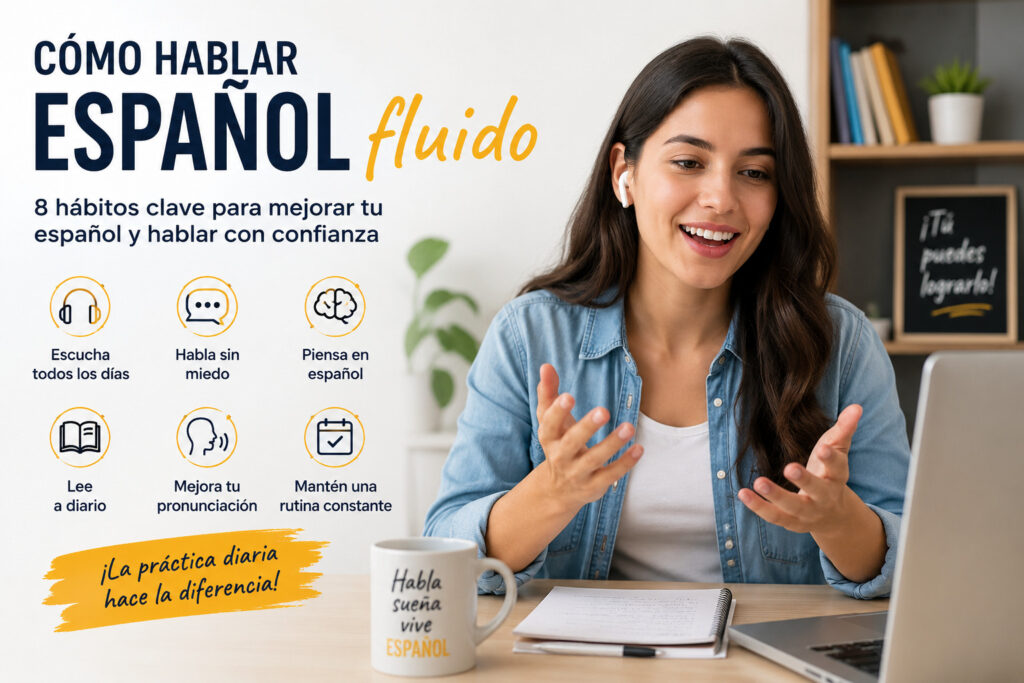
- Listen daily
- Speak without fear
- Think directly in the language
- Read consistently
- Practice pronunciation
- Maintain a steady routine
You’ll start noticing real improvement. Your Spanish will develop much faster than you expect.
If your goal is to improve your Spanish and truly build speaking fluency, our group courses offer the perfect environment to practice consistently, with guided instruction and real interaction with both the teacher and your classmates.
Aprende español con nuestros cursos y clases
- CEFR online Spanish courses
Spanish Online Course for Beginners – Level A1.1
110,00€ Select options This product has multiple variants. The options may be chosen on the product page - CEFR online Spanish courses
Spanish Course Level A1.2
110,00€ Select options This product has multiple variants. The options may be chosen on the product page - CEFR online Spanish courses
Online Spanish Course Basic Level – A2.1
110,00€ Select options This product has multiple variants. The options may be chosen on the product page