

Choosing to learn Spanish as a foreign language is an excellent investment for anyone wishing to expand their educational, career and personal prospects. As one of the world’s most widely spoken languages, Spanish continues to gain influence through international business, tourism, cultural exchange and global communication. Consequently, increasing numbers of learners are looking for the most effective way to achieve fluency. This has made the discussion surrounding online education vs traditional education increasingly important.
Advances in technology have transformed language learning in recent years. Whereas studying Spanish once meant enrolling at a language school or university, learners today have access to a wide range of online options. Virtual classrooms, interactive learning platforms and live video lessons with native-speaking tutors make it possible to study from almost anywhere. Nevertheless, traditional classroom-based learning remains a popular choice, particularly among students who appreciate face-to-face communication and a structured learning environment.
When deciding between online and traditional education, there is no single answer that suits everyone. The most suitable option depends on a variety of factors, such as individual learning goals, daily schedule, financial considerations, preferred study methods and the amount of real-life exposure to Spanish that a learner wants. In the following sections, we compare both approaches in detail, highlighting their strengths and limitations to help you make an informed decision.
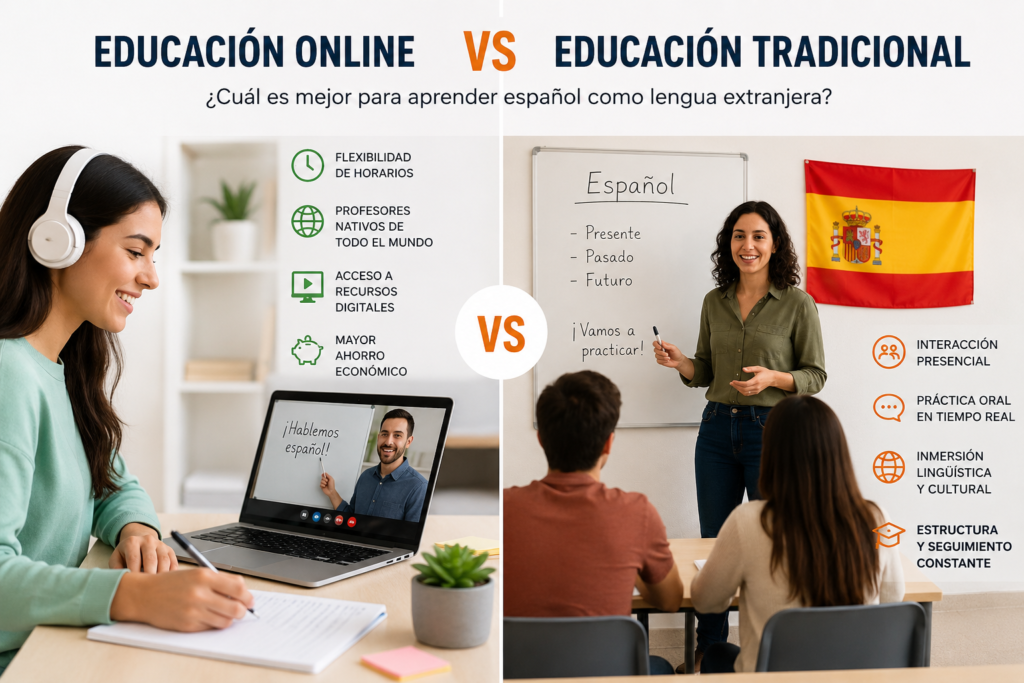
Understanding Online Education for Learning Spanish as a Foreign Language
Online education allows learners to study Spanish through internet-based courses, virtual classrooms and digital learning tools. Rather than attending lessons in person, students can join live sessions, complete coursework and communicate with experienced native-speaking tutors from almost anywhere with an internet connection.
Modern online Spanish as a Foreign Language (SFL) courses typically combine live tutorials with self-paced activities, multimedia resources, listening exercises, interactive quizzes and conversation practice. Many providers also use intelligent learning systems that adapt lessons to each student’s ability, ensuring a more personalised learning experience.
By eliminating geographical restrictions, online learning has opened the door for people around the globe to study Spanish regardless of where they live.
What Does Traditional Education Involve?
Traditional education refers to classroom-based learning delivered in language schools, colleges, universities or specialist Spanish language centres.
Students and teachers meet in person, creating an environment where questions can be answered immediately and communication takes place naturally. Lessons usually follow a fixed timetable and structured curriculum, with regular assessments and continuous guidance from the instructor.
Although digital learning has become increasingly popular, many learners still prefer classroom teaching because it provides a clear routine and direct support throughout the learning process.
Why Is Spanish Worth Learning?
Before exploring the differences between online education vs traditional education, it is useful to understand why Spanish remains one of the world’s most sought-after languages.
Studying Spanish can provide a range of personal and professional benefits, including:
- Communicating confidently with hundreds of millions of native speakers worldwide.
- Expanding employment opportunities in international markets.
- Accessing educational programmes offered by Spanish-speaking institutions.
- Enjoying richer travel experiences across Spain and Latin America.
- Discovering the history, literature, music and traditions of Hispanic cultures.
- Strengthening career prospects in multinational organisations.
Research also suggests that learning another language supports brain development by improving memory, concentration and critical thinking skills.
Advantages of Online Education for Spanish Learners
1. Flexible Learning Around Your Lifestyle
Perhaps the greatest appeal of online learning is the freedom it offers. Students are able to organise their studies around work, university, family commitments or other responsibilities instead of following rigid classroom schedules.
This flexibility makes it much easier to maintain consistent progress, whether studying from home, during business trips or while travelling abroad.
2. Access to Teachers from Across the Spanish-Speaking World
Online courses connect learners with qualified instructors from a wide variety of Spanish-speaking countries.
Studying with teachers from different regions exposes students to a broad range of accents, vocabulary and cultural perspectives, helping them develop a more complete understanding of the language.
3. Lessons Tailored to Individual Needs
Many online learning platforms use adaptive technology to monitor student performance and customise future lessons.
By identifying strengths and weaknesses, these systems can recommend targeted practice in areas such as grammar, pronunciation, listening comprehension or vocabulary development.
4. A Wealth of Digital Learning Materials
Online learners have access to an extensive selection of authentic Spanish-language resources, including:
- Audio programmes and podcasts
- Educational videos
- Digital newspapers and magazines
- Electronic books
- Television programmes and films
- Mobile learning applications
- Interactive practice activities
- Online language exchange networks
Using a variety of resources allows students to improve all four language skills in a balanced and engaging way.
5. Lower Overall Costs
For many learners, online education is a more affordable alternative to traditional classroom courses.
Besides lower tuition fees, students can also reduce expenses related to commuting, printed textbooks and accommodation, making language learning more accessible.
Challenges of Online Learning
Although online education offers considerable advantages, it is not without its drawbacks.
Independent study requires motivation, organisation and self-discipline. Without a regular study routine, learners may find it difficult to remain committed over time.
Technical issues can also interrupt lessons. Poor internet connectivity, software problems or equipment failures occasionally affect the quality of online classes.
In addition, some students feel that virtual learning cannot fully replicate the social interaction of a physical classroom, where spontaneous conversations and body language naturally enhance communication.
Advantages of Traditional Classroom Learning
1. Immediate Interaction
Face-to-face learning provides opportunities for instant communication between students and teachers.
Questions can be answered straight away, pronunciation corrected immediately and conversations developed naturally, creating a dynamic learning environment that builds speaking confidence.
2. Immersive Language Experience
Students who attend classes in a Spanish-speaking country benefit from constant exposure to the language beyond the classroom.
Daily activities such as shopping, travelling, ordering food or socialising all become opportunities to practise Spanish in authentic situations, helping learners develop fluency more quickly.
3. Clearly Structured Learning
Traditional courses usually follow a carefully organised syllabus with regular lesson times, learning objectives and ongoing assessments.
This level of structure is particularly valuable for students who prefer clear guidance and external accountability.
4. Learning Alongside Others
Studying in a classroom encourages teamwork through discussions, presentations, pair work and group activities.
Collaborative learning not only improves speaking skills but also increases confidence when using Spanish in real-life situations.
Limitations of Traditional Education
Despite its strengths, classroom learning may not suit every learner.
Attending lessons at fixed times requires a greater commitment, and travelling to the learning centre can be inconvenient for people with busy schedules.
Traditional courses are also likely to involve higher overall costs due to tuition fees, transport, textbooks and, where necessary, accommodation expenses.
Another potential disadvantage is that teachers generally progress at a pace suitable for the whole class. As a result, some learners may feel held back, while others may struggle to keep up with the rest of the group.
Comparing Online Education and Traditional Education
When evaluating online education vs traditional education for studying Spanish as a Foreign Language, it is important to recognise that both methods have their own strengths and are suited to different types of learners.
Online learning offers exceptional convenience. Students have the freedom to learn from any location, choose from teachers based in different Spanish-speaking countries and make use of a wide variety of digital materials. The flexibility and relatively low cost of this approach make it an attractive option for people with demanding schedules or limited access to language schools.
By comparison, traditional classroom learning provides a more structured educational experience. Studying alongside other learners encourages natural interaction, teamwork and face-to-face communication, while regular class schedules help many students stay motivated and maintain consistent progress.
Rather than asking which option is objectively better, it is more useful to consider which learning environment best matches a student’s goals, study habits and personal circumstances. Commitment, regular practice and the quality of instruction remain the most important factors in achieving success.
Which Learning Method Improves Speaking Skills More Effectively?
Developing strong communication skills is usually one of the highest priorities for anyone learning Spanish.
In a classroom setting, learners benefit from immediate interaction with both teachers and classmates. Conversations develop naturally, and instructors can correct pronunciation, grammar and sentence structure as soon as mistakes occur, helping students refine their spoken Spanish more quickly.
At the same time, online education has become increasingly effective at supporting speaking practice. Live virtual lessons, one-to-one tutoring and international conversation groups enable learners to speak Spanish frequently without leaving home.
Ultimately, regular conversation practice is far more important than the learning format itself. Students who consistently use Spanish in meaningful conversations can achieve a high level of fluency through either method.
Which Option Supports Grammar and Vocabulary Development?
Digital learning environments often provide additional advantages when studying grammar and vocabulary.
Many online platforms include intelligent revision systems, interactive practice activities and automated assessments that encourage learners to review language at appropriate intervals. These features make it easier to retain new vocabulary and strengthen grammatical knowledge over time.
Nevertheless, technology cannot completely replace expert guidance. Skilled teachers continue to play a vital role in explaining difficult grammar points, answering individual questions and providing personalised feedback that software alone cannot offer.
Why Blended Learning Is Becoming Increasingly Popular
Many organisations that teach Spanish as a Foreign Language are moving towards a blended learning model, combining traditional classroom teaching with online study.
Learners attend in-person lessons while also using digital resources, completing interactive exercises and receiving additional support through virtual tutorials. This balanced approach allows students to enjoy the social and communicative benefits of classroom learning while taking advantage of the flexibility offered by modern technology.
As a result, blended learning is widely regarded as one of the most effective approaches to language education, bringing together the strongest elements of both online and traditional learning in a single programme.
Choosing the Learning Option That Suits You Best
There is no single answer to the question of online education vs traditional education. The right choice depends on your lifestyle, learning preferences and long-term goals.
For learners who require flexibility or have limited access to specialist language centres, online courses are often the most practical solution. Studying remotely allows you to fit lessons around work, family responsibilities or other commitments while avoiding the time and expense of travelling to a classroom.
By contrast, traditional education may be a better fit for students who enjoy a clearly organised learning environment and benefit from regular face-to-face contact with teachers and classmates. Those who are able to study in a Spanish-speaking country also gain valuable exposure to the language in everyday situations, helping them reinforce what they learn during lessons.
Regardless of the format you choose, the quality of the course is what matters most. A strong programme should include experienced Spanish teachers, well-designed learning materials and plenty of opportunities to practise speaking in authentic contexts.
The Zona de Español Teaching Approach
At Zona de Español, our goal is to help students develop practical communication skills through live, interactive online lessons.
Instead of offering pre-recorded video courses, every class is taught in real time by a qualified teacher using Zoom. This allows students to ask questions, participate in discussions and receive immediate feedback throughout each lesson.
Zoom also provides a range of features that create an engaging learning experience, including shared whiteboards, live messaging and breakout rooms for pair and group work. As a result, our virtual classes offer many of the same benefits as a traditional classroom while giving students the freedom to learn from wherever they feel most comfortable.
Joining a class couldn’t be simpler. All you need is a notebook, a pen and the enthusiasm to improve your Spanish.
If you’re ready to start learning, take a look at our current courses and choose the programme that matches your level and objectives here.
Final Thoughts
The discussion surrounding online education vs traditional education highlights that both methods are capable of delivering excellent results for students learning Spanish as a Foreign Language.
Online learning provides flexibility, convenience and personalised study opportunities, while classroom-based education offers direct interaction, structured guidance and valuable opportunities for face-to-face communication. Each approach has its own strengths, and the best choice depends on the individual learner rather than the teaching format itself.
Thanks to advances in digital technology, students can now achieve a high level of Spanish proficiency without attending a physical classroom. At the same time, learners who study in Spanish-speaking countries continue to benefit from the unique advantages of total language immersion.
In the end, successful language learning is built on regular practice, consistent motivation and meaningful communication. Choosing a course that fits your needs and remaining committed to using Spanish as often as possible will have a far greater impact on your progress than whether you study online or in a traditional classroom.
Aprende español con nuestros cursos y clases
- CEFR online Spanish courses
Spanish Online Course for Beginners – Level A1.1
110,00€ Select options This product has multiple variants. The options may be chosen on the product page - CEFR online Spanish courses
Spanish Course Level A1.2
110,00€ Select options This product has multiple variants. The options may be chosen on the product page - CEFR online Spanish courses
Online Spanish Course Basic Level – A2.1
110,00€ Select options This product has multiple variants. The options may be chosen on the product page