

If you’re wondering how to remember Spanish words faster and actually make them part of your active vocabulary, memorizing long lists isn’t the answer. Instead, there are practical techniques that can make it easier to learn new vocabulary and recall it when you need it.
Building a strong vocabulary is an essential part of learning any language, but it can also be one of the most challenging aspects. You may learn a new Spanish word and remember it easily at first, only to find that a few days later, it has completely slipped your mind when you need it during a conversation.
In this article, you’ll discover 10 proven tricks to remember Spanish words, including learning vocabulary in context, using spaced repetition, creating mental connections, and putting new words into practice through real conversations.
The goal isn’t simply to learn a larger number of words. What really matters is learning vocabulary in a way that helps your brain retrieve it naturally when you need to communicate.
Why Is It So Hard to Remember Spanish Words?
Before looking at how to remember spanish words more effectively, it’s useful to understand why new words are so easy to forget.
Whenever you encounter an unfamiliar word, your brain has to build connections between that word and information you already know. Simply looking at a word on a vocabulary list and memorizing its translation often creates a weak connection.
For example, you might learn:
ahorrar = to save
You may recognize the word immediately the next time you see it. However, recognizing a word is not the same as being able to produce it naturally when you’re speaking Spanish.
Learning the word as part of a complete sentence is much more useful:
Quiero ahorrar dinero para viajar a España.
(I want to save money to travel to Spain.)
Now you’re learning more than just the meaning of ahorrar. You’re also seeing how the verb works in a real sentence and what words commonly appear around it.
The connection becomes even stronger when you use the new vocabulary to talk about your own experiences or plans:
Este año quiero ahorrar más dinero.
(This year I want to save more money.)
This is why remember Spanish words involves much more than simply repeating words. To make new vocabulary stick, you should encounter words in different contexts, hear them, use them yourself, and actively retrieve them from memory.
1. How to Remember Spanish Words Through Sentences
One of the most effective ways to remember spanish words is to stop treating new words as isolated items.
For example, rather than memorizing vocabulary like this:
- alquiler = rent
- sueldo = salary
- gastos = expenses
try learning each word as part of a meaningful sentence:
- El alquiler de mi piso es muy caro.
(The rent for my apartment is very expensive.) - Este año me han subido el sueldo.
(I got a pay rise this year.) - Tengo demasiados gastos este mes.
(I have too many expenses this month.)
This approach helps you understand not only what a word means, but also how native speakers use it naturally.
Context is particularly useful in Spanish because many words can have more than one meaning.
Take the word “banco,” for instance. Depending on the situation, it can refer to a bank or a bench.
If you only learn:
banco = bank
you might be confused when you come across:
Nos sentamos en un banco del parque.
(We sat on a bench in the park.)
Seeing the word in different situations gives your brain more information to connect with it, making it easier to remember later.
So, if you’re wondering how to remember Spanish words more effectively, one simple strategy is to learn vocabulary as part of complete sentences rather than as individual translations.
2. Use Mental Connections
Creating mental associations is another useful way to make Spanish vocabulary easier to remember.
Your brain is more likely to retain new information when you connect it to something familiar, such as an image, a personal experience, an emotion, or something you already know.
For example, suppose you’re learning the Spanish word:
mariposa
Rather than repeating the word several times, imagine a brightly colored butterfly flying right in front of you. The visual image gives your brain an additional way to remember the word.
You can also make the association personal.
To remember the word “llave,” you could picture an enormous key hanging in front of the door of your home.
Don’t be afraid to make your mental images unusual or even ridiculous. The more distinctive an association is, the easier it can be to recall.
You can also take advantage of similarities between Spanish and other languages you know. If a Spanish word sounds or looks similar to a familiar word, use that connection to help you remember it.
There’s no need to create an association for every new word you learn. This technique is particularly helpful for vocabulary that you repeatedly forget or find difficult to memorize.
3. Make Spaced Repetition Part of Your Routine
If you want to know how to remember Spanish words for longer, spaced repetition can be a very effective technique.
The idea is simple: rather than reviewing the same words over and over again in one study session, go back to them at increasingly longer intervals.
For instance:
- Day 1: Introduce the new word.
- Day 2: Review it briefly.
- Day 4: Test yourself again.
- Day 7: Put the word into a sentence.
- Day 14: See whether you can recall it without help.
- Day 30: Give it one final review.
This method works because retrieving information after a period of time makes your brain work harder to access it. Each successful attempt strengthens the memory and makes the vocabulary more likely to stay with you.
There are plenty of ways to use spaced repetition. You can work with physical flashcards, use a vocabulary app, or design your own review system.
One thing is particularly important, though: give yourself time to remember the answer before looking at it.
For example, if you’re learning the Spanish verb “desarrollar,” pause and try to recall what it means before checking your notes.
That small mental effort is not a problem—it is exactly what helps strengthen your memory.
4. Test Your Memory Before Checking the Answer
Another powerful way to improve your vocabulary is to practice retrieving words instead of simply recognizing them.
These are two different skills.
You might recognize a Spanish word when you see it on a page, but that doesn’t necessarily mean you’ll be able to produce it yourself while speaking.
For example, imagine you’re given this sentence:
Necesito ______ dinero para comprar una casa.
(I need ______ money to buy a house.)
If you’re given several possible answers, finding the correct one may be easy. But during an actual conversation, there won’t be a list of choices in front of you. You’ll have to find the word yourself.
To strengthen this skill, regularly challenge yourself with questions such as:
- ¿Cómo se dice esto en español?
(How do you say this in Spanish?) - ¿Qué palabra completa esta frase?
(What word completes this sentence?) - ¿Cómo puedo expresar esta idea?
(How can I express this idea?) - ¿Cuál es el contrario de esta palabra?
(What is the opposite of this word?) - ¿Cómo puedo utilizar esta palabra en una frase?
(How can I use this word in a sentence?)
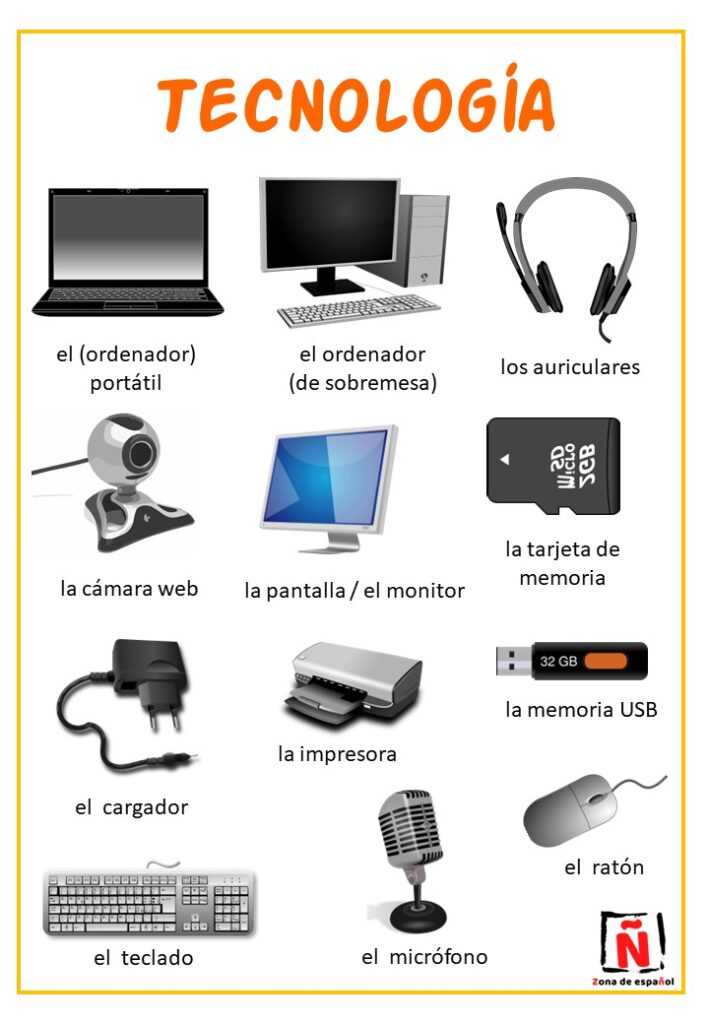
Images can also be useful for this type of practice.
For example, look at a picture of a window and try to come up with the Spanish word:
ventana
(window)
Then use it in your own sentence:
La ventana de mi habitación es muy grande.
(The window in my bedroom is very large.)
Exercises like this train your brain to retrieve vocabulary independently, which is essential if you want to use new Spanish words naturally in real conversations.
5. Put New Vocabulary into Practice
If you’re looking for effective strategies for how to remember Spanish words, one of the most important is to actually use the vocabulary you learn.
Words become much easier to retain when you actively include them in conversations instead of only reading or studying them. The more meaningful the situation, the stronger the connection your brain can create with the new vocabulary.
For example, if you’re learning Spanish for the workplace, you might come across words such as:
- reunión (meeting)
- horario (schedule)
- compañero (colleague)
- contrato (contract)
- sueldo (salary)
- vacaciones (holiday)
- entrevista (interview)
- proyecto (project)
Once you’ve learned them, don’t stop at memorizing their meanings. Use them to talk about your own professional life.
You could ask yourself questions like:
¿Cuándo tienes reuniones?
(When do you have meetings?)
¿Cuántas horas trabajas al día?
(How many hours do you work a day?)
¿Cómo es tu horario?
(What’s your schedule like?)
¿Cuándo fueron tus últimas vacaciones?
(When was your last holiday?)
When you use vocabulary in this way, words become connected to your own experiences rather than remaining as isolated items on a study list.
At Zona de Español, our online Spanish lessons are based on a communicative approach. We believe that becoming confident in a language requires much more than memorizing grammar rules and vocabulary. You need opportunities to use Spanish from the very beginning.
Speaking with others, listening to authentic language, asking questions, answering, and getting corrections all help transform vocabulary you understand into vocabulary you can use spontaneously.
6. Organize Vocabulary into Thematic Groups
A useful way to remember spanish words is to learn words that are connected by a common topic.
When several words are associated with the same subject, your brain has more links to use when trying to retrieve them later.
For example, if you’re learning Spanish for traveling, you could create a vocabulary group like this:
- aeropuerto (airport)
- avión (plane)
- vuelo (flight)
- billete (ticket)
- equipaje (luggage)
- maleta (suitcase)
- pasaporte (passport)
- hotel (hotel)
- reserva (reservation)
- habitación (room)
Later, simply thinking about traveling may help trigger some of these words because they have been stored as part of the same mental network.
You can apply the same idea to everyday situations.
At home
cocina (kitchen), dormitorio (bedroom), ventana (window), puerta (door), muebles (furniture), sofá (sofa), alquiler (rent), vecino (neighbor).
At work
reunión (meeting), compañero (colleague), jefe (boss), horario (schedule), contrato (contract), proyecto (project), sueldo (salary), oficina (office).
At a restaurant
carta (menu), camarero (waiter), reserva (reservation), plato (dish), bebida (drink), cuenta (bill), postre (dessert), propina (tip).
While traveling
aeropuerto (airport), estación (station), equipaje (luggage), billete (ticket), hotel (hotel), habitación (room), pasaporte (passport).
Creating these thematic connections gives you a useful framework for organizing and recalling vocabulary.
Just remember that bigger isn’t always better. Instead of trying to memorize dozens of unrelated words at once, focus on small vocabulary sets and use them regularly in sentences and conversations.
7. Prioritize Vocabulary That Is Useful to You
A common mistake among Spanish learners is trying to memorize every new word they come across. But you don’t need an enormous vocabulary to start expressing yourself.
A better approach is to concentrate on words that are directly connected to your needs, routines, and reasons for learning Spanish.
For instance, if you use Spanish in an international work environment, you might want to focus on vocabulary related to:
- reuniones (meetings)
- presentaciones (presentations)
- correos electrónicos (emails)
- proyectos (projects)
- negociaciones (negotiations)
- clientes (clients)
- horarios (schedules)
If you’re learning Spanish mainly for traveling, prioritize vocabulary that can help you deal with situations such as:
- hoteles (hotels)
- restaurantes (restaurants)
- transporte (transportation)
- compras (shopping)
- direcciones (directions)
- actividades turísticas (tourist activities)
On the other hand, if you’re preparing to live in Spain, everyday vocabulary will probably be much more valuable. You may need to talk about grocery shopping, finding a place to rent, taking public transportation, or interacting with your neighbors.
A simple question can help you decide whether a new word deserves your attention:
Will I actually use this word?
If you can imagine yourself using it regularly, move it higher up your learning list.
Learning vocabulary that has a clear purpose not only makes studying more efficient but can also keep you motivated because you can see how Spanish connects to your real life.
8. Hear New Vocabulary and Practice Saying It
Learning the written form of a Spanish word is only one part of the process. To communicate effectively, you also need to recognize words when you hear them and feel comfortable pronouncing them yourself.
For this reason, listening to Spanish on a regular basis can make a significant difference to your vocabulary development.
There are many sources you can use, including:
- podcasts;
- videos;
- movies and TV shows;
- songs;
- interviews;
- conversations;
- audiobooks;
- Spanish-learning resources.
When you discover a new word, don’t just read it silently. Listen to its pronunciation several times, then repeat it aloud.
For example, suppose you’re learning desarrollar. Listen carefully to the pronunciation and say it several times.
Next, practice the word in different contexts:
Quiero desarrollar mis habilidades.
(I want to develop my skills.)
La empresa está desarrollando un nuevo proyecto.
(The company is developing a new project.)
Es importante desarrollar buenos hábitos.
(It is important to develop good habits.)
By doing this, you’re practicing several skills simultaneously: vocabulary, pronunciation, listening, and speaking.
Regular exposure also helps your brain become familiar with the natural sound of Spanish. As a result, you’ll be more likely to recognize new vocabulary quickly when you hear it during an actual conversation.
9. Create Your Own Sentences
Writing down new vocabulary can be a very effective way to reinforce what you’ve learned. However, simply copying examples from a textbook isn’t as useful as creating sentences that are meaningful to you.
When you use a new Spanish word to describe your own experiences, routines, or plans, you give that word a personal context. This creates additional associations that can make it easier to retrieve later.
For example, if you’re learning “ahorrar,” you could write:
Estoy ahorrando dinero para hacer un viaje.
(I am saving money to go on a trip.)
If you’re studying “despertarse”:
Me despierto a las siete todos los días.
(I wake up at seven every day.)
Or, if you want to practice “aprovechar”:
Quiero aprovechar el fin de semana para descansar.
(I want to make the most of the weekend to relax.)
Because these sentences are connected to familiar situations, they are often easier to remember than examples that have no personal meaning.
One simple habit you can introduce is keeping a short Spanish diary. Write three to five sentences each day and try to include some of the vocabulary you’re currently learning.
There’s no need to write pages of text. A few meaningful sentences are enough to give new words some practical context.
10. How to Remember Spanish Words: Focus on Fewer Words at a Time
The final tip may sound obvious, but it’s something many language learners overlook:
Learning more words doesn’t necessarily mean remembering more words.
Trying to memorize dozens of new terms in one sitting can quickly overwhelm your memory. You may recognize some of them the following day, but recalling and using them spontaneously will probably be much harder.
A better strategy is to choose a small selection of words and work with them repeatedly over several days.
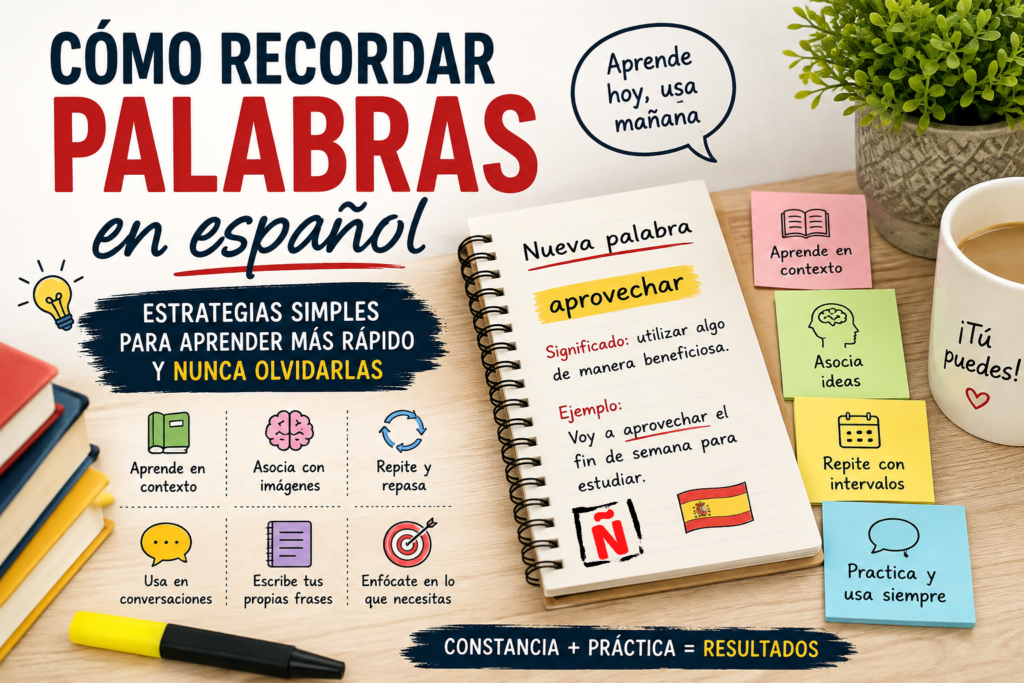
For example, let’s take the word:
aprovechar
Meaning: to make the most of something; to take advantage of something.
Sentence: Voy a aprovechar el fin de semana para estudiar.
(I’m going to make the most of the weekend to study.)
Once you’re familiar with the word, try using it in different situations:
Quiero aprovechar el buen tiempo para salir.
(I want to make the most of the good weather and go out.)
Aproveché el viaje para visitar a unos amigos.
(I took advantage of the trip to visit some friends.)
Hay que aprovechar esta oportunidad.
(We have to take advantage of this opportunity.)
Using the same word repeatedly in different contexts helps you understand it more deeply and makes it easier to recall when you need it.
In language learning, quality is often more valuable than quantity. It’s much better to learn five words thoroughly and feel comfortable using them than to memorize 50 words and forget most of them shortly afterwards.
How Many Spanish Words Should You Learn Each Day?
There isn’t a universal number of Spanish words that every learner should aim to study each day.
The right amount will vary depending on factors such as your current level, how much time you can dedicate to Spanish, what you want to achieve, and how complex the vocabulary is.
For many students, learning around 5 to 10 new words per day is a manageable target, provided they spend time reviewing those words and putting them into practice.
The key isn’t to maximize the number of words you study. It’s to make sure the words you learn actually stay with you.
For example, mastering five new words and using them repeatedly in sentences, activities, and conversations can be much more valuable than memorizing 30 words without ever seeing them in context.
It’s also worth remembering that forgetting vocabulary is a normal part of language learning.
If you forget a word, it doesn’t mean that you have a poor memory or that you’re incapable of learning languages. Each time you encounter that word again, you get another chance to strengthen the memory and make the word easier to retrieve.
Recognizing Spanish Vocabulary vs. Actually Using It
One of the most important things to understand about how to remember Spanish word is that recognizing a word and being able to use it are two different skills.
You might see a word in a text and think:
“This looks familiar.”
That means you probably understand the word when you encounter it, so it belongs to your passive vocabulary.
But when you’re speaking, you may find that the word doesn’t come to mind quickly enough.
The real objective is to gradually move vocabulary from passive knowledge into your active vocabulary, where you can access and use it when communicating.
Think of vocabulary learning as a three-step process:
1. Recognition
You understand the word when you come across it in speech or writing.
2. Recall
You can remember what the word means without being given the answer.
3. Active use
You can bring the word to mind and use it naturally in your own sentences and conversations.
The final stage is particularly important if you’re learning Spanish to communicate more confidently and fluently.
So, when you learn a new word, don’t simply memorize its definition. Challenge yourself to use it in context. The more actively you work with it, the easier it will become to retrieve when you need it.
A 15-Minute Daily Routine to Build Your Spanish Vocabulary
You don’t have to dedicate long hours to studying Spanish to make progress with vocabulary. A short, consistent routine can be surprisingly effective.
Try setting aside just 15 minutes each day and divide your practice into three simple steps.
Minutes 1–5: Add New Vocabulary
Start by choosing three to five new words around a topic you find useful or interesting.
Check their meanings and learn each one together with an example sentence rather than studying the words on their own.
Minutes 6–10: Challenge Yourself to Remember
Put your notes or vocabulary app aside and see how many of the new words you can recall without help.
You can make this more engaging by using pictures, definitions, or sentences with missing words.
For example:
Quiero ______ dinero para viajar.
(I want to ______ money to travel.)
Can you remember the word ahorrar without looking it up?
Minutes 11–15: Use What You’ve Learned
Now turn your new vocabulary into active language.
Write a few sentences about yourself or describe something from your daily life using the words you’ve just learned. You can also speak aloud for a couple of minutes and challenge yourself to include all of them.
The next day, spend a few minutes revisiting the same vocabulary before adding new words.
A short routine like this, repeated consistently, can gradually expand your Spanish vocabulary while helping you remember the words for longer.
What Is the Most Effective Way to Remember Spanish Words?
If you’re searching for the best answer to how to remember Spanish words, there’s no single technique that works perfectly on its own.
A much more effective approach is to combine several learning strategies and make them part of your regular Spanish practice.
Learn new vocabulary through complete sentences, connect words with memorable images or personal experiences, review them using spaced repetition, test yourself before looking at the answer, and, above all, use the words in meaningful conversations.
It’s also important to choose vocabulary that is relevant to your goals instead of trying to memorize every new word you encounter. Learning smaller amounts consistently is usually much more productive than cramming large lists into a single study session.
The key strategies to remember Spanish vocabulary are:
- Learn new words through context.
- Associate vocabulary with images, experiences, or ideas.
- Review words regularly, increasing the time between reviews.
- Try to retrieve vocabulary before checking the translation or definition.
- Use new words when speaking with other people.
- Group related vocabulary by topic.
- Prioritize words that are useful for your everyday needs.
- Listen to Spanish and practice saying new words aloud.
- Write your own sentences using recently learned vocabulary.
- Work with small vocabulary sets and review them consistently.
Learn Spanish and Put New Vocabulary into Practice from Day One
Expanding your vocabulary is important, but memorizing words isn’t the final goal. What really matters is being able to use the language to communicate naturally and confidently.
At Zona de Español, we provide online Spanish lessons for learners at different levels. Our native teachers specialize in Spanish as a foreign language and use a communicative approach in their classes.
Our lessons combine grammar, vocabulary, listening, and speaking practice so that students can develop the skills they need to communicate in real-world situations.
We also offer Spanish courses for individuals and companies, conversation classes, and DELE exam preparation.
If you want to build a stronger Spanish vocabulary, communicate with more confidence, and learn how to use new words naturally, regular practice with a qualified teacher can make a significant difference.
Learning a new word is only the first step. Remembering it is useful, but being able to bring it to mind and use it naturally when you need it is what turns vocabulary knowledge into real communication.
Aprende español con nuestros cursos y clases
- CEFR online Spanish courses
Spanish Online Course for Beginners – Level A1.1
110,00€ Select options This product has multiple variants. The options may be chosen on the product page - CEFR online Spanish courses
Spanish Course Level A1.2
110,00€ Select options This product has multiple variants. The options may be chosen on the product page - CEFR online Spanish courses
Online Spanish Course Basic Level – A2.1
110,00€ Select options This product has multiple variants. The options may be chosen on the product page