

For many language learners, how to learn Spanish at home is a key question. Studying from home can be a convenient alternative to attending a traditional language school, particularly if you have a busy schedule or live far from a classroom. Thanks to the internet, you can now find countless resources to support your Spanish learning, from language apps and podcasts to online videos, digital books, interactive activities and live Spanish lessons.
However, having access to hundreds of resources does not automatically guarantee progress. The important thing is knowing which materials to choose and, above all, how to use them as part of an effective learning routine.
If your goal is to improve your Spanish at home, simply learning lists of vocabulary or doing grammar exercises is unlikely to be enough. You need regular exposure to the language and opportunities to develop different skills. Listening, speaking, reading and writing should all be included, alongside vocabulary building, grammar practice and pronunciation work.
So, how to learn Spanish at home without becoming overwhelmed or losing motivation? The answer is to create a realistic study plan that you can follow consistently. In this guide, we will explore useful tools, practical ways to organise your study time and activities suitable for different levels. We will also look at how combining self-study with online Spanish lessons can give your learning an extra boost.
Is it really possible to learn Spanish at home?
Absolutely. You do not need to attend a language school in person to make meaningful progress in Spanish. Digital technology has made language learning far more accessible, allowing students to practise wherever they are.
Your home can become your own Spanish-learning environment. You might review new words on your laptop, listen to a Spanish podcast while cooking, read a short article on your phone, watch a series in Spanish or join a live lesson without leaving the house.
Nevertheless, there is a difference between consuming Spanish content and deliberately using that content to learn.
Watching a Spanish series, for instance, can improve your familiarity with pronunciation, intonation and everyday expressions. But watching episode after episode without actively engaging with the language is unlikely to be enough to help you speak confidently.
The same applies to grammar. Understanding how a particular structure works is useful, but real progress comes when you begin using that structure yourself in sentences and conversations.
If you are looking for practical advice on how to learn Spanish at home, try incorporating a mixture of activities into your weekly routine:
- Introduce new vocabulary and revise it regularly.
- Learn grammar through examples and practical exercises.
- Listen to Spanish spoken by native speakers.
- Read texts that match your current level.
- Write short texts and gradually make them more complex.
- Practise Spanish pronunciation and intonation.
- Use the language actively through speaking and conversation.
- Go back over previously studied material.
- Ask a teacher or proficient speaker to correct your mistakes.
You do not have to do everything every day. What matters most is creating a balanced routine that gives you regular contact with Spanish and that you can realistically maintain over time.
Why learn Spanish from home?
Choosing to study Spanish at home can make language learning easier to fit around your everyday life. It is particularly useful for learners who have demanding work schedules, family commitments or limited access to language schools.
Study when it suits you
One of the main benefits is the freedom to choose your own study times. You can organise your Spanish practice around work, university, family life or other responsibilities rather than following a fixed classroom timetable.
Learn wherever you are
You do not need a dedicated classroom. A computer, tablet or smartphone can give you access to a wide range of Spanish-learning materials wherever you have an internet connection.
Choose from countless learning materials
Online resources cover almost every area of Spanish. You can find activities for grammar, vocabulary, pronunciation, listening comprehension, reading and much more. This makes it easier to find materials that suit both your level and your interests.
Focus on your personal weaknesses
Studying independently also gives you greater control over what you practise. For example, if you find listening particularly challenging, you can spend more time with podcasts, videos or other audio resources. If your vocabulary needs improvement, you can focus your study sessions on learning and reviewing new words.
Learn with a teacher online
Studying independently does not mean that you have to learn completely on your own. Online Spanish lessons allow you to work with a teacher from the comfort of your home while still benefiting from real interaction.
A teacher can help you identify mistakes, explain difficult points, practise conversation and provide guidance based on your individual needs. Combining independent practice with regular online lessons can therefore be an effective way to make your Spanish learning more structured and productive.
Ultimately, knowing how to learn Spanish at home is not about finding the largest possible number of resources. It is about choosing the right ones, using them actively and developing a consistent routine that keeps you connected to Spanish.
How to Learn Spanish at Home: 10 Tips to Make Progress
1. Be clear about your reason for learning Spanish
A good Spanish study plan starts with a clear purpose. Before deciding what to study or how much time to dedicate to it, think about what you actually want to achieve.
What motivates you to learn Spanish?
Perhaps you want to:
- Travel around Spain or Latin America.
- Move to a Spanish-speaking country.
- Talk to Spanish-speaking friends or relatives.
- Use Spanish in your professional life.
- Make your CV more attractive.
- Prepare for a DELE exam.
- Attend a university in a Spanish-speaking environment.
- Follow films and TV programmes without relying on subtitles.
- Feel more confident when speaking Spanish.
Your motivation will influence the type of Spanish you should focus on.
For instance, someone planning to travel will benefit from learning practical language for booking accommodation, ordering food, using public transport, shopping and dealing with everyday situations.
On the other hand, a learner who needs Spanish for their career may need to concentrate on professional terminology and practise situations such as meetings, presentations, telephone calls and negotiations.
For this reason, try to avoid vague goals such as “I want to learn Spanish”. A more specific target could be:
“I want to be able to have a 15-minute conversation in Spanish without switching to English.”
A clearly defined goal gives you something measurable to work towards and makes it easier to see how far you have come.
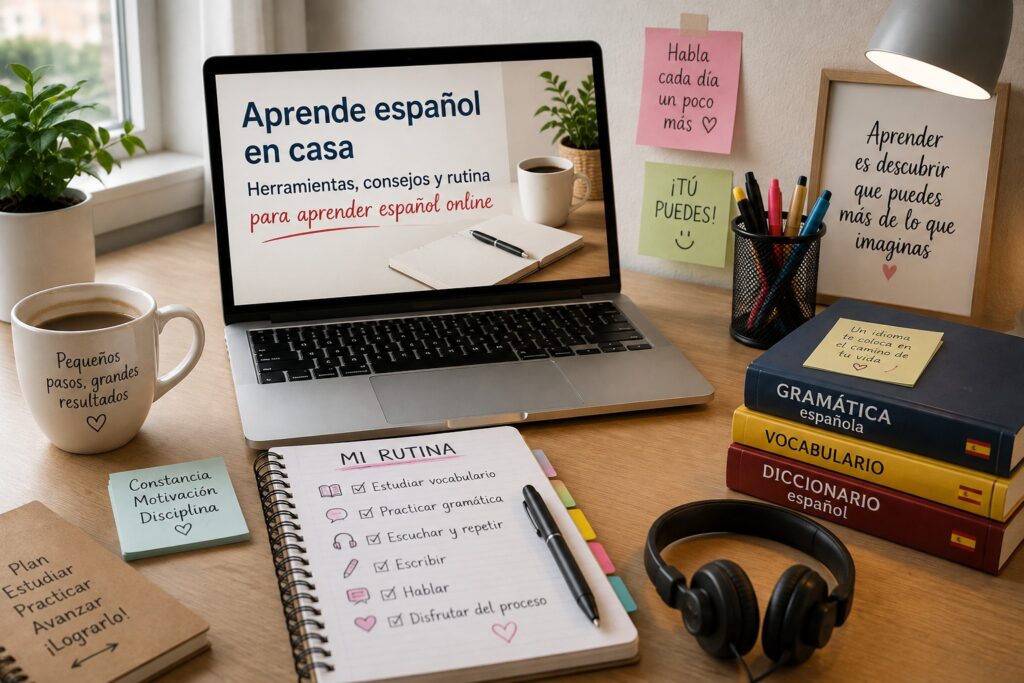
2. Build a routine you can actually follow
When considering how to learn spanish at home, one of the most useful things you can do is establish a study schedule that fits naturally into your everyday life.
You do not need to spend several hours studying every day. For most learners, shorter and more frequent sessions can be much easier to maintain than one long study session each week.
For example, your weekly plan could look something like this:
Monday: vocabulary and grammar.
Tuesday: listening practice and vocabulary revision.
Wednesday: speaking and conversation.
Thursday: reading and grammar.
Friday: writing and speaking practice.
Saturday: watch a Spanish-language film or series or listen to a podcast.
Sunday: review the week’s material.
There is no need to follow this exact timetable. The best routine is the one that works with your own schedule and responsibilities.
If you only have 20 minutes available, make those 20 minutes count. If you have an hour, you can divide your session between several different skills.
The most important factor is consistency. Studying for a manageable amount of time on a regular basis is generally more useful than spending several hours studying intensively for a few days and then stopping altogether.
3. Learn vocabulary through context
Memorising endless lists of words is not always the most effective way to expand your vocabulary.
A better approach is to learn new words as part of complete sentences and realistic situations.
For example, rather than simply memorising:
aprovechar = to make the most of
you could learn it through a sentence such as:
Quiero aprovechar el fin de semana para visitar Madrid.
This way, you learn not only what “aprovechar” means, but also how it works in a real sentence.
You can organise vocabulary into groups based on specific topics:
Travel
- airport
- luggage
- ticket
- accommodation
- booking
Restaurant
- menu
- waiter
- bill
- dish
- to order
Work
- meeting
- company
- colleague
- working hours
- contract
Everyday life
- to get up
- to have breakfast
- to work
- to shop
- to rest
It is also a good idea to put new vocabulary into practice as soon as possible. If you learn ten new words but never use them, you are more likely to forget them.
4. Make use of spaced repetition
Have you ever learnt a Spanish word and then completely forgotten it a few days later?
There is nothing unusual about that. Remembering new vocabulary requires regular revision and repeated exposure.
Spaced repetition is a technique where you review new words at increasingly longer intervals. This allows the information to move from short-term to longer-term memory.
For example:
- Day 1: introduce a new word.
- Day 2: review it for the first time.
- Day 4: revise it again.
- Day 7: check it once more.
- Day 14: repeat the review.
- Day 30: revise the word again.
You can do this with traditional flashcards or with a digital vocabulary-learning tool.
However, simply memorising the translation is not always enough.
Rather than writing:
“barato = cheap”
try putting the word into a complete sentence:
“Este restaurante es barato y la comida está muy buena.”
Learning vocabulary in this way gives you a clearer idea of how the word is used and makes it easier to recall when you need it.
5. Listen to Spanish every day
Developing your listening skills requires regular exposure to the language.
At the beginning, you may listen to a conversation and only understand a handful of words. This does not mean that you are not making progress.
Your ear needs time to become familiar with the natural speed of speech, different sounds, intonation and the variety of ways Spanish can be spoken.
There are many types of content you can use:
- Podcasts.
- YouTube videos.
- Songs.
- Interviews.
- News programmes.
- TV series.
- Films.
- Educational content.
One useful technique is to listen to the same piece of content more than once.
During the first listening, focus on getting the general meaning.
On the second attempt, concentrate on the vocabulary you hear.
Then, on the third, try to pick out specific phrases and expressions.
Spanish subtitles can also be useful when you need extra support.
As you continue practising, you will gradually begin to recognise words and grammatical structures that previously seemed difficult without having to consciously think about them.
6. Read in Spanish every day
Reading is an excellent way to build your vocabulary while becoming more familiar with the way Spanish is structured.
If you are a beginner, there is no need to start with a long or complicated novel.
You could begin with:
- Graded stories.
- Short articles.
- Blogs.
- Easy-to-understand news.
- Recipes.
- Dialogues.
- Graded readers.
- Texts designed for language learners.
As your Spanish improves, you can gradually move on to more challenging authentic material.
When you come across an unfamiliar word, try to work out its meaning from the surrounding text before reaching for a dictionary.
You do not need to look up every single unknown word either. If you understand the main message, you can often work out the meaning of less important words from the context.
7. Begin speaking Spanish as early as possible
Many Spanish learners make the mistake of waiting until they feel confident enough before they start speaking. However, you do not need an advanced level or complete knowledge of Spanish grammar to communicate.
Start with simple sentences and gradually build from there:
- Me llamo Ana.
- Vivo en Londres.
- Trabajo desde casa.
- Me gusta viajar.
- Ayer fui al cine.
As your vocabulary and confidence grow, you can begin using longer and more detailed sentences.
If you are learning Spanish at home, talking to yourself can be a simple way to practise speaking. You can describe your daily activities as you do them:
- Estoy preparando la comida.
- Ahora voy a trabajar.
- Después voy a salir a caminar.
Another option is to ask yourself questions and answer them aloud:
- ¿Qué hice ayer?
- ¿Qué voy a hacer este fin de semana?
- ¿Qué me gusta hacer en mi tiempo libre?
- ¿Cuál es mi película favorita?
Speaking on your own is useful, but interacting with other people is essential if you want to become a confident communicator.
This is why online Spanish conversation classes can be such a valuable part of your learning routine. A teacher can identify and correct your mistakes, show you more natural ways to express your ideas and introduce vocabulary and useful phrases suitable for your level.
8. Make grammar part of your practice
Grammar is essential for learning Spanish, but studying it should go beyond simply learning rules by heart.
Whenever you learn a new grammatical form, try to use it straight away in meaningful sentences. This will help you understand not only how the structure works, but also when to use it.
For example, when studying the pretérito perfecto: haber + past participle
you could practise by creating sentences such as:
- He viajado a España.
- He visto esa película.
- He terminado el trabajo.
- He aprendido muchas palabras nuevas.
When learning the pretérito indefinido, you could use examples such as:
- Ayer fui al supermercado.
- El año pasado viajé a Madrid.
- El sábado comí con unos amigos.
Regularly using new grammar in this way helps you move from simply recognising a grammatical rule to being able to use it naturally when communicating.
9. Create a Spanish-learning environment at home
A useful strategy for learning Spanish at home is to make the language part of your everyday surroundings and activities.
Start by labelling objects around your home with their Spanish names:
- door
- window
- table
- chair
- mirror
- kitchen
- fridge
- sofa
You can also change the language settings on some of the apps you use on a regular basis.
If you enjoy gaming, try playing your favourite games in Spanish.
If cooking is something you enjoy, search for recipes written in Spanish.
If you exercise regularly, listen to a Spanish podcast while you work out.
You can also follow Spanish-learning profiles and Spanish-speaking content creators on social media.
These small changes give you more opportunities to encounter Spanish throughout the day without necessarily having to set aside additional study time.
10. Mix self-study with online Spanish lessons
Apps, podcasts, videos and books can be excellent learning resources, but studying with them on your own also has its limitations.
An app can tell you whether an answer is right or wrong, but it may not explain why one expression is more appropriate or natural than another.
A video can introduce a grammar point, but it cannot interact with you or respond to what you say.
A textbook can provide a detailed explanation of a grammatical structure, but it cannot listen to your speech and give you personalised pronunciation feedback.
For this reason, combining independent learning with lessons from a teacher can be a more complete approach.
Online Spanish lessons give you the opportunity to:
- Ask questions and clarify doubts.
- Identify and correct recurring mistakes.
- Practise speaking with another person.
- Improve your pronunciation.
- Develop a broader range of vocabulary.
- Understand grammar more clearly.
- Build confidence when communicating.
- Receive feedback tailored to your needs.
- Practise using Spanish in real-life situations.
At the same time, online learning means you can benefit from professional guidance while still enjoying the flexibility and convenience of studying from home.
Tools to Help You Learn Spanish at Home
The most useful learning resources will depend on your personal goals, level and learning style. Rather than relying on just one tool, it is often more effective to combine several resources and give each one a specific purpose.
Vocabulary apps
Flashcard apps can be a convenient way to introduce new vocabulary and keep previously learnt words fresh through spaced repetition.
They are particularly useful when you tend to forget words shortly after learning them.
However, flashcards should not be your only method of practising vocabulary. Combine them with activities that allow you to see, hear and use new words in context.
An online dictionary can give you much more than a simple translation. You can use one to check:
- Definitions.
- How a word is pronounced.
- Example sentences.
- Grammatical gender.
- Verb forms.
- Different meanings and contexts.
Remember that translating a word directly does not necessarily show you how a Spanish speaker would use it naturally.
Spanish podcasts
Podcasts are a convenient resource for getting used to spoken Spanish and developing your listening comprehension.
You can fit them into your day by listening while you are walking, cooking or doing other routine activities.
Beginners should look for podcasts designed with language learners in mind. As their comprehension improves, they can gradually start listening to content created for native speakers.
YouTube
YouTube contains a large amount of material that can be used to practise Spanish.
Among the available content, you can find videos covering:
- Grammar.
- Vocabulary.
- Pronunciation.
- Culture.
- Conversation.
- Everyday and colloquial language.
To make these videos more useful, avoid simply watching them without actively engaging with the language.
Write down phrases that catch your attention, practise repeating them aloud and try to include them in your own Spanish.
Films and TV series
Watching Spanish-language films and series can be an enjoyable way to become familiar with natural speech and everyday language.
If you are still developing your listening skills, start with subtitles and gradually stop using them as you become more comfortable.
Spanish subtitles can be particularly helpful because they let you connect the sounds you hear with the written words.
There is no need to understand everything from the beginning.
First, concentrate on following the plot and understanding the main idea.
A 30-Minute Spanish Study Routine at Home
If you do not have much free time, a short but consistent routine can still be effective.
10 minutes: Vocabulary practice
Go over vocabulary you have previously learnt and introduce a few new words.
Try using them in your own sentences to reinforce what you have learnt.
10 minutes: Listening practice
Choose a short Spanish video or podcast.
On your first listen, concentrate on understanding the overall message. Then listen again and focus on unfamiliar words and expressions.
10 minutes: Speaking or writing
Use the last ten minutes to produce some Spanish yourself.
You could give a brief summary of what you heard, talk about what you have done during the day or answer a question in Spanish.
A 30-minute session may seem short, but making time for it every day can help you establish a sustainable learning habit.
A One-Hour Routine for Learning Spanish Online
If you can dedicate more time to your studies, you can extend your routine and give greater attention to different language skills.
15 minutes: review and learn vocabulary.
15 minutes: grammar study.
15 minutes: listening activities.
15 minutes: speaking or writing practice.
Another option is to include online Spanish lessons on specific days of the week.
For example:
Monday: self-directed study.
Tuesday: online Spanish lesson.
Wednesday: vocabulary revision and listening.
Thursday: conversation lesson.
Friday: grammar and writing practice.
Weekend: Spanish films, series, podcasts or other leisure content.
This type of schedule combines guided learning with independent practice, giving you a balanced way to keep working on your Spanish.
How Long Does It Take to Learn Spanish at Home?
There is no universal number of hours that will determine exactly when someone reaches a specific level of Spanish.
The time needed can vary considerably depending on factors such as:
- Your first language.
- The level you start from.
- What you want to achieve.
- How regularly you study.
- How much Spanish you encounter in your daily life.
- How often you practise speaking.
- Whether you have learnt other languages before.
For example, studying for 30 minutes every day can produce very different results from studying for two hours once a week.
If you are wondering how to learn spanish at home effectively, remember that regular practice is more important than trying to study for long periods occasionally.
Instead of concentrating solely on how long it will take to reach your goal, ask yourself:
What can I do today to make my Spanish a little better?
Even a short study session can contribute to your progress when you keep doing it consistently.
Common Mistakes to Avoid When Learning Spanish at Home
Depending entirely on a single app
Apps can be helpful for working on vocabulary and grammar, but they cannot cover every aspect of language learning. You also need regular practice with listening, speaking and communication.
Memorising vocabulary without context
Learning individual words in isolation can make them harder to remember and use. Whenever possible, learn new vocabulary as part of phrases, sentences or everyday situations.
Trying to avoid mistakes when speaking
You do not need to wait until your Spanish is perfect before you start talking. Making mistakes is a normal and valuable part of the learning process.
Speaking from the beginning can help you build confidence and identify the areas where you need more practice.
Leaving your studies until you have free time
If Spanish is something you only study when you happen to have spare time, it is easy for several days to pass without practising.
Choose a regular time for your Spanish studies, even if you can only dedicate 20 minutes a day.
Working with material that is beyond your level
Using content that is far too difficult can make learning frustrating and discourage you from continuing.
If you can barely understand what you are reading or listening to, choose resources that match your current ability and gradually increase the difficulty.
Studying without receiving feedback
When you learn completely independently, you may continue making the same mistakes without realising it.
A teacher can help you spot recurring errors, explain what needs to change and guide you towards more accurate Spanish.
How to Stay Motivated While Learning Spanish
Motivation naturally comes and goes, so it is better to build habits that do not rely entirely on feeling like studying every day.
Set yourself small, achievable goals.
For example:
- Learn 100 new words this month.
- Read a graded book.
- Watch a series in Spanish.
- Have a 20-minute conversation.
- Keep a diary for 30 days.
- Prepare for a DELE exam.
- Complete an online Spanish course.
Keeping track of your progress can also make a difference.
At first, you may have to mentally translate every sentence you hear or read. After several months of regular practice, you may find that you can understand simple conversations directly in Spanish.
Noticing these improvements can give you a sense of progress and help you stay motivated.
Is It Better to Learn Spanish Independently or with a Teacher?
Learning Spanish by yourself can be very useful, but having a teacher can make the process more effective in several ways.
A teacher can adjust lessons and activities to suit your current level, identify mistakes you may not notice yourself and help you concentrate on the skills that need the most attention.
It is also important to distinguish between understanding a grammar rule and using it naturally in a real conversation.
You might know exactly how a verb tense is constructed but still find it difficult to produce it quickly and confidently when speaking.
Communicating regularly gives you the opportunity to turn knowledge that you recognise into language that you can actively use.
For this reason, a balanced approach is to combine independent practice with live online Spanish lessons.
Learn Spanish Online with Zona de Español
If you want to learn spanish at home but would like a structured approach and regular practice with teachers, Zona de Español offers online Spanish lessons designed for different levels and learning goals.
We are an online Spanish academy for international learners, providing courses for students who want to develop their Spanish for a wide range of personal, academic and professional situations.
Our options include:
- Online Spanish courses for different levels.
- Spanish conversation classes.
- DELE exam preparation.
- Spanish for businesses.
- Spanish for professionals.
- One-to-one online Spanish lessons.
- Training focused on communicating in real-life situations.
All lessons take place online, allowing you to study Spanish from home while still having direct interaction with a teacher.
Our aim is to help students go beyond memorising grammar rules and develop the ability to use Spanish confidently for real communication.
By combining grammar, vocabulary, listening and speaking practice, our courses address the different skills you need to continue making progress.
Who are Zona de Español classes for?
Our courses are suitable both for complete beginners and for learners who already have some knowledge of Spanish and want to take their skills further.
They can also be particularly useful for people who:
- Need Spanish for their career.
- Want to prepare for the DELE exam.
- Would like to improve their speaking skills.
- Want to learn Spanish for travelling.
- Need to communicate with Spanish-speaking clients or colleagues.
- Want to learn Spanish at home.
- Are looking for online lessons with a teacher.
Learning from home does not mean having to learn completely on your own.
You can use apps, books, podcasts and videos for independent practice while also benefiting from a teacher’s guidance to answer questions, practise conversation and receive useful corrections.
Frequently Asked Questions About How to Learn Spanish at Home
What is the most effective way to learn Spanish at home?
The most effective approach is to work on a variety of skills rather than focusing on just one area. Try to include vocabulary, grammar, listening, reading, writing and speaking in your learning routine. Regular practice is also essential for making continuous progress.
Online Spanish lessons can be a useful addition to self-study, particularly when you want to improve your speaking and have your mistakes corrected.
Is it possible to learn Spanish at home without a teacher?
Yes. Many aspects of Spanish, including vocabulary, grammar, reading and listening, can be studied independently. However, working with a teacher gives you the opportunity to practise communication, receive feedback and benefit from a more organised learning method.
How long should I study Spanish every day?
There is no ideal number of minutes that applies to everyone. If you are short on time, even 20 or 30 minutes of daily practice can be a good starting point. The key is to make Spanish part of your regular routine.
How can I practise speaking Spanish at home?
Try speaking aloud, talking through your daily activities or answering questions in Spanish. Taking part in online conversation classes can also give you regular opportunities to speak with a teacher and receive useful corrections.
What is the fastest way to learn Spanish vocabulary?
Rather than memorising individual words, learn vocabulary in sentences and meaningful contexts. Spaced repetition can help you retain new words, while using them regularly in speaking and writing will reinforce what you have learnt.
Can watching TV series help me learn Spanish?
Yes. Spanish-language series can improve your listening skills and expose you to authentic vocabulary and everyday expressions. To get more from this activity, take note of useful new phrases and use Spanish subtitles when they are helpful.
Do online Spanish lessons really work?
They can be very effective, particularly because they combine the convenience of studying from home with direct contact with a teacher. Online lessons can help you practise speaking, identify mistakes and follow a programme suited to your level and learning objectives.
Conclusion: How to Learn Spanish at Home and Make Real Progress
If you are still wondering how to learn spanish at home, remember that you do not need a miracle app or endless hours of study every day to improve.
Successful language learning comes from consistency and from using a variety of activities rather than relying on just one method.
Build a realistic routine, study vocabulary in context, listen to Spanish regularly, read material that matches your level and practise grammar through real examples. Most importantly, look for as many opportunities as possible to speak.
Digital resources can be extremely helpful, but they do not have to be your only source of learning. Combining independent study with online Spanish lessons allows you to enjoy the freedom of studying from home while also benefiting from the support and guidance of a teacher.
Learn Spanish from home, establish a routine, practise regularly and take another step towards your goals with Zona de Español.
Aprende español con nuestros cursos y clases
- CEFR online Spanish courses
Spanish Online Course for Beginners – Level A1.1
110,00€ Select options This product has multiple variants. The options may be chosen on the product page - CEFR online Spanish courses
Spanish Course Level A1.2
110,00€ Select options This product has multiple variants. The options may be chosen on the product page - CEFR online Spanish courses
Online Spanish Course Basic Level – A2.1
110,00€ Select options This product has multiple variants. The options may be chosen on the product page