

Finding the right books on Spanish grammar can make a real difference once you have reached an intermediate or advanced level and want to improve your accuracy in both speaking and writing.
At the beginning of your Spanish-learning journey, you can make significant progress through courses, apps, videos, and conversation practice. However, as your level increases, you are likely to come across more complex grammar questions: When should you use the subjunctive? What is the difference between ser and estar in certain contexts? How do Spanish past tenses work? When should you use por or para? And how do direct and indirect object pronouns work?
At this stage, having a reliable grammar reference can help you understand not only what to say, but also why a particular structure is correct.
In this article, we have selected 10 Spanish grammar books that are particularly useful for learners who want to gain a deeper understanding of how Spanish works. Some are specifically designed for Spanish learners, while others can serve as valuable reference books for those who already have an advanced level.
Why Use Spanish Grammar Books to Improve Your Level?
Grammar should not be reduced to a list of rules that you have to memorise without understanding the context. Its real purpose is to help you understand how a language works and use it with greater confidence and accuracy.
Books on Spanish grammar can be particularly valuable from B1, B2 and C1 onwards, as they provide detailed explanations that are often missing from materials designed for beginners.
For example, a learner may know the difference between:
- He vivido en Madrid durante cinco años.
- Viví en Madrid durante cinco años.
However, they may still be unsure why the present perfect is used in one situation and the preterite in another, depending on the context and the variety of Spanish being used.
A good grammar reference allows you to explore these distinctions in a clear and structured way.
These books can also help you:
- expand your knowledge of Spanish grammar;
- identify recurring mistakes in speaking and writing;
- understand more complex structures;
- improve your written Spanish;
- prepare for official exams such as the DELE;
- find answers to specific grammar questions;
- reinforce what you have learned in class.
That said, studying grammar does not mean spending hours memorising rules. The most effective approach is to use a grammar book alongside reading, listening, conversation and writing practice. This combination allows you to understand grammatical structures and, most importantly, use them naturally in real-life communication.
10 Best Books on Spanish Grammar
Below, we have selected 10 books that can be especially useful for learners who want to develop their Spanish grammar skills and gain a deeper understanding of how the language works.
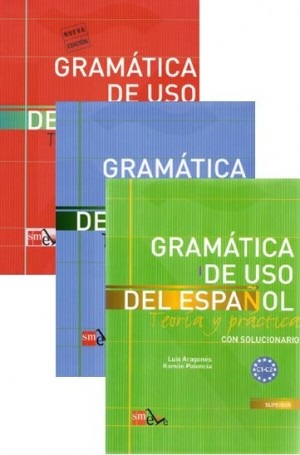
1. Gramática de uso del español (SM)
Gramática de uso del español, by Luis Aragonés and Ramón Palencia, is one of the best-known grammar references among learners of Spanish as a foreign language.
One of its main strengths is its level-based structure, making it easier to find explanations that match your current stage of learning. The explanations are generally supported by examples and exercises, allowing learners to practise each grammar point as they study it.
The series is particularly useful for independent learners because it goes beyond theoretical explanations and includes practical activities to help you check whether you have actually understood the material.
For learners looking for books on Spanish grammar that can take them beyond simply “knowing the rule” and help them use grammatical structures accurately, this collection can be a useful addition to their study resources.
2. Uso de los pasados (Edelsa)
The Spanish verb system can be one of the biggest challenges for foreign learners.
Knowing when to use the pretérito perfecto, pretérito indefinido, imperfecto, or pluscuamperfecto is not always straightforward. Verb choices often depend on the context, the speaker’s intention, and the variety of Spanish being used.
For this reason, resources that focus specifically on how Spanish past tenses are used can be particularly valuable for learners. These types of books allow you to work on areas such as:
- completed actions;
- habitual actions;
- descriptions and background information;
- specific events;
- relationships between different points in the past;
- the contrast between imperfecto and indefinido.
For B1 or B2 learners who still find Spanish past tenses confusing, focusing on this area in greater depth can make a noticeable difference to both their spoken and written Spanish. A good grammar reference can also help you understand why a particular tense is used rather than simply memorising isolated rules.
3. Using Books on Spanish Grammar to Master the Subjunctive
One of the Spanish grammar topics that often causes difficulties, even for advanced learners, is the subjunctive.
The challenge is not simply learning the different verb forms. A student may know how to form:
- hable;
- hablara;
- haya hablado;
- hubiera hablado;
and still struggle to decide when each form should be used.
Books on Spanish grammar that focus specifically on the subjunctive can help learners understand its different meanings and the contexts in which it is used.
For example:
- Espero que vengas mañana.
- No creo que tenga tiempo.
- Aunque sea difícil, lo intentaré.
- Si tuviera más tiempo, viajaría más.
These examples show how the subjunctive is used with wishes, opinions, doubts, conditions, evaluations and many other grammatical structures.
For advanced learners, understanding these contexts is much more useful than simply memorising lists of rules. A good grammar reference can help you recognise why the subjunctive is needed and use it more naturally in your own Spanish.
One useful resource is Uso del Indicativo y Subjuntivo, published by Edelsa.
4. Gramática comunicativa del español (Edelsa)
Another interesting option is to choose grammar books that present Spanish structures from a communicative perspective.
This approach can be particularly useful because it connects grammar with real-life communication. Rather than studying a rule in isolation, learners can see how a particular structure affects the meaning of a sentence and the message the speaker wants to convey.
For example, there is a difference between:
Creo que María está en casa.
and:
No creo que María esté en casa.
The difference is not simply a matter of verb form. It also reflects the speaker’s attitude towards the information being expressed.
This type of approach is particularly suitable for learners who already know many grammar rules but want to use them more naturally and confidently in real communication.
For this reason, books on Spanish grammar with a communicative focus can be a valuable resource for advanced students who want to move beyond memorising rules and start using Spanish more intuitively.
5. Nuevo Sueña
Although Nuevo Sueña is not a grammar book in the strictest sense, it can be a very useful resource for Spanish learners as it brings together grammar, vocabulary and practical communication.
Its contextual approach makes it a good choice for students who find it easier to understand grammar when it is presented as part of a wider language-learning context rather than as a series of isolated rules.
Using a coursebook alongside one of the more specialised books on Spanish grammar can be particularly effective. Students can first encounter a grammatical structure through a real context and then use a grammar reference to explore its meaning and usage in more depth.
For instance, after completing a unit about personal experiences, learners could review the different past tenses used to describe events and experiences.
This approach helps learners see grammar as an active part of communication rather than simply a list of rules to memorise.
6. Books on Spanish Grammar for Foreign Learners
Grammar books specifically created for foreign learners can be an excellent choice because they take into account the common difficulties faced by people learning Spanish as a second language.
A native speaker may use a particular structure correctly without being able to explain why it works. A grammar book designed for foreign learners, on the other hand, aims to anticipate common challenges and explain differences in a clear and accessible way.
These books often focus on areas such as:
- gender and number;
- articles;
- pronouns;
- prepositions;
- ser and estar;
- verb tenses;
- the subjunctive;
- verbal periphrases;
- reported speech;
- conditional sentences;
- linking words and connectors.
They can be particularly useful as reference books whenever a question comes up while studying. For learners looking for books on Spanish grammar, having a resource that addresses the difficulties specific to non-native speakers can make studying much more effective.
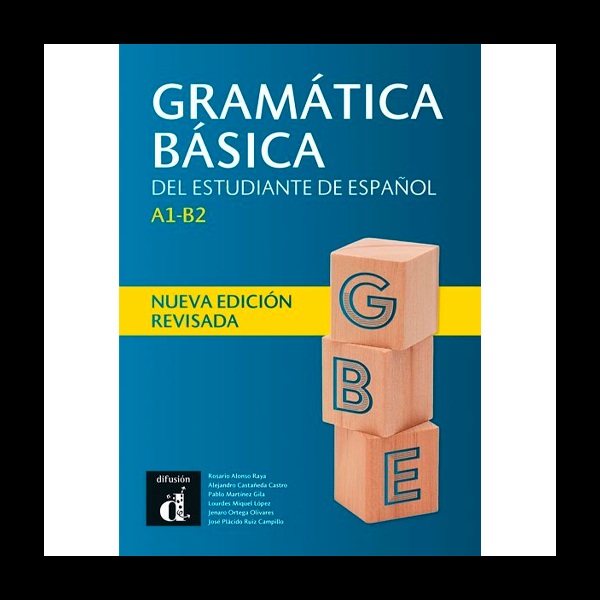
One example is Gramática básica del estudiante de español nueva edición revisada, published by Difusión.
7. Diccionario de dudas y dificultades de la lengua española
Although a dictionary of usage and common language difficulties is not strictly a grammar textbook, it can be an extremely useful resource for advanced Spanish learners.
As your level improves, your questions are no longer limited to grammar. You may also find yourself wondering:
- Is this expression correct?
- Is this the right preposition to use?
- Is this word used with this meaning?
- Does this sentence sound natural?
- Is there a difference between two expressions that seem similar?
A good reference dictionary can help answer many of these questions while also giving you a better understanding of how Spanish is actually used.
For this reason, learners looking for books on Spanish grammar to reach a C1 or C2 level may find it useful to combine a traditional grammar reference with a more specialised language reference work. This combination can provide a broader understanding of both grammatical rules and real-world usage.
8. Gramática descriptiva de la lengua española
For learners who want to take their understanding of Spanish much further, there are academic works such as Gramática descriptiva de la lengua española.
These kinds of books are mainly aimed at readers with a strong interest in how Spanish works, including university students, teachers, researchers and learners with a very high level of Spanish.
It is not necessarily the right choice for someone who has just started learning the language. However, it can be an excellent reference work for those who want to explore Spanish from a deeper linguistic perspective.
The main difference compared with a grammar book designed for learners is the amount of information provided and the depth of the analysis.
This is why it is worth considering your specific learning goals before choosing one of these books. If your main aim is to improve your everyday communication, a more practical resource will probably be more suitable. If you want to study Spanish linguistics in greater depth, an academic grammar such as Gramática descriptiva de la lengua española may be a much better fit.
Among the many books on Spanish grammar, academic works like this one are therefore best suited to learners who want to go beyond practical language use and explore the structure of Spanish in detail.
9. Nueva gramática de la lengua española
Nueva gramática de la lengua española, published by the Real Academia Española and the Asociación de Academias de la Lengua Española, is one of the key reference works for understanding modern Spanish grammar.
It is a comprehensive work that covers a wide range of aspects of the Spanish language. Rather than focusing only on the rules traditionally taught in Spanish courses, it also explores how grammatical structures work in different contexts and across the many varieties of Spanish spoken around the world.
For a foreign learner, it may be too extensive to use as an everyday study book. However, it is an invaluable resource when you need to look up a specific question or want to explore Spanish grammar in greater depth.
It is also worth remembering that Spanish is an international language, with differences between the Spanish spoken in Spain and the varieties used across Latin America.
Understanding these differences can help advanced learners develop a broader view of Spanish and appreciate the diversity of the language.
For learners interested in books on Spanish grammar, this is an especially useful reference for exploring not only grammatical rules but also the way Spanish varies across different regions and contexts.
10. Specific Textbooks for DELE Preparation
Finally, if your goal is to obtain an official Spanish certificate, dedicated DELE preparation books can be an excellent complement to books on Spanish grammar.
At levels such as B2, C1 and C2, grammar is not tested in isolation. Instead, it is incorporated into a range of reading, listening, writing and speaking tasks.
Preparing for an exam is therefore about more than memorising grammatical rules. You also need to be able to apply your language knowledge effectively in different communicative situations.
For example, a learner may understand the subjunctive perfectly from a theoretical point of view but still need practice to use it accurately when writing an argumentative text.
This is why DELE preparation books can be particularly useful when combined with a reliable grammar reference. We recommend the preparation books published by Edelsa.
How to Choose the Right Spanish Grammar Book
There is no one-size-fits-all grammar book for Spanish learners.
The most suitable option will depend on your current level, your specific needs, and your goals for learning Spanish.
If You Are at A1 or A2 Level
You do not need an advanced grammar reference when you are just starting out.
At this stage, it is usually more helpful to work with a beginner-friendly book that introduces the basic structures gradually and in a clear order.
Your main focus should be on areas such as:
- the present indicative;
- gender and number;
- articles;
- basic pronouns;
- ser and estar;
- hay and estar;
- common verbs;
- basic past tenses;
- frequently used prepositions.
If You Are at B1 Level
At B1, you can start working with a more comprehensive Spanish grammar book.
This is a good stage to strengthen your understanding of topics such as:
- differences between the Spanish past tenses;
- the future and conditional tenses;
- pronouns;
- verbal periphrases;
- por and para;
- ser and estar;
- the present subjunctive;
- subordinate clauses.
If You Are at B2 Level
At B2, grammar becomes increasingly important.
At this stage, the goal is no longer simply to form grammatically correct sentences. You also need to learn how to express subtle differences in meaning and communicate with greater precision.
It is a good idea to focus on areas such as:
- all the Spanish subjunctive tenses;
- conditional structures;
- reported speech;
- linking words and connectors;
- subordinate clauses;
- verbal periphrases;
- common word combinations and collocations;
- differences between formal and informal language.
If You Are at C1 or C2 Level
At advanced levels, a Spanish grammar book can become more of a reference tool than a traditional study book.
You do not necessarily need to work through an entire chapter every day. Instead, you can use your grammar reference to look up a specific structure whenever you have a question or want to clarify a particular point.
It is also a good idea to combine grammar study with authentic materials such as books and literature, newspapers, podcasts, discussions, and real conversations. This allows you to see how grammatical structures are actually used in different contexts and develop a more natural command of Spanish.
How to Study Spanish Grammar Without Getting Bored
One common mistake when working with books on Spanish grammar is trying to read every chapter in order and memorise every rule.
There is no need to study grammar this way.
Instead, use your grammar book as a practical reference. Look up the areas you find difficult, work through relevant exercises, and return to specific explanations whenever you need to reinforce your understanding.
1. Focus on One Specific Structure
Instead of trying to study “the subjunctive” as a whole, set yourself a more precise goal.
For example:
I want to learn how to express wishes using the subjunctive.
Once you feel comfortable with this, you can move on to other uses, such as opinions, doubts, emotions and hypothetical situations.
2. Read the Explanation
Take a few minutes to understand how the structure works.
There is no need to memorise every sentence in the explanation. Instead, focus on the main idea and ask yourself:
What does this rule actually mean?
3. Look at Examples
Examples are essential because they show you how a grammatical structure works in context.
Read several sentences and compare them. Try to identify what they have in common and what makes the structure work.
4. Create Your Own Examples
This is one of the most important steps.
If you are studying:
Es importante que + subjuntivo
do not just read the examples in the book. Create your own sentences, such as:
- Es importante que estudies.
- Es importante que practiques.
- Es importante que llegues a tiempo.
Then try using the same structure when speaking. This helps turn passive knowledge into something you can use naturally.
5. Find the Structure in Real Spanish
Read an article, listen to a podcast or watch a series in Spanish.
Whenever you come across the structure you are studying, write it down and take note of the context in which it appears.
This is a great way to confirm that the grammar you study in books on Spanish grammar is also used naturally in the Spanish spoken and written by real speakers.
6. Practise with a Teacher
Grammar books are excellent learning resources, but they cannot always identify or correct mistakes in your spoken and written Spanish.
A teacher can spot errors that you may not notice yourself and show you how to use a particular structure in a more natural way.
Combining independent study with conversation classes can be especially effective for advanced learners who want to improve both their accuracy and fluency.
At Zona de Español, we offer advanced Spanish courses from B2 to C2. Take a look at our online Spanish courses and keep developing your Spanish!
Why Books on Spanish Grammar Are Not Enough
Using high-quality books on Spanish grammar can help you understand how the language works, but studying grammar alone will not automatically make you a more accurate or fluent Spanish speaker.
Grammar should be seen as a means of improving your communication, rather than as an end in itself.
For example, you might spend several days learning the rules for conditional sentences and feel that you understand them perfectly. However, if you never put them into practice, you may find it difficult to use a structure such as:
Si tuviera más tiempo, viajaría más.
when you need it spontaneously in a conversation.
For this reason, try to finish each grammar session with an opportunity to actively use what you have learned. You could:
- write five original sentences;
- describe a personal experience;
- answer a series of questions;
- have a conversation;
- record yourself speaking;
- summarise an article;
- write a short argumentative text.
The key is to move from simply recognising and understanding grammar to being able to use it naturally and spontaneously.
A Study Routine Using Spanish Grammar Books
If you want to use grammar books to improve your Spanish, try following this simple 30-minute routine:
10 minutes: Study a grammar explanation.
5 minutes: Look at and analyse some examples.
5 minutes: Write your own sentences using the structure.
5 minutes: Find examples of the same structure in authentic Spanish content.
5 minutes: Practise speaking and use the structure yourself.
This approach is much easier to maintain than spending hours trying to memorise endless lists of grammar rules.
You can also repeat the same routine a few days later to see whether you still remember the structure and can use it correctly.
How Many Spanish Grammar Books Do You Need?
Probably fewer than you might think.
There is no need to buy ten different books and try to study them all at the same time. In fact, having too many resources can make your learning process more confusing rather than more effective.
A balanced study system could include:
- One main grammar book suited to your current level.
- An exercise book if you need additional practice.
- A reference book, particularly from B2 or C1 onwards.
- Authentic Spanish materials, such as books, newspapers, podcasts and videos.
With this combination, you can create a more balanced learning system that allows you to study grammar, practise actively and see how Spanish is used in real contexts.
Conclusion: Choose the Right Books on Spanish Grammar and Use Them Regularly
The right books on Spanish grammar can be valuable tools for learners who want to reach an advanced level and communicate in Spanish with greater accuracy.
However, there is no need to memorise every rule or spend hours studying grammar. What matters most is choosing a resource that matches your level, focusing on specific structures, studying useful examples and, above all, putting what you learn into practice in real communication.
If you are at B1 or B2, a practical grammar book with exercises can help you strengthen and consolidate your knowledge. If you have reached C1 or C2, you may benefit more from having a comprehensive reference work that you can turn to whenever a specific question comes up.
Remember that grammar works best when combined with other forms of language practice. Read in Spanish, listen to authentic content, speak with other Spanish users, write regularly and pay attention to how grammatical structures are actually used.
Ultimately, the purpose of studying grammar is not to be able to explain every rule in Spanish.
The real goal is to use Spanish clearly, naturally and accurately.
Aprende español con nuestros cursos y clases
- CEFR online Spanish courses
Spanish Online Course for Beginners – Level A1.1
110,00€ Select options This product has multiple variants. The options may be chosen on the product page - CEFR online Spanish courses
Spanish Course Level A1.2
110,00€ Select options This product has multiple variants. The options may be chosen on the product page - CEFR online Spanish courses
Online Spanish Course Basic Level – A2.1
110,00€ Select options This product has multiple variants. The options may be chosen on the product page