

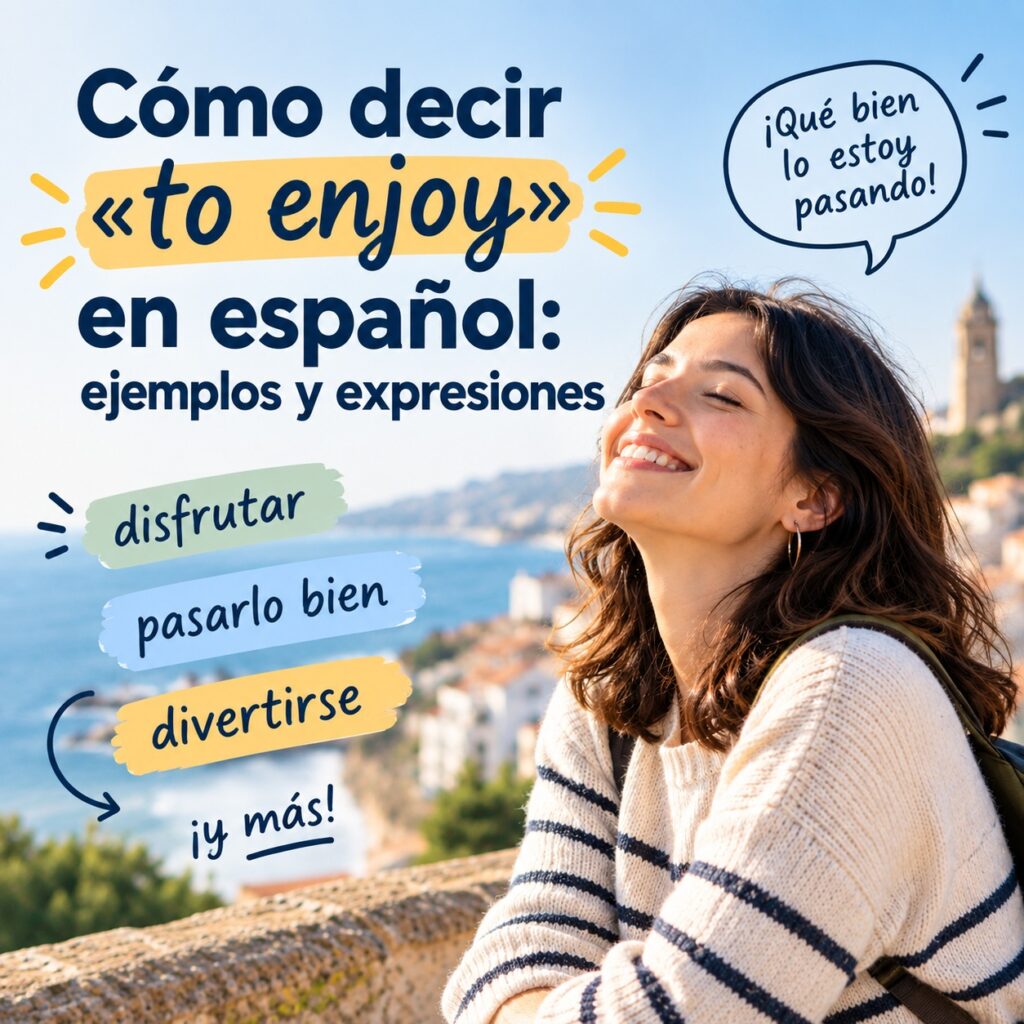
If you are learning Spanish, you may have already wondered how to say to enjoy in Spanish. At first, the answer might seem quite straightforward, since disfrutar is usually the first translation that comes to mind. However, there is not always a direct equivalent that works naturally in every situation.
In fact, depending on the context, the English verb “to enjoy” can be expressed in Spanish in several different ways. The most common options include disfrutar, pasarlo bien, gozar and divertirse. In addition, verbs such as gustar and encantar can sometimes convey a similar idea, although their meaning and use may be slightly different.
For this reason, choosing the right expression is not simply a matter of translating one word into another. Instead, you need to consider what you are talking about, what you want to express and, importantly, how the sentence is structured in Spanish.
With this in mind, this article will explore the most common ways to express the meaning of “to enjoy” in Spanish. Along the way, you will learn when to use each option and see practical examples that will help you understand the differences and sound more natural when communicating in Spanish.
How to Say “To Enjoy” in Spanish
In many situations, the closest equivalent of “to enjoy” is the verb disfrutar.
For example:
- I enjoy reading → Disfruto leyendo. (I enjoy reading.)
- I enjoy Spanish food → Disfruto de la comida española. (I enjoy Spanish food.)
- She enjoys travelling → Ella disfruta viajando. (She enjoys travelling.)
- We enjoyed the party → Disfrutamos de la fiesta. (We enjoyed the party.)
However, it is important to remember that disfrutar does not always follow exactly the same grammatical pattern as “to enjoy” in English.
Depending on what comes after the verb, Spanish commonly uses structures such as:
- disfrutar de + noun
- disfrutar + gerund
- disfrutar de + infinitive, although this structure is less frequent in some contexts
So, knowing that “to enjoy” means “disfrutar” is only the starting point. To use the verb correctly and naturally, it is important to understand the different structures and alternatives available in Spanish. This is particularly useful when learning how to say to enjoy in Spanish in different everyday situations.
1. Disfrutar: The Most Common Translation
When learning how to say to enjoy in Spanish, disfrutar is the most useful word to start with. It is the most common and direct option in many everyday situations.
The verb disfrutar is used when we want to express that someone gets pleasure, satisfaction or enjoyment from an activity, experience or situation.
Examples with “disfrutar”
- I enjoy music. → Disfruto de la música. (I enjoy music.)
- She enjoys her job. → Ella disfruta de su trabajo. (She enjoys her job.)
- We enjoyed the trip. → Disfrutamos del viaje. (We enjoyed the trip.)
- They enjoy living in Spain. → Disfrutan viviendo en España. (They enjoy living in Spain.)
- He enjoys spending time with his family. → Disfruta pasando tiempo con su familia. (He enjoys spending time with his family.)
When the thing we enjoy is an activity, Spanish often uses disfrutar followed by a gerund. This is a very common structure in everyday Spanish:
- Disfruto leyendo. (I enjoy reading.)
- Disfruto cocinando. (I enjoy cooking.)
- Disfruto viajando. (I enjoy travelling.)
- Disfruto aprendiendo español. (I enjoy learning Spanish.)
- Disfrutamos caminando por la playa. (We enjoy walking along the beach.)
Another common construction is disfrutar de + noun. We use it when the object of enjoyment is a person, thing, experience or situation:
- Disfruto de la música. (I enjoy music.)
- Disfrutamos de las vacaciones. (We enjoy our holiday.)
- Disfrutó de una deliciosa comida. (He/She enjoyed a delicious meal.)
- Quiero disfrutar de este momento. (I want to enjoy this
2. “Enjoy Yourself” = Pasarlo Bien
A common difficulty when learning how to say to enjoy in Spanish comes up with the English expression “enjoy yourself”.
In this situation, translating “enjoy” directly as disfrutar would not normally sound natural in Spanish. Instead, we usually use the expression pasarlo bien.
For example:
- Enjoy yourself! → ¡Pásalo bien! (Have a good time!)
- Enjoy yourselves! → ¡Pasadlo bien! (Have a good time!)
- Did you enjoy yourself? → ¿Te lo pasaste bien? (Did you have a good time?)
- We really enjoyed ourselves. → Nos lo pasamos muy bien. (We had a really good time.)
Pasarlo bien is one of the most common ways of talking about having a good time in Spanish.
For instance, if a friend is heading to a party, you can simply say:
¡Pásalo bien! (Have a good time!)
If several people are going away on holiday, you can say:
¡Pasadlo bien! (Have a good time!)
Other versions and regional expressions can be found across Latin America. However, pasarlo bien/mal is particularly common and natural in Spain.
Pasarlo bien in Different Tenses
The expression pasarlo bien includes the pronoun lo, which changes depending on the subject of the sentence. Here is how it is used with each person:
- Yo me lo paso bien.
- Tú te lo pasas bien.
- Él/Ella se lo pasa bien.
- Nosotros nos lo pasamos bien.
- Vosotros os lo pasáis bien.
- Ellos se lo pasan bien.
When talking about something that happened in the past, the pronoun and verb also change accordingly:
- Me lo pasé muy bien.
- Te lo pasaste genial.
- Nos lo pasamos fenomenal.
For example:
I really enjoyed the party.
In natural Spanish, we would say:
Me lo pasé muy bien en la fiesta.
This is a good example of why translating word for word does not always work. Instead of looking for an exact equivalent for every word, it is better to use the Spanish expression that naturally conveys the same idea.
3. Divertirse = To Have Fun
Another useful verb to learn when exploring how to say to enjoy in Spanish is divertirse.
Although it can sometimes be translated as “to enjoy”, its meaning is generally closer to “to have fun”. Therefore, it cannot be used as a direct replacement for “to enjoy” in every situation.
For example:
- We had fun at the party. → Nos divertimos en la fiesta.
- The children are having fun. → Los niños se están divirtiendo.
- Did you have fun? → ¿Te divertiste?
Divertirse can also be used when an activity is enjoyable because it is entertaining or fun.
For example:
I enjoy playing video games.
Depending on what you want to express, you could say:
Disfruto jugando a videojuegos.
Another possibility is:
Me divierto jugando a videojuegos.
Both options are grammatically correct, but there is a slight difference in meaning.
Disfrutar emphasises the pleasure or satisfaction you get from doing something. Divertirse, on the other hand, suggests that you have fun because the activity is entertaining, amusing or enjoyable.
4. Gozar: A More Formal or Literary Alternative
The verb gozar is another option you may encounter when looking for ways to express “to enjoy” in Spanish.
It is especially common in certain fixed expressions and contexts where the meaning is related to having, benefiting from or experiencing something positive.
For example:
- They enjoy excellent health. → Gozan de una salud excelente.
- She enjoys great popularity. → Goza de gran popularidad.
- He enjoys certain privileges. → Goza de ciertos privilegios.
In sentences like these, gozar de tends to have a somewhat more formal or literary tone than disfrutar de.
One particularly common expression is gozar de buena salud:
Mi abuelo goza de buena salud.
Although gozar is perfectly correct, disfrutar is usually the more natural choice in everyday Spanish when we are talking about enjoying an activity, experience or pleasant moment.
5. Gustar and Encantar: When “Enjoy” Means That You Like Something
In some English sentences, “enjoy” can simply express that you like something.
For example:
Me gusta la música clásica. (I enjoy classical music.)
We could also say:
Me encanta la música clásica. (I love classical music.)
In these situations, it is not always necessary to use disfrutar.
The best option depends on the meaning we want to convey and the nuance or style we want to give the sentence.
Compare these examples:
Disfruto de la música clásica. (I enjoy classical music.)
This sentence presents music as an experience that gives us pleasure.
Me gusta la música clásica. (I like classical music.)
This simply expresses a preference.
Me encanta la música clásica. (I love classical music.)
This expresses a stronger preference or enthusiasm.
For this reason, when learning how to say to enjoy in Spanish, it is important to remember that there is no single translation that can be used automatically in every sentence.
6. “Enjoy your meal!” = ¡Que aproveche!
If you are wondering how to say to enjoy in Spanish in the context of eating, there are two expressions you should know: ¡Que aproveche! and ¡Buen provecho!
For example:
- ¡Que aproveche! (Enjoy your meal!)
- ¡Buen provecho! (Enjoy your meal!)
Both expressions are commonly used when someone is about to eat or is already having a meal. They are a polite way of wishing someone an enjoyable meal.
In Spain, ¡Que aproveche! is especially common and natural.
For example, imagine that you are having lunch at a restaurant and one of the people at your table has just received their food. You can simply say:
¡Que aproveche! (Enjoy your meal!)
7. “Enjoy your holiday!” = ¡Disfruta de tus vacaciones!
When you want to wish someone a pleasant holiday in Spanish, disfrutar is a very common and natural verb to use.
The most straightforward option is:
¡Disfruta de tus vacaciones!
You can also use:
¡Que disfrutes de tus vacaciones!
This form is especially common when you are expressing a wish for someone to have a pleasant experience.
The same structure can be used in other situations:
- ¡Disfruta del viaje! (Enjoy your trip!)
- ¡Disfruta del fin de semana! (Enjoy your weekend!)
- ¡Disfruta del día! (Enjoy your day!)
- ¡Disfruta del concierto! (Enjoy the concert!)
Another alternative is pasarlo bien, for example:
¡Pásalo bien en tus vacaciones! (Have a good time on your holiday!)
Even so, disfrutar is a particularly direct and natural choice when telling someone to enjoy a holiday, trip, event or special occasion.
8. “Enjoy the View” = disfrutar de las vistas
When talking about pleasant experiences or things that we appreciate, disfrutar de is one of the most useful structures to learn in Spanish.
For instance:
Disfruta de las vistas. (Enjoy the view.)
You can use the same structure in many similar situations:
- Disfruta del paisaje. (Enjoy the scenery.)
- Disfruta de la playa. (Enjoy the beach.)
- Disfruta del sol. (Enjoy the sun.)
- Disfruta del momento. (Enjoy the moment.)
- Disfruta de la experiencia. (Enjoy the experience.)
Expressions like these are very common in everyday Spanish. Learning how to use disfrutar de correctly will help you express the idea of enjoying different places, moments and experiences naturally.
9. “I Enjoyed It” = Lo disfruté / Me gustó / Me lo pasé bien
One of the points that can cause confusion when learning how to say to enjoy in Spanish is the expression “I enjoyed it.”
There is not always one fixed way to translate this sentence. The most appropriate option will depend on what “it” refers to and the type of experience we are describing.
For example:
Disfruté de la película. (I enjoyed the movie.)
Another possible translation is:
Me gustó la película. (I liked the movie.)
However, when referring to a social event such as a party, Spanish would normally use a different expression:
Me lo pasé muy bien en la fiesta. (I really enjoyed the party.)
As these examples show, the most natural translation depends on the context. The same English verb can be expressed in Spanish using different verbs or expressions.
For this reason, when learning how to say to enjoy in Spanish, it is better to focus on the meaning of the complete sentence rather than translating each word individually.
10. ¿Disfrutar or disfrutar de?
A common grammar question for Spanish learners is whether to use disfrutar with or without de. The choice depends on what follows the verb.
When we are referring to something that gives us pleasure or that we enjoy, we commonly use disfrutar de + noun.
For example:
- Disfruto de la naturaleza. (I enjoy nature.)
- Disfrutamos de nuestras vacaciones. (We enjoy our holiday.)
- Disfrutó de la cena. (He/She enjoyed the dinner.)
- Quiero disfrutar de la vida. (I want to enjoy life.)
If we are referring to an activity, Spanish often uses disfrutar + gerund instead.
For example:
- Disfruto leyendo. (I enjoy reading.)
- Disfruto cocinando. (I enjoy cooking.)
- Disfruto viajando. (I enjoy travelling.)
- Disfrutamos hablando español. (We enjoy speaking Spanish.)
So, to express the idea of enjoying the process of learning Spanish, we can say:
Disfruto aprendiendo español. (I enjoy learning Spanish.)
Understanding these two structures will make it much easier to talk naturally about the things you enjoy doing in Spanish.
11. Useful Expressions with “Disfrutar”
Here are some useful expressions with disfrutar that you can add to your Spanish vocabulary:
Disfrutar de la vida
→ To enjoy life
Disfrutar de las vacaciones
→ To enjoy your holiday
Disfrutar del tiempo libre
→ To enjoy your free time
Disfrutar de la naturaleza
→ To enjoy nature
Disfrutar de una comida
→ To enjoy a meal
Disfrutar de la compañía de alguien
→ To enjoy someone’s company
Disfrutar del momento
→ To enjoy the moment
Disfrutar de una experiencia
→ To enjoy an experience
Disfrutar haciendo algo
→ To enjoy doing something
For example:
Me gusta disfrutar de mi tiempo libre leyendo. (I enjoy spending my free time reading.)
12. Spanish Expressions Relatd to “Enjoy”
Although disfrutar is the most common option, Spanish has several other verbs and expressions that can convey the idea of “enjoy” depending on the context.
Pasarlo bien
This expression is used when someone has a good time or enjoys themselves.
Nos lo pasamos muy bien en la fiesta. (We had a really good time at the party.)
Divertirse
This verb focuses more on having fun or finding something entertaining.
Los niños se divirtieron mucho. (The children had a lot of fun.)
Disfrutar de
This structure is used to express enjoyment of a person, thing, experience or situation.
Disfrutamos de nuestras vacaciones. (We enjoyed our holiday.)
Gozar de
This expression can also convey the meaning of “to enjoy”, especially when referring to something positive in a more formal context.
El edificio goza de una ubicación excelente. (The building enjoys an excellent location.)
Aprovechar
Although aprovechar does not directly mean “to enjoy”, it can sometimes be used in situations where the idea is to make the most of something.
For example:
Aprovecha el día.
This can be translated as “Make the most of the day” and expresses the idea of taking full advantage of an opportunity, moment or situation.
13. How to Say to Enjoy in Spanish: Common Mistakes When Translating “To Enjoy”
A frequent mistake when learning how to say to enjoy in Spanish is assuming that the English verb always corresponds to disfrutar.
While disfrutar is certainly one of the main translations, the most appropriate choice can change depending on the context and the meaning of the sentence.
For example:
Enjoy yourself!
A literal translation such as:
Disfruta tú mismo.
would sound unnatural in most everyday situations.
Instead, Spanish speakers would normally say:
¡Pásalo bien! (Have a good time!)
The same principle applies to:
Enjoy your meal!
Although disfrutar can be used in sentences related to food, the usual expression said to someone before or during a meal is:
¡Que aproveche! (Enjoy your meal!)
These examples show why it is better to learn Spanish expressions as complete phrases rather than simply memorising one-to-one translations between individual words.
14. Quick Guide to How to Say “To Enjoy” in Spanish
| English | Spanish | Use |
|---|---|---|
| to enjoy | disfrutar | Experiences and activities |
| to enjoy something | disfrutar de algo | Experiences, things and situations |
| to enjoy doing something | disfrutar haciendo algo | Activities |
| enjoy yourself | pasarlo bien | Social situations and leisure |
| to have fun | divertirse | Entertaining activities |
| enjoy your meal | ¡Que aproveche! | Meals |
| enjoy your meal | ¡Buen provecho! | Meals |
| to enjoy something | gustar | When expressing a preference |
| to really enjoy something | encantar | When expressing a strong preference |
| to enjoy certain benefits | gozar de | Formal contexts |
15. How to Say “To Enjoy” in Spanish: Practical Examples
Now that we have looked at the main ways to express the idea of “to enjoy”, let’s put them into practice with some complete examples. This will help you see how the meaning changes depending on the context and why there is not always a single translation.
If you are learning how to say to enjoy in Spanish, these examples will help you recognise which verb or expression sounds most natural in each situation.
I enjoy reading books.
→ Disfruto leyendo libros.
I enjoy Spanish food.
→ Disfruto de la comida española.
She enjoys her job.
→ Ella disfruta de su trabajo.
We enjoyed our holiday.
→ Disfrutamos de nuestras vacaciones.
Did you enjoy the film?
→ ¿Disfrutaste de la película?
Did you enjoy the party?
→ ¿Te lo pasaste bien en la fiesta?
Enjoy yourself!
→ ¡Pásalo bien!
Enjoy your meal!
→ ¡Que aproveche!
Enjoy your trip!
→ ¡Disfruta del viaje!
The children are having fun.
→ Los niños se están divirtiendo.
I enjoy learning Spanish.
→ Disfruto aprendiendo español.
I really enjoy living in Spain.
→ Disfruto mucho viviendo en España.
He enjoys good health.
→ Goza de buena salud.
Conclusion: How to Say “To Enjoy” in Spanish
If you are still wondering how to say to enjoy in Spanish, the first word to remember is disfrutar. However, as we have seen throughout this article, there is not always a single translation that works in every situation. Instead, Spanish uses a variety of verbs and expressions, and the most suitable option depends largely on the context and the meaning you want to convey.
To begin with, disfrutar is the most versatile choice and can be used in a wide range of everyday situations. For example:
Disfruto leyendo. (I enjoy reading.)
Similarly, when you are referring to a specific thing, place or experience, the structure disfrutar de is commonly used:
Disfruto de la playa. (I enjoy the beach.)
On the other hand, if you want to tell someone to enjoy themselves or have a good time, you would normally use the expression pasarlo bien rather than a direct translation with disfrutar:
¡Pásalo bien! (Enjoy yourself! / Have a good time!)
Likewise, when the intended meaning is “have fun”, the verb divertirse is generally the most appropriate choice:
Los niños se divierten mucho. (The children have a lot of fun.)
There are also specific situations in which Spanish uses a completely different expression. For instance, when someone is about to eat, you would normally say:
¡Que aproveche! (Enjoy your meal!)
Alternatively, you can use:
¡Buen provecho! (Enjoy your meal!)
In addition, verbs such as gustar, encantar and gozar can also express the idea of “to enjoy” in certain contexts. Nevertheless, each one has its own meaning and usage, so it is important to consider the context before choosing between them.
For this reason, the best way to learn how to say to enjoy in Spanish is not simply to memorise that “to enjoy” means disfrutar. Instead, it is much more useful to learn the complete structures and expressions in which these verbs are normally used. As a result, you will find it easier to recognise them when you encounter them and, more importantly, use them naturally when speaking Spanish.
Therefore, try incorporating expressions such as disfrutar de, disfrutar haciendo algo, pasarlo bien and divertirse into your active vocabulary. With regular practice, you will gradually become more confident about choosing the right expression for each situation and will be able to communicate the idea of “enjoy” more naturally and accurately in Spanish.
Learn More Practical Spanish with Zona de Español
Would you like to take your Spanish beyond textbooks and learn the words and expressions that native speakers actually use in everyday conversations? At Zona de Español, you can expand your vocabulary, learn useful everyday expressions and develop the practical communication skills you need to speak Spanish with greater confidence.
So, if you are ready to put your Spanish into practice, explore our courses and find the option that suits you best. Visit our Spanish courses page and take the next step in your Spanish learning journey.
Aprende español con nuestros cursos y clases
- CEFR online Spanish courses
Spanish Online Course for Beginners – Level A1.1
110,00€ Select options This product has multiple variants. The options may be chosen on the product page - CEFR online Spanish courses
Spanish Course Level A1.2
110,00€ Select options This product has multiple variants. The options may be chosen on the product page - CEFR online Spanish courses
Online Spanish Course Basic Level – A2.1
110,00€ Select options This product has multiple variants. The options may be chosen on the product page