

Learning Spanish change-of-state verbs (verbos de cambio in Spanish) can be challenging for students learning Spanish as a foreign language. One reason is that Spanish uses several different verbs to describe a change, depending on the type of transformation involved.
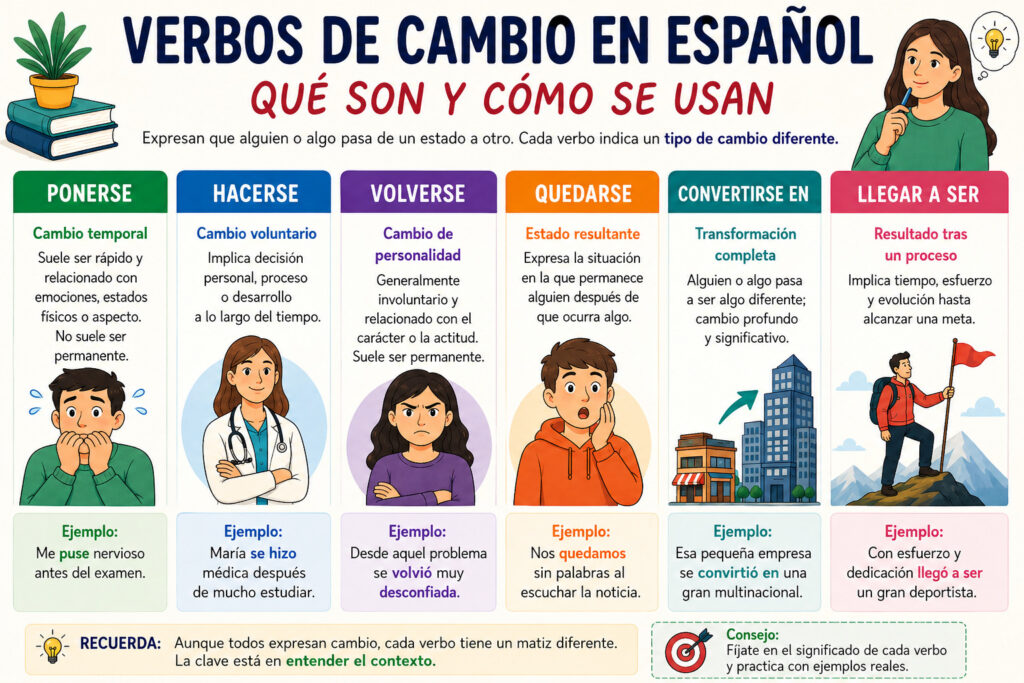
The main verbos de cambio in Spanish are ponerse, hacerse, volverse, quedarse, convertirse en and llegar a ser.
Although these verbs may sometimes seem similar, they are not interchangeable. Each one expresses a particular type of change. Choosing the right verb depends on factors such as whether the change is temporary or permanent, intentional or involuntary, sudden or gradual.
For example:
- Me puse nervioso antes del examen. (I became nervous before the exam.)
- Me hice médico después de estudiar seis años. (I became a doctor after studying for six years.)
- Me volví desconfiado después de aquella experiencia. (I became distrustful after that experience.)
All three sentences describe a change, but each one refers to a different type of transformation.
In this guide to Spanish change-of-state verbs, you will learn what these verbs mean, when to use each one and the main differences between them. You will also find practical examples to help you understand these structures and use them naturally in Spanish.
What Are Verbos de Cambio (Spanish Change-of-State Verbs)?
Verbos de Cambio or Spanish change-of-state verbs are used to express a transition from one state, condition or situation to another. They can describe changes involving people, animals, objects or situations.
A change can affect many different aspects, including:
- mood and emotions;
- personality;
- profession;
- physical appearance;
- health;
- identity;
- financial circumstances;
- the development of a business or project.
For example:
- Marta se puso muy contenta cuando encontró trabajo. (Marta became very happy when she found a job.)
- Javier se hizo abogado. (Javier became a lawyer.)
- Mi abuelo se volvió muy paciente con los años. (My grandfather became very patient over the years.)
- Después del accidente se quedó cojo. (After the accident, he was left unable to walk properly.)
- La pequeña tienda se convirtió en una gran empresa. (The small shop became a large company.)
Although all these sentences describe a change, the meaning and type of transformation are different in each case.
This is one of the main difficulties for Spanish learners. It is not enough to translate the equivalent of “to become” from your native language. You need to identify what kind of change is taking place and choose the Spanish verb that best expresses it.
Why Does Spanish Have So Many Change-of-State Verbs (verbos de cambio)?
Many Spanish learners wonder why there are so many different verbs for expressing change when they can all appear to mean “to become” or “to change”.
The answer lies in the nuances. Each verb adds specific information about how the transformation happens or what kind of result it produces.
When native speakers choose between ponerse, hacerse, volverse, quedarse, convertirse en and llegar a ser, they consider factors such as:
- whether the change is temporary or lasting;
- whether it is the result of a personal decision;
- whether it happens suddenly or unexpectedly;
- whether it affects someone’s personality or simply their temporary mood;
- whether it develops gradually;
- whether it is the result of a long process.
These distinctions make Spanish more precise and allow speakers to express subtle differences in meaning.
Compare these examples:
Ana se puso triste. (Ana became sad.)
This tells us that Ana became sad, usually as a reaction to a particular situation or event. The change may be temporary.
Ana se volvió triste. (Ana became a sad person.)
Here, the meaning is different. It suggests a change in Ana’s personality or usual behaviour: she gradually became a sadder person.
Now consider:
Ana se hizo monja. (Ana became a nun.)
This expresses an important life change resulting from a decision or process. Becoming a nun is not simply a temporary change of mood; it represents a new role or stage in her life.
As these examples show, choosing a different verbos de cambio in Spanish can significantly change the meaning of a sentence. Understanding these nuances is essential if you want to speak Spanish naturally and accurately.
Ponerse: Temporary Changes
Among the Spanish change-of-state verbs (verbos de cambio in Spanish) , ponerse is one of the first verbs learners usually encounter. It is also extremely common in everyday Spanish.
We use ponerse when someone enters a new state quite suddenly, especially when talking about emotions, physical conditions or temporary changes in appearance.
The important idea to remember is that this change is generally temporary. The person moves into a particular state, but that state is not expected to last indefinitely.
For instance, someone might become nervous before a job interview and then calm down once the interview is over. Similarly, they might become happy after hearing some good news but return to their usual mood later.
Common adjectives with ponerse
You will often hear ponerse used with adjectives such as:
- ponerse nervioso;
- ponerse contento;
- ponerse triste;
- ponerse furioso;
- ponerse serio;
- ponerse enfermo;
- ponerse rojo;
- ponerse pálido;
- ponerse moreno.
Learning these combinations as complete expressions can make it much easier to use ponerse naturally in conversation.
Examples
- Me puse muy nervioso antes del examen. (I became very nervous before the exam.)
- Mi madre se puso muy contenta al vernos. (My mother was really happy when she saw us.)
- Nos pusimos tristes cuando terminó el viaje. (We became sad when the trip ended.)
- Pedro se puso rojo de vergüenza. (Pedro went red with embarrassment.)
- Después de correr, me puse muy cansado. (After running, I became very tired.)
- El niño se puso a llorar al perder su juguete. (The boy started crying when he lost his toy.)
A Useful Way to Remember Ponerse
One way of remembering ponerse is to imagine that you are temporarily “putting on” a particular state.
Just as you can put on a coat and take it off later, you can ponerse nervioso, ponerse triste or ponerse contento and then return to your previous state.
This is simply a memory aid rather than a grammatical rule, but it can be useful when learning the different Spanish change-of-state verbs.
A Common Mistake
A frequent mistake among learners is to use ponerse to describe becoming a professional.
❌ Se puso profesor. (He became a teacher.)
✅ Se hizo profesor. (He became a teacher.)
When we talk about becoming a teacher or taking on another profession, we normally use hacerse because the change is understood as a more stable transformation, often associated with a personal choice or decision.
Hacerse: Voluntary or Gradual Changes
Among the Spanish change-of-state verbs, hacerse (verbos de cambio in Spanish) is generally used when a change is connected to someone’s own choice or develops naturally over a period of time.
For this reason, it is especially common when talking about professions, religion, political or social beliefs, nationality and lifestyle changes.
In many situations, the person plays an active role in the transformation and makes a conscious decision to change.
When do we use hacerse?
Some of the most common situations include:
- professions;
- religion;
- nationality;
- ideology or beliefs;
- eating habits;
- changes associated with age.
Examples
- Mi hermana se hizo arquitecta. (My sister became an architect.)
- Pablo se hizo vegetariano hace dos años. (Pablo became a vegetarian two years ago.)
- Después de vivir mucho tiempo allí, se hizo canadiense. (After living there for a long time, he became Canadian.)
- Se hizo budista durante un viaje a Asia. (He became a Buddhist while travelling in Asia.)
- Mi abuelo se hizo mayor muy rápido. (My grandfather grew old very quickly.)
In the last example, of course, nobody actively chooses to grow older. Here, hacerse highlights the idea of a gradual process.
Hacerse with Professions
One of the most important uses of hacerse is talking about becoming a professional or taking on a particular career.
We say:
- hacerse médico; (to become a doctor)
- hacerse abogado; (to become a lawyer)
- hacerse profesor; (to become a teacher)
- hacerse ingeniero; (to become an engineer)
- hacerse piloto. (to become a pilot)
We do not normally use ponerse to express this type of change.
Hacerse and Changes in Beliefs
Hacerse is also frequently used when someone adopts a new ideology, set of beliefs or way of thinking.
For example:
- Se hizo comunista. (He became a communist.)
- Se hizo liberal. (He became a liberal.)
- Se hizo ecologista. (He became an environmentalist.)
In these examples, the change generally involves a personal decision or a conscious shift in beliefs.
Hacerse + Adjective
Although this structure is less common than some of the other uses, hacerse can also appear with adjectives to describe a gradual transformation.
For example:
- hacerse famoso; (to become famous)
- hacerse rico; (to become rich)
- hacerse fuerte. (to become strong)
In these cases, the change normally develops progressively rather than happening suddenly.
Volverse: Personality Changes
While ponerse usually describes a temporary state and hacerse is often linked to deliberate choices or gradual transformations, volverse is mainly used for changes in personality or behaviour that happen without being consciously chosen and tend to become lasting.
Among the verbos de cambio in Spanish, volverse can be particularly tricky because some adjectives can be combined with different verbs. The choice of verb changes the meaning of the sentence.
Compare:
Se puso serio. (He became serious.)
This normally describes a temporary change in someone’s expression, attitude or mood.
Now compare it with:
Se volvió serio. (He became a serious person.)
Here, the sentence suggests that his character has changed. Being serious has become part of the way he normally behaves.
The difference may seem small, but it can communicate two very different situations.
Common adjectives with volverse
Some adjectives that frequently occur with volverse are:
- antipático; (unpleasant)
- egoísta; (selfish)
- desconfiado; (distrustful)
- amable; (kind)
- agresivo; (aggressive)
- insoportable; (unbearable)
- impaciente; (impatient)
- pesimista; (pessimistic)
- optimista; (optimistic)
- reservado. (reserved)
These combinations are useful to learn as complete expressions because they appear frequently when describing changes in someone’s character.
Examples
- Desde que cambió de trabajo se volvió muy antipático. (He became very unpleasant after changing jobs.)
- Mi perro se volvió agresivo después del accidente. (My dog became aggressive after the accident.)
- Con los años mi abuelo se volvió más tranquilo. (Over the years, my grandfather became calmer.)
- Después de aquella experiencia se volvió mucho más prudente. (After that experience, he became much more cautious.)
- El jefe se volvió insoportable. (The boss became unbearable.)
In each example, the change goes beyond a temporary feeling. The person’s or animal’s usual behaviour has changed in a more significant way.
Volverse loco
One of the most familiar expressions with volverse is volverse loco, which can have either a literal or a figurative meaning.
For example:
- Después del accidente se volvió loco. (He went crazy after the accident.)
However, the expression is also very common in everyday speech as an exaggeration:
- Me estoy volviendo loco con tanto trabajo. (I’m going crazy with all this work.)
Here, the speaker is simply saying that they feel overwhelmed or under a lot of pressure. It does not necessarily refer to an actual loss of mental health.
A Common Mistake
Learners sometimes use hacerse when they want to describe a change in someone’s personality:
❌ Se hizo antipático. (He became unpleasant.)
In this context, the more natural option is:
✅ Se volvió antipático. (He became unpleasant.)
The reason is that the sentence describes a transformation in someone’s personality or behaviour, rather than a deliberate decision to become a certain type of person.
Quedarse: Focusing on the Result of a Change
Quedarse is a very common and flexible verb in Spanish. As one of the verbos de cambio (Spanish change-of-state verbs), it is used to draw attention to the state that remains after a change or event has taken place.
The main difference between ponerse and quedarse is the focus. Ponerse normally describes entering a temporary state, whereas quedarse highlights the condition that results from an event or transformation. This resulting state can last for a long time and, in some situations, can be permanent.
For example:
- Después del accidente se quedó cojo. (He was left unable to walk properly after the accident.)
- Me quedé sin palabras. (I was speechless.)
- Nos quedamos sorprendidos. (We were surprised.)
- El niño se quedó dormido en el sofá. (The child fell asleep on the sofa.)
In these sentences, the emphasis is on what state remains afterwards, rather than on the actual moment of transition.
When Do We Use Quedarse?
There are three particularly useful contexts in which learners will often encounter quedarse as a change-of-state verb.
1. To Describe the Result of an Event
We use quedarse when an event or experience leaves someone in a particular physical or emotional condition.
Examples
- Se quedó ciego después del accidente. (He was left blind after the accident.)
- Me quedé muy preocupado tras la llamada. (I was very worried after the phone call.)
- Nos quedamos agotados después de la excursión. (We were exhausted after the trip.)
2. Quedarse sin
The structure quedarse sin is extremely common. It means that someone no longer has something or that something has run out.
Examples
- Nos quedamos sin dinero durante el viaje. (We ran out of money during the trip.)
- Se quedó sin batería. (His battery ran out.)
- Me he quedado sin café. (I’ve run out of coffee.)
- El equipo se quedó sin entrenador. (The team was left without a coach.)
3. Common Expressions with Quedarse
There are many fixed expressions built with quedarse, and learning them can make your Spanish sound much more natural.
Some useful examples are:
- quedarse de piedra (to be stunned)
- quedarse helado (to be shocked / stunned)
- quedarse con la boca abierta (to be amazed)
- quedarse sin palabras (to be speechless)
- quedarse en blanco (to go blank)
For example:
- Me quedé de piedra cuando escuché la noticia. (I was stunned when I heard the news.)
- Durante el examen me quedé en blanco. (I went blank during the exam.)
- Todos nos quedamos con la boca abierta al verlo. (We were all amazed when we saw him.)
These expressions are particularly useful because they are frequently heard in everyday Spanish, as well as in films and TV programmes. Learning them as complete phrases will help you understand native speakers and communicate more naturally.
Convertirse en: A Major Transformation
Convertirse en is one of the Verbos de cambio (Spanish change-of-state verbs) used to describe a substantial transformation. It indicates that a person, animal, object, organisation or situation changes into something different.
The key idea is that the transformation is significant enough to affect the identity, role or nature of the subject.
Because of this, convertirse en is often found in news articles, historical accounts and texts describing major developments or changes in society.
Examples
- La oruga se convirtió en mariposa. (The caterpillar turned into a butterfly.)
- El pequeño negocio se convirtió en una multinacional. (The small business became a multinational company.)
- El pueblo se convirtió en un importante destino turístico. (The village became a major tourist destination.)
- Internet se ha convertido en una herramienta imprescindible. (The internet has become an essential tool.)
- Se convirtió en uno de los mejores jugadores del mundo. (He became one of the best players in the world.)
As these examples show, convertirse en is not limited to people. We can use it to talk about businesses, places, objects, organisations and even abstract ideas.
Convertirse en vs Hacerse
One of the questions learners often have is how to distinguish convertirse en from hacerse. Both can sometimes be translated as “to become”, but they do not necessarily focus on the same aspect of the change.
Compare:
Se hizo médico. (He became a doctor.)
Here, the emphasis is on the person’s decision and the process of choosing a profession. He studied Medicine and then entered the profession.
Now consider:
Se convirtió en un médico muy famoso. (He became a very famous doctor.)
In this sentence, the important point is the result: over time, he achieved a high level of recognition in his profession.
Another comparison:
- Se hizo empresario. (He became a businessman.)
- Su empresa se convirtió en una referencia internacional. (His company became an international benchmark.)
The first sentence describes a professional decision or change in someone’s career. The second highlights the transformation of a company and the position it eventually achieved.
This distinction can help learners understand why convertirse en is often used when the emphasis is on the final result of a significant transformation.
Llegar a ser: Reaching a Goal
Llegar a ser is another of the Verbos de cambio in Spanish (Spanish change-of-state verbs) used to describe a transformation, but its main focus is on the journey that leads to the final result. The expression often suggests that achieving this new state required time, persistence, effort or personal development.
It is particularly useful when talking about someone’s career, achievements, ambitions or long-term success.
Examples
- Llegó a ser presidente de la empresa. (He eventually became the company’s president.)
- Puede llegar a ser un gran profesor. (He could become a great teacher.)
- Con mucho trabajo llegó a ser un reconocido científico. (Through hard work, he became a renowned scientist.)
- Nunca imaginó que llegaría a ser tan famoso. (He never imagined that he would become so famous.)
In each case, the final situation is presented as the result of a process. The person does not simply change from one state to another; they progress towards a particular outcome.
Llegar a ser vs Convertirse en
These two verbos de cambio in Spanish can sometimes be used in similar contexts, but they place the emphasis on different aspects of the transformation.
With convertirse en, the main idea is the result or new status:
La empresa se convirtió en líder del mercado. (The company became the market leader.)
With llegar a ser, the emphasis is more clearly on the development or circumstances that made the result possible:
La empresa llegó a ser líder gracias a años de innovación. (The company became the market leader thanks to years of innovation.)
Both expressions can therefore be appropriate in some situations. The choice depends on whether you want to highlight the final transformation or the process that led to it.
Comparing Verbos de Cambio in Spanish (Change-of-State Verbs)
Once you understand the meaning of each verb, comparing them side by side makes the differences much clearer. This overview can help you choose the right Spanish change-of-state verb (verbos de cambio) depending on the situation.
| Verb | Main use | Example |
|---|---|---|
| Ponerse | A short-term or temporary change | Me puse nervioso. (I became nervous.) |
| Hacerse | A deliberate or gradual transformation | Se hizo médico. (He became a doctor.) |
| Volverse | A change in someone’s personality or behaviour | Se volvió egoísta. (He became selfish.) |
| Quedarse | The state or condition resulting from an event | Se quedó dormido. (He fell asleep.) |
| Convertirse en | A significant transformation into something new | Se convirtió en actor. (He became an actor.) |
| Llegar a ser | Achieving a new status after a process | Llegó a ser director. (He eventually became a director.) |
A useful way to choose between these verbos de cambio in Spanish is to ask yourself what exactly you want to emphasise.
Ask yourself: What kind of change am I describing?
- Is it a temporary feeling or physical state? → ponerse
- Is it the result of a personal choice or a gradual change? → hacerse
- Has someone’s character or behaviour changed? → volverse
- Are you focusing on the condition someone is left in? → quedarse
- Has someone or something undergone a major transformation? → convertirse en
- Is the new situation the result of a long process or journey? → llegar a ser
Learning these distinctions will help you avoid one of the most common difficulties with Spanish change-of-state verbs: choosing a verb simply because its English translation is “to become”. In Spanish, the context and the type of change are what determine the most natural choice.
Common Mistakes with Spanish Change-of-State Verbs (verbos de cambio)
When learning Spanish change-of-state verbs, it is easy to mix them up, especially because several of them can be translated into English using “to become”. Here are some typical mistakes and the more natural alternatives.
Error 1: Using hacerse for temporary emotions
❌ Me hice nervioso.
(I became nervous.)
✅ Me puse nervioso.
(I became nervous.)
Why? Use ponerse when describing a temporary emotional or physical state.
Error 2: Using ponerse with professions
❌ Se puso abogado.
(He became a lawyer.)
✅ Se hizo abogado.
(He became a lawyer.)
Why? Hacerse is normally used when someone enters a profession or adopts a professional role.
Error 3: Using hacerse for personality changes
❌ Mi vecino se hizo antipático.
(My neighbour became unpleasant.)
✅ Mi vecino se volvió antipático.
(My neighbour became unpleasant.)
Why? Volverse is the more natural choice for changes in someone’s character or usual behaviour.
Error 4: Using volverse for the result of an event
❌ Después del accidente se volvió ciego.
(He became blind after the accident.)
✅ Después del accidente se quedó ciego.
(He became blind after the accident.)
Why? Quedarse focuses on the condition that results from an event or experience.
Error 5: Combining llegar a and convertirse en incorrectly
❌ La empresa llegó a convertirse famosa.
(The company became famous.)
✅ La empresa se convirtió en una empresa famosa.
(The company became a famous company.)
Why? Convertirse must be followed by en when it means “to become”. If you use llegar a, the structure is different: La empresa llegó a ser famosa (The company eventually became famous).
Exercise
Complete the sentences using the correct verbo de cambio (Spanish change-of-state verb).
- Laura se ______ muy contenta cuando aprobó el examen.
- Después de muchos años de estudio, Carlos se ______ médico.
- Desde que tuvo aquel problema se ______ muy desconfiado.
- Nos ______ sin gasolina en mitad del viaje.
- Esa pequeña empresa se ______ en una multinacional.
- Con esfuerzo llegó a ______ uno de los mejores chefs del país.
- puso
- hizo
- volvió
- quedamos
- convirtió
- ser
If you got them all right, congratulations! You now have a solid understanding of the main differences between Spanish change-of-state verbs (verbos de cambio).
How to Master Spanish Change-of-State Verbs
Knowing the grammar rules is a good starting point, but the best way to become confident with Spanish change-of-state verbs (verbos de cambio) is to encounter them regularly in authentic situations.
Here are some practical ways to practise:
- Read books, news articles and other texts written in Spanish.
- Listen to podcasts that are suitable for your current level.
- Watch Spanish-language films and series and notice how native speakers use these verbs.
- Create your own example sentences to practise each verb.
- Have conversations with native speakers or work with a Spanish teacher.
Rather than trying to memorise long lists of isolated verbs, learn them as fixed expressions or useful combinations. For example, remember ponerse nervioso (to become nervous), hacerse mayor (to grow older), volverse loco (to go crazy) and quedarse sin palabras (to be speechless) as complete phrases.
The more you encounter these expressions in context, the easier it will become to choose the right verb naturally when speaking or writing in Spanish.
Frequently Asked Questions About Spanish Change-of-State Verbs (verbos de cambio)
Which change-of-state verb is most commonly used?
Ponerse is probably the one learners will encounter most often. It is especially common when describing temporary emotions, moods and physical conditions.
Which Spanish change-of-state verbs tend to cause the most confusion?
Volverse and quedarse are often particularly challenging. In some cases, both can be used with similar adjectives, but they express different types of change. The surrounding context helps determine which option is appropriate.
Can different change-of-state verbs be used to describe the same situation?
Sometimes, yes. However, choosing a different verb can introduce a different meaning or emphasis.
For example:
- Se puso serio. (He became serious for a short time.)
- Se volvió serio. (He developed a more serious personality.)
Both sentences describe a change, but ponerse focuses on a temporary state, while volverse suggests a more lasting change in someone’s character.
This is why paying attention to the type of change is essential when choosing between Spanish change-of-state verbs (verbos de cambio).
Verbos de cambio (Spanish change-of-state verbs): Conclusion
Mastering Spanish change-of-state verbs is an important step towards speaking Spanish more naturally and expressing subtle differences in meaning. While choosing between these verbs can be confusing at first, recognising the type of change being described will make the process much easier.
Keep these key ideas in mind:
- Ponerse → short-term changes in emotions, mood or physical condition.
- Hacerse → changes linked to personal choices, professions, beliefs or lifestyle.
- Volverse → lasting changes in personality or behaviour.
- Quedarse → the condition or state left after an event.
- Convertirse en → a significant transformation into something new.
- Llegar a ser → reaching a new status or situation after a period of development.
The best way to master these distinctions is through regular exposure and practice. Reading, listening and speaking Spanish frequently will help you recognise these patterns and eventually choose the appropriate verb without having to think about the rule each time.
Ready to put what you have learned into practice? Try the extra activities and see how well you can use these verbos de cambio (Spanish change-of-state verbs) in Spanish.
Learn Spanish Change-of-State Verbs (verbos de cambio) with Zona de Español
Knowing the rules is only the beginning. To really master Spanish change-of-state verbs, you need opportunities to use them naturally when speaking. At Zona de Español, our online Spanish courses give you plenty of practice so that you can turn grammar knowledge into real communication.
Our classes combine grammar with conversation and everyday situations, allowing you to develop practical Spanish that you can use with confidence. You will not only work on Spanish change-of-state verbs, but also improve other key areas such as ser and estar, verb tenses, the subjunctive, prepositions and useful everyday vocabulary.
Aprende español con nuestros cursos y clases
- CEFR online Spanish courses
Spanish Online Course for Beginners – Level A1.1
110,00€ Select options This product has multiple variants. The options may be chosen on the product page - CEFR online Spanish courses
Spanish Course Level A1.2
110,00€ Select options This product has multiple variants. The options may be chosen on the product page - CEFR online Spanish courses
Online Spanish Course Basic Level – A2.1
110,00€ Select options This product has multiple variants. The options may be chosen on the product page