

In this article, we outline the 10 most common mistakes in Spanish, providing clear examples, straightforward explanations and practical advice on how to avoid them. It is designed both for learners of Spanish and for native speakers who wish to refine their command of the language.
What Is Considered Incorrect Spanish and Why It Matters
One of the most frequent questions among students and speakers alike is what counts as incorrect Spanish. Whether the aim is to pass an exam, improve professional writing or speak with greater confidence, identifying the most common mistakes is a crucial step in mastering the language.
In an online Spanish academy, this question comes up time and again:
👉 “¿Esto está mal dicho?” (“Is this said incorrectly?”)
👉 “¿Lo dice así todo el mundo, pero es correcto?” (“Everyone says it like this, but is it correct?”)
The reality is that many mistakes have become normalised through everyday use, social media or the influence of other languages. However, when the goal is to learn Spanish properly, communicate clearly or reach an advanced level, it is essential to understand what is regarded as incorrect Spanish and why.
What Is Considered Incorrect Spanish According to the Standard?
Before looking at specific mistakes, it is helpful to clarify a key concept, especially in the context of learning Spanish as a foreign language.
Incorrect Spanish vs Colloquial Spanish
- Colloquial Spanish: an informal, relaxed and context-based use of the language. It does not always follow every rule, but it is socially accepted.
- Incorrect Spanish: usage that contradicts the grammatical, spelling or syntactic rules of standard Spanish.
The Real Academia Española (RAE) establishes these rules as a common reference point. Although language evolves over time, not all frequently used forms are correct. For this reason, understanding what constitutes incorrect Spanish is essential for learners who wish to speak and write accurately.
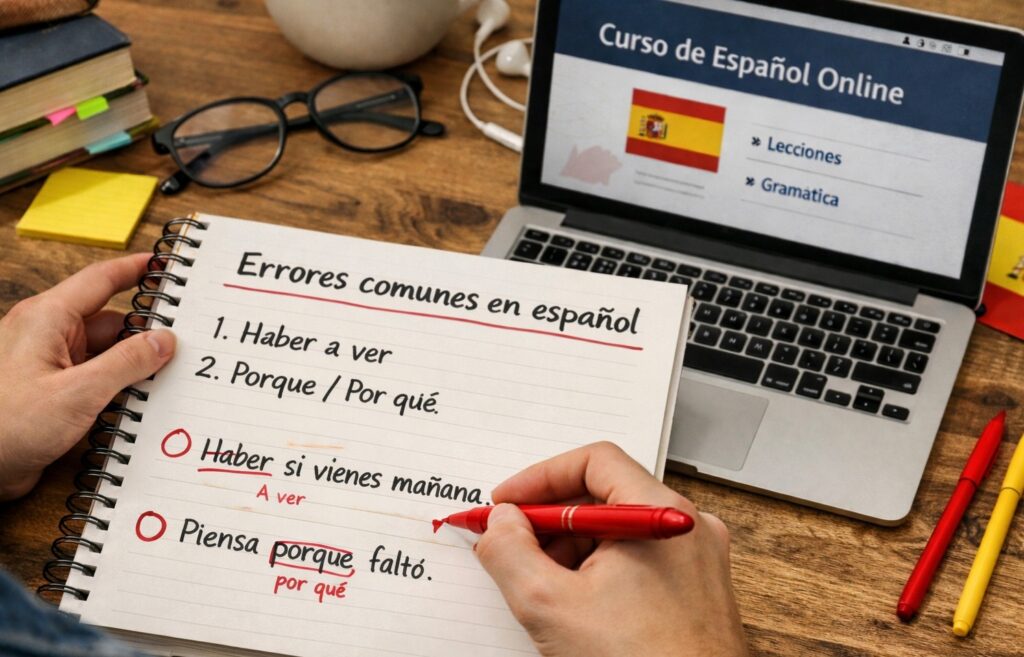
Let us now look at some of the most frequent mistakes in Spanish:
Mistake 1: Confusing “haber” and “a ver”
This is one of the most common errors among learners of Spanish and one of the first issues addressed in beginner and intermediate online courses.
❌ Incorrect usage
- Haber si puedes asistir a la clase. (“Let’s see if you can attend the class.”)
- Vamos haber qué aprendemos hoy. (“Let’s see what we learn today.”)
✅ Correct usage
- A ver si puedes asistir a la clase. (“Let’s see if you can attend the class.”)
- Vamos a ver qué aprendemos hoy. (“Let’s see what we learn today.”)
Simple explanation
- Haber is a verb: hay, había, he, hubo. (“there is/are”, “there was/were”, “I have”, “there was”)
- A ver is used to express expectation, interest or intention. (“let’s see”)
A helpful tip for learners
If you can replace the expression with “veamos” (“let us see”), then the correct form is a ver.
Mistake 2: Misusing “porque”, “por qué”, “porqué” and “por que”
This mistake is particularly common in written Spanish and frequently appears in exams, essays and formal emails.
Correct forms and usage
- porque → expresses cause
Estudio español porque quiero trabajar en España.
(“I study Spanish because I want to work in Spain.”) - por qué → used in questions
¿Por qué estudias español?
(“Why do you study Spanish?”) - porqué → a noun (means “reason”)
No entiendo el porqué de esta regla.
(“I do not understand the reason for this rule.”) - por que → less common structure
Luchó por que se reconocieran sus derechos.
(“He/She fought for their rights to be recognised.”)
Mastering the difference between these forms is essential to avoid incorrect Spanish in academic contexts.
Mistake 3: Saying “hubieron problemas”
Although this form is very common, even among native speakers, it is grammatically incorrect.
❌ Incorrect usage
- Hubieron muchos errores en el examen.
(“There were many mistakes in the exam.”)
✅ Correct usage
- Hubo muchos errores en el examen.
(“There were many mistakes in the exam.”)
Grammatical explanation
When the verb haber is used to express existence, it is impersonal and must always appear in the singular form.
This mistake is typically addressed at intermediate and advanced levels of Spanish learning.
Mistake 4: Dequeísmo and Queísmo
These two errors often create uncertainty among online Spanish learners.
❌ Incorrect usage
- Pienso de que estudiar español es importante. (dequeísmo)
(“I think that studying Spanish is important.”) - Me di cuenta que cometí un error. (queísmo)
(“I realised that I made a mistake.”)
✅ Correct usage
- Pienso que estudiar español es importante.
(“I think that studying Spanish is important.”) - Me di cuenta de que cometí un error.
(“I realised that I made a mistake.”)
Practical tip
Replace the subordinate clause with “eso” (“that”). If the sentence works naturally without “de”, then you should not include it.
Mistake 5: Confusing “sino” and “si no”
This is a very common error when learners start writing more complex texts.
❌ Incorrect usage
- No es un error, si no una confusión. (“It’s not a mistake, if not a confusion.”)
✅ Correct usage
- sino → expresses contrast
No es un error, sino una confusión. (“It’s not a mistake, but a confusion.”) - si no → expresses condition
Si no estudias, no aprobarás. (“If you don’t study, you won’t pass.”)
Mistake 6: Misusing “le”, “lo” and “la”
This is one of the most challenging topics for learners of Spanish as a foreign language.
❌ Incorrect examples
- Le vi ayer. (referring to an object) (“I saw him/her/it yesterday.”)
- La dije la respuesta. (“I told her/it the answer.”)
✅ General correct usage
- lo / la → direct object
- le → indirect object
Although some instances of leísmo are accepted, overusing these forms is a clear sign of incorrect Spanish in formal contexts.
Mistake 7: Incorrect plural formation
Plurals cause confusion for both learners and native speakers.
❌ Incorrect usage
- Los curriculums (“The curriculums”)
- Los lápiz (“The pencils”)
✅ Correct usage
- Los currículos (“The curricula”)
- Los lápices (“The pencils”)
This mistake often appears in writing exercises in online Spanish courses.
Mistake 8: Incorrect use of the gerund
The gerund should not indicate actions that occur afterwards.
❌ Incorrect usage
- Estudió español durante años, consiguiendo trabajo después. (“He/She studied Spanish for years, obtaining a job afterwards.”)
✅ Correct usage
- Estudió español durante años y consiguió trabajo después. (“He/She studied Spanish for years and got a job afterwards.”)
This error is particularly common in formal and academic texts.
Mistake 9: Agreement Errors
❌ Incorrect usage
- La problema es difícil. (“The problem is difficult.”)
- Habían muchas dudas. (“There were many doubts.”)
✅ Correct usage
- El problema es difícil. (“The problem is difficult.”)
- Había muchas dudas. (“There were many doubts.”)
Agreement is a fundamental aspect, especially at beginner levels of Spanish learning.
Mistake 10: Common Accentuation Errors
Accents remain one of the biggest challenges in Spanish.
Common examples:
- aun / aún
- esta / está
- solo / sólo (used when ambiguity arises)
Examples:
- Aún no he terminado el curso. (“I haven’t finished the course yet.”)
- Aun los estudiantes avanzados se equivocan. (“Even advanced students make mistakes.”)
Incorrect Spanish Among Online Spanish Learners
In digital learning, mistakes tend to recur because:
- Writing is more frequent than speaking
- Learners translate mentally from their native language
- Vocabulary is learned without context
For this reason, in an online Spanish academy, it is essential to address these errors systematically and progressively.
How to Avoid Incorrect Spanish and Improve Your Level
If you are learning Spanish, these tips will help:
- Practice with native-speaking teachers
- Read texts suited to your level
- Write regularly and receive corrections
- Consult reliable sources such as the Real Academia Española (RAE)
- Learn the most common mistakes from the start
Why Learning Spanish Correctly Makes a Difference
Speaking correctly does not mean speaking rigidly. It means:
- Communicating clearly
- Avoiding misunderstandings
- Enhancing your academic and professional opportunities
Understanding what counts as incorrect Spanish gives you control over the language and allows you to choose how and when to use it.
Conclusion: Mastering Spanish Is a Journey, Not an Obsession
Making mistakes is a natural part of learning. The key is to recognise them, understand them, and correct them step by step. In an online Spanish academy, this process is much smoother with expert guidance and consistent practice.
If your goal is to improve your Spanish, steer clear of common errors, and build confidence in both speaking and writing, following a structured approach with specialised teachers can make all the difference.
Want to start learning Spanish correctly and avoid these mistakes from the very beginning?
Explore our online Spanish courses, designed to suit your level and learning pace.
Aprende español con nuestros cursos y clases
- CEFR online Spanish courses
Spanish Online Course for Beginners – Level A1.1
110,00€ Select options This product has multiple variants. The options may be chosen on the product page - CEFR online Spanish courses
Spanish Course Level A1.2
110,00€ Select options This product has multiple variants. The options may be chosen on the product page - CEFR online Spanish courses
Online Spanish Course Basic Level – A2.1
110,00€ Select options This product has multiple variants. The options may be chosen on the product page