

In this guide, you’ll discover 10 great free apps to learn Spanish in 2026, with an in-depth and up-to-date breakdown of each one. We’ll look at their main features, strengths, limitations, and the type of learner who will benefit most from using them.
If you’re searching for free apps to learn Spanish, you’re in the right place. In 2026, studying Spanish on your smartphone isn’t just possible—it has become one of the most effective, accessible, and flexible ways to master the language. Whether you want to learn Spanish for travel, career opportunities, moving to a Spanish-speaking country, or simply for personal growth, there are now powerful free tools that can take you from complete beginner to a confident conversational level.
Spanish is the second most widely spoken language in the world by native speakers and one of the most valuable languages in the international job market. Because of this growing demand, language-learning apps have evolved dramatically in recent years. Many now integrate artificial intelligence, speech recognition, spaced-repetition systems, and personalized learning paths to make studying more efficient and engaging.
1. Duolingo
When people think about free language-learning apps, Duolingo is still the global benchmark. Much of its popularity comes from its gamified approach, which turns studying into a fun and almost addictive experience.
Lessons are organized into themed units that cover vocabulary, grammar patterns, listening comprehension, and pronunciation. Each lesson typically takes between three and seven minutes, making it easy to stay consistent and practice a little every day.
One of its biggest strengths in 2026 is its adaptive learning system. The app uses artificial intelligence to track your mistakes and automatically give you more practice in areas where you struggle. It also includes speaking exercises powered by increasingly accurate voice-recognition technology.
Main advantages: the free version is fully functional, it’s excellent for complete beginners, and the streak system encourages daily practice.
Limitations: grammar explanations are sometimes quite brief. For that reason, in our academy we recommend using this app as a complement to Spanish classes. Another drawback is that lessons can feel repetitive if you don’t combine the app with other learning resources.
It’s perfect for beginners starting from thewho need to build a daily learning habit, and it’s also great for expanding basic vocabulary.
2. Babbel
Babbel stands out for its structured and professional learning approach. Although its main model is subscription-based, it offers introductory lessons for free so users can begin without paying.
Unlike more game-like apps, Babbel focuses on practical communication scenarios—introductions, workplace conversations, travel situations, restaurants, and job interviews. Its grammar explanations are concise and clear, helping learners understand the logic behind each structure.
The app also uses spaced repetition to reinforce vocabulary over time and includes fairly detailed pronunciation exercises.
Advantages: clear explanations, practical focus, and well-organized lesson progression.
Drawbacks: the free content is limited, and advancing further usually requires a subscription.
Babbel is particularly suitable for students who prefer a more structured and serious learning experience rather than a purely gamified one.
3. Busuu
Busuu combines a structured course with social interaction, making it one of the most complete free Spanish-learning apps in its basic version.
What truly sets it apart is the ability to submit written or spoken exercises for correction by native speakers. This type of human feedback can significantly improve the quality of your learning.
The platform includes grammar explanations, vocabulary practice, listening exercises, and speaking activities, all organized according to the levels of the Common European Framework of Reference for Languages (A1–C1).
Advantages: real feedback from native speakers, solid course structure, and an active community.
Disadvantages: some advanced features require a paid plan.
It’s highly recommended for learners who want to improve their writing skills and receive authentic corrections. While it doesn’t fully replace a teacher’s feedback, it’s still very useful for self-study.
4. Memrise
Memrise is particularly effective for building vocabulary in a natural way. One of its biggest advantages is the use of short videos featuring real native speakers, exposing learners to authentic accents and everyday speech.
The app relies heavily on spaced-repetition techniques to help words and expressions stick in your long-term memory. It’s especially helpful for learning common phrases and colloquial expressions used in daily conversations.
Advantages: strong vocabulary retention and exposure to real pronunciation.
Disadvantages: grammar explanations are not as detailed as in other apps.
It’s ideal for reinforcing vocabulary and improving listening comprehension.
5. HelloTalk
HelloTalk is not a traditional course but a language-exchange social network. It connects you with native speakers through text messages, voice recordings, and video calls.
The app includes built-in correction tools that allow users to edit sentences directly within the chat. This turns each conversation into a small personalized learning session.
Advantages: real conversations, cultural exchange, and free access to the main features.
Disadvantages: the quality of the experience depends on finding reliable language partners.
HelloTalk is ideal for intermediate learners who want to improve their fluency and don’t have Spanish-speaking friends to practice with.
6. Tandem
Tandem works in a similar way to HelloTalk, but with a stronger focus on verified profiles and smarter matching between users. This system helps connect learners with native speakers who share similar goals, interests, or learning preferences.
Because of this matching process, conversations on Tandem often feel more meaningful and productive. You can practice casual everyday chats, but it’s also possible to have more structured conversations about work, studies, or professional topics.
Advantages: a large global community and free video call features that allow real-time speaking practice.
Limitations: the platform doesn’t provide a structured language course or step-by-step curriculum.
Tandem is an excellent option for learners who want to improve their fluency and sound more natural through real conversations with native speakers.
7. Mondly
Mondly stands out for incorporating innovative technologies such as conversational chatbots and even augmented reality learning experiences.
Lessons are organized around practical topics and everyday situations, making them easy to follow. The interface is modern, visually appealing, and designed to keep learners engaged.
It’s a good choice for people who want a more technological and interactive learning experience compared to traditional language apps.
However, one drawback is that the free daily lesson is quite short and mainly focuses on translation exercises and basic vocabulary. Many of the more advanced or interesting features require a paid plan. Some learners also find the repetition helpful at first but somewhat frustrating after extended use.
8. Drops
Drops focuses almost entirely on vocabulary building through quick five-minute sessions.
Instead of long explanations, the app uses colorful illustrations and visual associations to help learners remember words and expressions more easily. This visual approach makes memorization faster and more intuitive.
Drops works especially well as a short daily supplement, particularly for beginners who need to expand their basic vocabulary quickly.
9. Beelinguapp
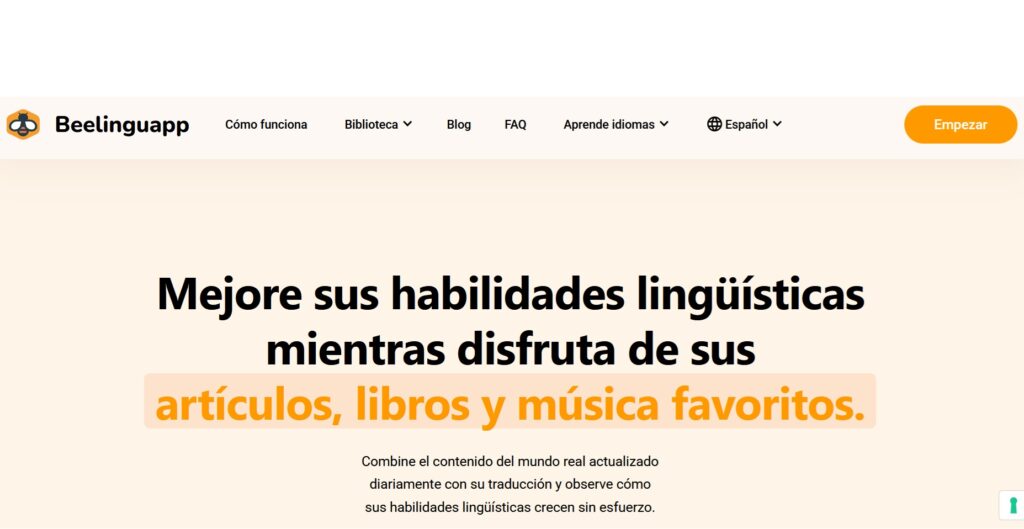
Beelinguapp offers a different type of learning experience by allowing users to read texts in Spanish alongside a parallel translation in their native language.
Its library includes short stories, news articles, and audiobooks. You can read while listening at the same time, which helps develop both reading comprehension and listening skills simultaneously.
Although much of the app’s content is part of a paid subscription, there are still several texts available for free that learners can explore.
10. LingQ
LingQ takes a strong immersion-based approach. Instead of relying on traditional exercises, it helps users learn Spanish through real-world content such as podcasts, interviews, articles, and authentic conversations.
The system automatically saves new vocabulary you encounter and builds personalized study lists so you can review words later.
This platform is particularly well suited for intermediate and advanced learners who want more exposure to natural Spanish and authentic language use.
Final thoughts
Using language-learning apps has never been easier than it is today. With so many digital tools available, studying Spanish on your phone in 2026 is more accessible than ever. However, the key to progress isn’t downloading dozens of apps—it’s choosing a few complementary ones and practicing consistently.
A practical strategy could be using Duolingo or Busuu to maintain a structured learning path, combining them with Drops or Memrise for vocabulary practice, and adding conversation through HelloTalk or Tandem. Reading stories on Beelinguapp or exploring authentic content on LingQ can accelerate your progress even further.
If you dedicate around 20–30 minutes a day to study and practice speaking at least once a week, reaching a solid conversational level within a year is a realistic goal.
Technology can be an incredibly powerful learning tool—but consistency and discipline are what truly make the difference.
At Zona de Español, as well as in many other Spanish academies, we always recommend combining apps and digital tools with regular Spanish classes. While apps are excellent for self-study and review, they can’t fully replace the guidance of an experienced teacher who understands what to teach and how to teach it effectively. Used together, however, these tools can significantly strengthen your learning journey.
Aprende español con nuestros cursos y clases
- CEFR online Spanish courses
Spanish Online Course for Beginners – Level A1.1
110,00€ Select options This product has multiple variants. The options may be chosen on the product page - CEFR online Spanish courses
Spanish Course Level A1.2
110,00€ Select options This product has multiple variants. The options may be chosen on the product page - CEFR online Spanish courses
Online Spanish Course Basic Level – A2.1
110,00€ Select options This product has multiple variants. The options may be chosen on the product page