

“Qué guay!” is a phrase you’ll hear all the time in Spain. In this post, we’re going to explore how to use it properly.
Learning Spanish isn’t just about memorising grammar rules and vocabulary lists – it’s about getting to grips with how people actually speak in everyday situations. One of the expressions that captures this perfectly is “qué guay”. Common in informal conversations, it’s a way of showing excitement, surprise or approval, and it highlights how language shifts depending on the region and the age of the speaker.
Here, we’ll dive into what this expression really means, where it comes from, how to use it naturally, and plenty of examples to help you make it part of your daily Spanish.
We’ll also give you a taste of how our online Spanish school helps learners pick up these authentic expressions, blending cultural insight with practice and explanation, so that improving your Spanish feels both effective and enjoyable.
What does the expression ‘qué guay’ stand for?
In Spain, the expression “qué guay” is often used to express excitement, happiness or approval when something makes us feel pleased or pleasantly surprised. In English, it can be rendered as “how cool” or “awesome”, depending on the situation. For example:
Ejemplo 1:
María ha comprado entradas para el concierto de su banda favorita. Juan le dice:
“¡Qué guay! Me alegro mucho por ti.”
Ejemplo 2:
Un amigo te cuenta que aprobó un examen difícil. Tú respondes:
“¡Qué guay! Sabía que lo conseguirías.”
In both examples, “qué guay” carries a sense of enthusiasm and positivity.
Where ‘guay’ comes from and how it has evolved
The word “guay” has a somewhat uncertain origin, but it’s thought to come from the English word “way”, which in 1960s and 70s Spain was used in the context of youth slang and fashion. Over time, it caught on and became a common informal way to show enthusiasm or approval. Today, “guay” is used by both young people and adults in casual situations.
In Spain, many colloquial expressions have interesting or foreign origins, often from English, reflecting cultural and media influences. Learning these expressions not only broadens your vocabulary but also gives you a deeper understanding of Spanish culture.
Using ‘qué guay’ the right way
To use “qué guay” naturally, there are a few things to keep in mind:
- Informal context
It’s mostly used in casual situations, among friends, family, or classmates. It’s not suitable for formal settings such as job interviews, official letters, or professional meetings.
- Incorrect:
Estimado señor Pérez, su propuesta es guay. - Correct:
¡Qué guay tu propuesta! Me encanta la idea.
- Intonation
The way you say it makes a big difference. Usually, it’s spoken with a cheerful, rising tone to emphasise positive feelings:
- “¡Qué guay!” → with excitement
- “Sí, guay…” → in a more neutral or ironic tone
- Common combinations
“Qué guay” is often paired with verbs or nouns:
- Qué guay + verb:
“¡Qué guay que hayas venido!” - Qué guay + noun:
“¡Qué guay el regalo que me diste!”
Regional and age-related differences
Although this expression is understood all over Spain, how often it’s used and in what way can vary by region and age:
- Young people: They use it effortlessly to show excitement about plans, music, clothes, or technology.
- Adults: They use it too, but often in a more relaxed or even nostalgic way.
- Regions: In some areas, people might prefer synonyms like “genial”, “fantástico” or “chulo”.
At our online Spanish school, Zona de Español, we focus on these subtle differences so students not only learn the vocabulary but also know when and how to use it appropriately in different social and cultural situations.
Practical conversation examples
To help you use this expression like a native speaker, here are some everyday situations:
Ejemplo 1: At school or a class
- Ana: “Hoy tenemos clase de cocina española.”
- Luis: “¡Qué guay! Me encantan las tapas.”
Ejemplo 2: Among friends
- Pedro: “He conseguido entradas para el cine.”
- Marta: “¡Qué guay! ¿A qué hora vamos?”
Ejemplo 3: On social media
- Usuario 1: “He terminado de leer ese libro que me recomendaste.”
- Usuario 2: “¡Qué guay! ¿Te ha gustado?”
Ejemplo 4: Making travel plans
- Juan: “Mañana vamos a la playa.”
- Carla: “¡Qué guay! Necesito desconectar un poco.”
Other ways to say ‘qué guay
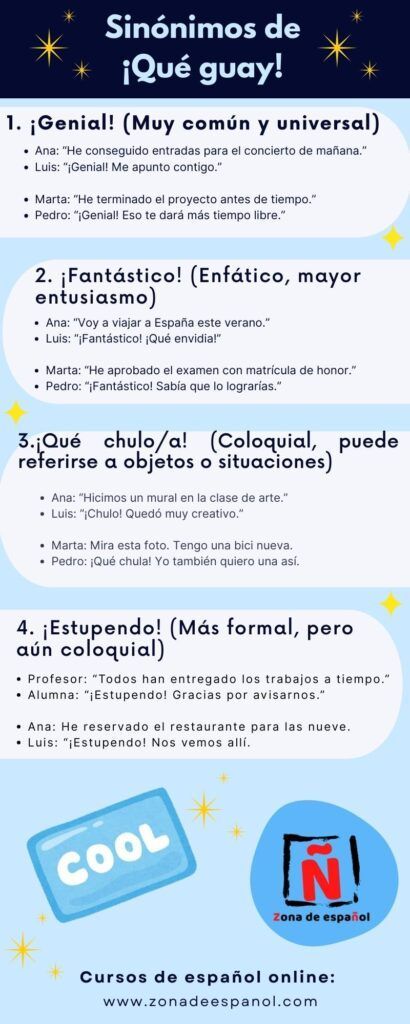
If you want to mix up your language and avoid always using the same expression, there are several synonyms of “qué guay” commonly used in Spain:
- ¡Genial! → Very common and widely used.
- ¡Fantástico! → More emphatic, expressing stronger enthusiasm.
- ¡Chulo! → Colloquial, especially among young people; can refer to things or situations.
- ¡Estupendo! → Slightly more formal, but still casual.
Example:
- Marta: “He comprado un coche nuevo.”
- Luis: “¡Qué chulo! ¿De qué color es?”
Knowing these synonyms will allow you to adapt your language to different situations and age groups.
Frequent mistakes with ‘qué guay’
Although it’s easy to use, Spanish learners often make a few common mistakes:
1. Using it in formal situations:
- Incorrect: “Qué guay su propuesta de negocios.”
- Correct: “Su propuesta de negocios es excelente.”
2. Mixing it up with negative expressions:
“Guay” always has a positive meaning. It isn’t used to show dislike or irony, unless the tone is clearly sarcastic. The way you say it really matters here.
3. Pronouncing it too stiffly:
Sounding natural is key. Listen to native speakers and practise the intonation.
Why it’s important to learn informal expressions
Learning colloquial expressions like these doesn’t just expand your vocabulary; it also:
- Helps you fit in more easily in casual conversations.
- Makes it easier to understand Spanish movies, series, and music.
- Lets you sound more natural and less like a literal translator when speaking.
At Zona de Español, we teach all these expressions in real-life, practical contexts, making your learning both effective and fun.
How to pick up expressions like this
Learning Spanish isn’t just about memorising vocabulary and grammar rules. Knowing colloquial expressions and idioms is essential to sound natural and understand everyday life in Spain. Our online academy provides:
- Interactive live lessons: Taught by native speakers who cover not just vocabulary, but also cultural and social context. All lessons and courses are delivered via Zoom, so you can learn comfortably from home or the office.
- Themed courses: From Spanish for travellers to professional Spanish, including everyday expressions like “qué guay”, “vale”, “¡genial!” and many others.
- Up-to-date learning resources: Exercises, videos, and guides centred on authentic and current Spanish expressions used in Spain.
You can explore more posts about colloquial expressions, proverbs, grammar tips, and much more on the Zona de Español blog.
Summary and conclusions
The expression “qué guay” perfectly illustrates how Spanish combines language, culture, and emotion in a simple yet impactful phrase. Using it correctly helps you express excitement and connect naturally with native speakers. Learning these expressions through an online Spanish course also gives you the chance to practise in real-life situations, guided by native teachers and supported with up-to-date resources.
If you want to speak Spanish as it’s used in Spain, get a feel for youth slang, and boost your fluency, now is the perfect time to join our online academy. With everything from conversation classes and courses for all levels to private lessons, we provide all the tools you need to master not only standard Spanish but also the everyday colloquial expressions Spaniards actually use.
Aprende español con nuestros cursos y clases
- CEFR online Spanish courses
Spanish Online Course for Beginners – Level A1.1
110,00€ Select options This product has multiple variants. The options may be chosen on the product page - CEFR online Spanish courses
Spanish Course Level A1.2
110,00€ Select options This product has multiple variants. The options may be chosen on the product page - CEFR online Spanish courses
Online Spanish Course Basic Level – A2.1
110,00€ Select options This product has multiple variants. The options may be chosen on the product page