

If you’re learning Spanish and enjoy eating out, knowing how do you ask for the bill in Spanish is essential, especially when you’re ready to pay but aren’t sure which expression to use.
Should you say la cuenta, por favor (the bill, please)? Would ¿me trae la cuenta? (could you bring me the bill?) be more appropriate? And are there any differences between Spain and other Spanish-speaking countries?
The good news is that asking for the bill in Spanish is relatively straightforward. The easiest and most reliable phrase to remember is La cuenta, por favor (the bill, please). There are also several alternatives you can use depending on the situation, how formal you want to sound and which country you are in.
In this article, you will learn the most common expressions for asking for the bill in Spanish, along with some regional variations to help you feel more comfortable and confident when dining out.
The simplest option: «La cuenta, por favor» (The bill, please)
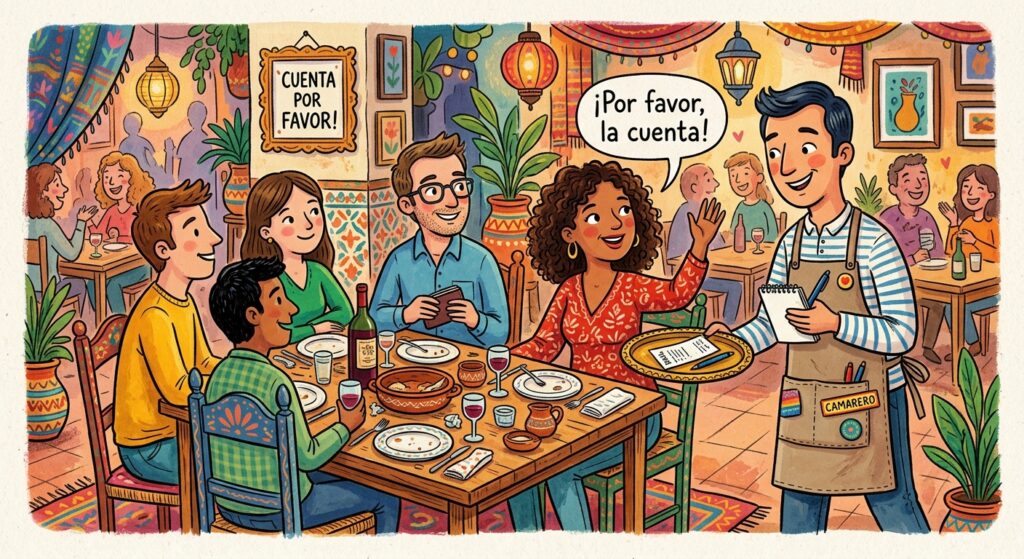
If you are unsure what to say when it is time to pay, you can simply use La cuenta, por favor (The bill, please). It is short, clear and polite. There is no need to form a complete sentence, as the context makes your request perfectly clear.
For example:
—¿Todo bien? (Is everything alright?)
—Sí, gracias. La cuenta, por favor. (Yes, thank you. The bill, please.)
You can also make your request a little more explicit by saying ¿Me trae la cuenta, por favor? (Could you bring me the bill, please?) or ¿Nos trae la cuenta, por favor? (Could you bring us the bill, please?).
Your tone of voice matters, too. Saying La cuenta (The bill) on its own may sound a little abrupt if your tone is too direct. Adding por favor (please) and speaking in a friendly manner will help you sound polite and natural.
If you are wondering how do you ask for the bill in spanish, this is the key phrase to learn first. For beginners, La cuenta, por favor (The bill, please) is probably the most useful expression to remember when eating out in Spain.
5 common ways to ask for the bill in Spanish
When dining out in Spain, you have several options for asking for the bill. Some are more direct, while others sound a little more polite. Learning a few alternatives will help you communicate naturally in different restaurant situations.
1. «¿Me trae la cuenta?» (Could you bring me the bill?)
Imagine you have finished your meal and are ready to leave. You can get the waiter’s attention and say:
¿Me trae la cuenta, por favor? (Could you bring me the bill, please?)
This is a natural, widely used expression in Spanish restaurants. The verb traer (to bring) is particularly useful here because you are asking the waiter to bring something to your table.
If you are eating with other people, simply change me (me) to nos (us):
- ¿Me trae la cuenta, por favor? (Could you bring me the bill, please?)
- ¿Nos trae la cuenta, por favor? (Could you bring us the bill, please?)
You may also hear the shorter ¿Me trae la cuenta? (Could you bring me the bill?). Although por favor (please) is not essential, including it makes your request sound more courteous.
If you’re searching for how do you ask for the bill in spanish, start by learning this expression. It is practical, easy to remember and suitable for most restaurant situations in Spain.
2. «¿Me cobra, por favor?» (Could you take my payment, please?)
You do not always need to ask the waiter to bring you the bill. Another natural option is to use the verb cobrar (to charge or take payment).
¿Me cobra, por favor? (Could you take my payment, please?)
You are asking to pay rather than specifically requesting the bill. This expression is particularly useful in Spanish bars and cafés, where you might pay at the counter or settle the bill as you finish your drink or snack.
Another handy question is ¿Cuánto es, por favor? (How much is it, please?). Use this when you are ready to pay and simply want to know the total.
Both expressions are useful to know if you want to feel more confident ordering and paying in Spain.
3. «¿Nos trae la cuenta?» (Could you bring us the bill?)
Spanish makes it easy to indicate whether you are asking for yourself or for a group. You simply change the pronoun:
- ¿Me trae la cuenta? (Could you bring me the bill?) — when you are asking for yourself.
- ¿Nos trae la cuenta? (Could you bring us the bill?) — when you are asking on behalf of everyone at the table.
For example, if you are eating alone, you might say:
—¿Me trae la cuenta, por favor? (Could you bring me the bill, please?)
But if you are having dinner with three friends, you would normally say:
—¿Nos trae la cuenta, por favor? (Could you bring us the bill, please?)
For a more formal and courteous request, you can use ¿Podría traernos la cuenta, por favor? (Could you bring us the bill, please?).
The conditional form podría (could) softens the request and makes it sound more polite. Learning these small differences will help you understand how do you ask for the bill in spanish in a way that suits the situation.
4. «¿Podría traerme la cuenta?» (Could you bring me the bill?)
When you want to sound particularly courteous, especially in a more formal setting, you can phrase your request like this:
¿Podría traerme la cuenta, por favor? (Could you bring me the bill, please?)
The key word here is podría (could), the conditional form of poder (to be able to). It makes the request less direct and gives it a more formal, polite tone.
Compare these two options:
- ¿Me trae la cuenta? (Could you bring me the bill?) — a natural, polite choice for everyday situations.
- ¿Podría traerme la cuenta, por favor? (Could you bring me the bill, please?) — slightly more formal and deferential.
If you are dining with other people, you can use the plural form:
¿Podría traernos la cuenta, por favor? (Could you bring us the bill, please?)
This wording is useful in a more formal restaurant or whenever you want to be especially courteous. However, there is no need to use the conditional every time. In most everyday situations in Spain, La cuenta, por favor (The bill, please) or ¿Me trae la cuenta? (Could you bring me the bill?) will sound perfectly natural.
If you are learning how do you ask for the bill in spanish, it is worth knowing both the everyday expressions and these more formal alternatives.
5. How Do You Ask for the Bill in Spanish: Using a gesture to ask for the bill
In some Spanish-speaking places, you can also use a simple hand gesture to let the waiter know you are ready to pay. The usual movement is to mime writing or signing your name in the air.
For example, if the restaurant is busy and the waiter is some distance away, you could make this gesture to get their attention and then say La cuenta, por favor (The bill, please).
Although the gesture can be a useful way to signal that you would like to pay, it is best not to rely on it alone. Whenever possible, combine it with a spoken request to make your intention clear.
This gesture is also recognised in Spain and in other Spanish-speaking countries, although customs can vary from one place to another. If you are learning how do you ask for the bill in spanish, knowing both the words and this non-verbal signal can be helpful when eating out.
Asking for the bill in Spanish: regional differences
Spanish speakers across the world will generally understand La cuenta, por favor (The bill, please). However, the wording people use in everyday conversations is not always the same. Certain expressions are more common in particular places, and the level of formality can also influence how someone makes the request.
There is no single expression that everyone in a country uses. Local habits, the type of venue and the situation all play a part.
What to say when asking for the bill in Spain
In Spain, you can choose from several natural expressions depending on where you are and how formal you want to sound. If you are learning how do you ask for the bill in spanish, getting familiar with the phrases people use in Spanish bars and restaurants will help you feel more at ease when it is time to pay.
In Spain, there are several natural ways to ask for the bill, depending on the setting and how formal you want to be:
- La cuenta, por favor. (The bill, please.)
- ¿Me trae la cuenta, por favor? (Could you bring me the bill, please?)
- ¿Nos trae la cuenta, por favor? (Could you bring us the bill, please?)
- ¿Me cobra, por favor? (Could you take my payment, please?)
In a more relaxed setting, particularly in local bars, you might also hear ¿Me pones la cuenta? (Can you get me the bill?).
The verb poner (to serve or get someone something) is commonly used when ordering in Spain. For instance, you might say ¿Me pones un café? (Can I have a coffee?) or ¿Nos pones dos cervezas? (Can we have two beers?).
This informal use extends to asking for the bill, too. However, if you are unsure how do you ask for the bill in spanish, La cuenta, por favor (The bill, please) and ¿Me trae la cuenta? (Could you bring me the bill?) are reliable choices that work in a wide range of situations.
Asking for the bill in Mexico
If you are eating out in Mexico, you can use familiar expressions such as:
- La cuenta, por favor. (The bill, please.)
- ¿Me trae la cuenta, por favor? (Could you bring me the bill, please?)
You may also come across the word nota (receipt or bill) in certain Mexican contexts, particularly when referring to a document showing a purchase or payment. However, expressions using nota are not universal, so it is best not to assume that ¿Me da mi nota? (Could you give me my bill?) is the standard way to ask for the bill in every Mexican restaurant.
Another expression you might hear is ¿Me regala la cuenta, por favor? (Could you bring me the bill, please?). In Mexico, as in some other parts of Latin America, regalar (literally, to give as a gift) can be used in polite requests without suggesting that anything is free.
If you are visiting Mexico and are unsure how do you ask for the bill in spanish, La cuenta, por favor (The bill, please) remains a simple, reliable option that is widely understood.
Asking for the bill in Colombia
If you visit a restaurant in Colombia, you may hear people say ¿Me regala la cuenta, por favor? (Could I have the bill, please?). This is a common, polite way to ask for the bill.
The verb regalar normally means “to give as a gift”, but in this expression, it is simply part of a courteous request. Nobody is expecting the restaurant to waive the bill! You can think of it as a more polite way of saying ¿Me da la cuenta? (Could I have the bill?) or ¿Me trae la cuenta? (Could you bring me the bill?).
When dining with others, the same expression works with nos: ¿Nos regala la cuenta, por favor? (Could we have the bill, please?).
Although this use of regalar is particularly associated with Colombian Spanish, you may come across it elsewhere in Latin America, too. If you’re learning how do you ask for the bill in Spanish, recognising this regional expression will help you understand local speakers and feel more comfortable when eating out.
Spanish restaurant customs: when is it time to pay?
Knowing the right words to use is only part of dining out in another country. Understanding how things work in local restaurants can help you avoid awkward moments, too.
Should you wait for the waiter to bring the bill?
In some Spanish-speaking countries, finishing your meal doesn’t necessarily mean the bill will arrive at your table straight away. Unlike in places where staff bring it as soon as you’ve finished eating, you may need to ask for it yourself.
Imagine you’ve had dessert and a coffee. The waiter comes over and asks:
—¿Algo más? (Would you like anything else?)
You reply that you don’t need anything else, but the waiter doesn’t bring the bill. There’s no need to worry: they may simply be giving you time to enjoy the conversation. In many restaurants, particularly when people are dining socially, it’s perfectly acceptable to stay at the table after the meal rather than rushing off.
There isn’t one rule for every Spanish-speaking country, and practices can differ between restaurants, too. In Spain, for example, diners commonly signal when they’re ready to pay instead of expecting the bill to arrive automatically.
When it’s time to leave, a simple La cuenta, por favor (The bill, please) is usually all you need.
Tips and extra charges on your restaurant bill
Before paying at a restaurant, it’s worth knowing whether the amount shown on the bill covers everything or whether additional charges may apply.
In Spanish, propina (tip) refers to extra money given to staff to thank them for their service. Tipping practices vary widely across Spanish-speaking countries, so don’t assume that the same rules apply everywhere. If you’re travelling, a little research into local expectations can help you avoid confusion.
You may also see the word cubierto, which can have different meanings depending on where you are. In some restaurants, it refers to a charge for table service or items provided as part of the dining experience. Whether this fee exists, and what it covers, depends on the establishment and local customs.
If anything on the bill is unclear, you can ask the waiter directly:
- ¿El servicio está incluido? (Is service included?)
- ¿La propina está incluida? (Is the tip included?)
- ¿El cubierto está incluido? (Is there a cover charge?)
These simple questions can help you understand the charges before you pay and make asking for the bill in Spanish a more straightforward experience.
«La cuenta» and «la factura»: what’s the difference?
If you’ve finished your meal and want to pay, the word to remember is la cuenta (the bill). It’s the usual term for the amount you owe at a restaurant.
For example, you could say:
- La cuenta, por favor. (The bill, please.)
- ¿Me trae la cuenta? (Could you bring me the bill?)
- ¿Nos trae la cuenta, por favor? (Could you bring us the bill, please?)
Paying at a restaurant in Spanish: essential phrases to remember
Finished your meal and ready to go? You don’t need complicated Spanish to settle the bill. A few practical expressions will help you communicate politely and confidently with restaurant staff.
The phrase La cuenta, por favor (The bill, please) is a reliable choice in a wide range of situations. If you’d rather make a full request, try ¿Me trae la cuenta, por favor? (Could you bring me the bill, please?).
Eating out with friends or family? Use ¿Nos trae la cuenta, por favor? (Could you bring us the bill, please?) to ask for everyone’s bill.
Once you’re ready to pay, these expressions can come in handy, too:
- ¿Aceptan tarjeta? (Do you accept cards?)
- ¿Puedo pagar con tarjeta? (Can I pay by card?)
- ¿Puedo pagar en efectivo? (Can I pay in cash?)
- ¿Podemos pagar por separado? (Can we pay separately?)
- ¿Cuánto es? (How much is it?)
Whether you’re travelling in Spain or another Spanish-speaking country, learning how to ask for the bill in Spanish is a small step that can make eating out feel much easier. Practise these phrases before your next meal, and you’ll be better prepared to order, pay and enjoy the experience without worrying about what to say.
La factura (the invoice), however, serves a different purpose. Rather than simply showing what you need to pay, it is a formal document recording a commercial transaction. You might need one when claiming business expenses or keeping your company’s accounts.
For instance:
¿Me puede hacer una factura a nombre de la empresa? (Could you issue an invoice in the company’s name?)
The distinction is straightforward: use cuenta when you’re ready to settle your restaurant bill, and factura when you require a formal invoice.
Remember that the exact requirements for invoices can vary from one country to another. If you need one for professional or accounting purposes, explain your needs to the restaurant to make sure you receive the appropriate document.
Want to build your confidence in everyday conversations and sound more natural in Spanish? Explore our online Spanish courses for adults, from A1 to C2, and take the next step towards speaking Spanish with greater ease.
Frequently asked questions about how to ask for the bill in Spanish
How do you say “Can I have the bill, please?” in Spanish?
A simple and polite way to ask is:
La cuenta, por favor. (The bill, please.)
If you’d prefer to make a complete request, you could say:
¿Me trae la cuenta, por favor? (Could you bring me the bill, please?)
For a slightly more formal option, try:
¿Podría traerme la cuenta, por favor? (Could you bring me the bill, please?)
All three expressions are useful when you’re dining out and ready to pay.
How do you ask to split the bill in Spanish?
If you’d like everyone to pay their own share, you can ask:
¿Podemos pagar por separado? (Can we pay separately?)
Another natural option is:
¿Podemos dividir la cuenta? (Can we split the bill?)
Here’s how a short exchange might sound:
—¿Podemos pagar por separado, por favor? (Can we pay separately, please?)
—Sí, claro. (Yes, of course.)
How do you ask whether a restaurant accepts cards?
If you want to check whether you can pay by card, use either of these questions:
¿Aceptan tarjeta? (Do you accept cards?)
¿Puedo pagar con tarjeta? (Can I pay by card?)
The first asks about the restaurant’s payment options, while the second focuses on whether you can use a card for your own payment.
Should you use «tú» or «usted» when speaking to a waiter?
The choice depends on the country, the setting and how formal the interaction is.
In Spain, tú is widely used in everyday situations, although usted remains an option when a more formal tone is appropriate. In some other Spanish-speaking countries, using usted is more common, even in routine interactions.
If you’re unsure which form to choose, listen to how the waiter addresses you and follow the tone of the conversation.
Fortunately, you can avoid this dilemma altogether with a phrase such as La cuenta, por favor (The bill, please). It’s polite and straightforward, and you don’t need to choose between tú and usted.
What is the easiest way to remember how to ask for the bill in Spanish?
Start with La cuenta, por favor. It’s a practical expression that will serve you well in many restaurants. As your Spanish improves, you can add alternatives such as ¿Me trae la cuenta? (Could you bring me the bill?) and learn to recognise the different expressions used across Spanish-speaking countries.
With a little practice, you’ll feel more comfortable handling the payment whenever you eat out in Spanish.
Aprende español con nuestros cursos y clases
- CEFR online Spanish courses
Spanish Online Course for Beginners – Level A1.1
110,00€ Select options This product has multiple variants. The options may be chosen on the product page - CEFR online Spanish courses
Spanish Course Level A1.2
110,00€ Select options This product has multiple variants. The options may be chosen on the product page - CEFR online Spanish courses
Online Spanish Course Basic Level – A2.1
110,00€ Select options This product has multiple variants. The options may be chosen on the product page