

Introduction
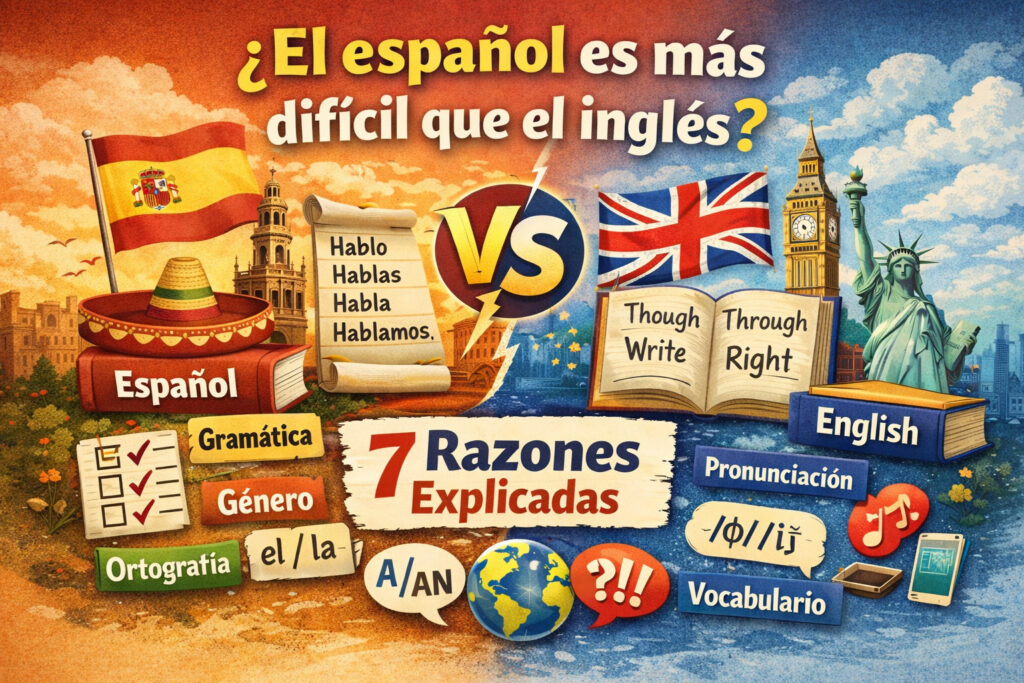
In this post called “Is Spanish More Difficult Than English? 7 Real Reasons Explained” The principal question is: Is Spanish more difficult than English? It’s one of the most common questions among language learners, especially those deciding which language to study first.
The truth is that language difficulty is not absolute. What feels hard for one person may be relatively easy for another. Factors such as your native language, learning environment, exposure, and even motivation all influence how challenging a language seems.
English and Spanish are two of the most widely spoken languages in the world. English dominates global communication in business, technology, and science, while Spanish is one of the most spoken native languages and has a strong cultural presence across multiple continents.
To answer the question “Is Spanish more difficult than English?”, we need to go beyond simple opinions and analyze real linguistic differences. In this article, we’ll explore seven key reasons that explain the perceived difficulty of both languages.
1. Pronunciation: Spanish is easier to read aloud
When analyzing Is Spanish more difficult than English?, pronunciation is often one of the clearest differences.
Spanish pronunciation is highly consistent. Most words are pronounced exactly as they are written, which makes it easier for learners to read aloud without hesitation. Once you learn the basic sound rules, you can correctly pronounce most words, even if you’ve never seen them before.
For example, words like “familia,” “amigo,” and “necesario” follow predictable pronunciation patterns.
English, on the other hand, is known for its irregular pronunciation. Words that look similar can sound completely different, such as “though,” “through,” “thought,” and “tough.”
Because of these inconsistencies, many learners find English pronunciation more difficult to master. In this area, Spanish is generally considered more learner-friendly.
2. Grammar: Spanish requires more memorization
Another key point when asking Is Spanish more difficult than English? is grammar.
Spanish grammar is more complex, especially when it comes to verb conjugations. Verbs change depending on the subject, tense, and mood, meaning learners must memorize multiple forms for each verb.
For example, the verb “hablar” changes in the present tense:
yo hablo, tú hablas, él habla, nosotros hablamos, ellos hablan.
In addition, Spanish includes a wide range of tenses and moods, such as the subjunctive, which can be particularly challenging for learners.
English grammar is simpler in comparison. Verbs usually remain the same across subjects, with only minor changes. For example:
I speak, you speak, we speak, they speak, and “he speaks.”
Because of this simplicity, many learners find English easier at the beginning stages.
3. Grammatical gender: an extra layer in Spanish
A major reason why people ask this question is the concept of grammatical gender.
In Spanish, nouns are either masculine or feminine, and this affects articles and adjectives. For example:
“el libro” (masculine) and “la mesa” (feminine).
Adjectives must also agree with the noun:
“el coche rojo” vs. “la casa roja.”
For learners whose native language does not include gender, this system can be confusing and requires additional memorization.
English avoids this complexity. Nouns generally do not have gender, and adjectives remain unchanged regardless of the noun.
This makes English sentence structure simpler in this regard.
4. Spelling: Spanish is more logical
Spelling is another important factor in this discussion.
Spanish spelling is relatively straightforward. Words are usually written as they sound, making it easier for learners to develop writing skills quickly.
While there are some exceptions and rules to learn, the overall system is consistent.
English spelling is much more irregular. Many words include silent letters, and spelling often does not match pronunciation. Examples like “knife,” “island,” and “honest” illustrate this inconsistency.
Additionally, English contains many homophones such as “their,” “there,” and “they’re,” which can cause confusion.
For this reason, many learners find English spelling more challenging than Spanish spelling.
5. Vocabulary: English is more familiar globally
When considering Is Spanish more difficult than English?, vocabulary also plays an important role.
English has a strong global presence, especially in fields like technology, business, and science. As a result, many English words are already familiar to people around the world.
Words like “internet,” “email,” “software,” and “marketing” are widely recognized, even by non-native speakers.
This familiarity can make English easier to learn at the beginning.
Spanish is also widely spoken, but its vocabulary is less dominant in global industries. This can make it feel less immediately accessible for some learners.
6. Speaking speed: Spanish may seem faster
Another factor in the debate about Is Spanish more difficult than English? is speaking speed.
Spanish is often spoken more quickly in terms of syllables per second. This can make it sound overwhelming for beginners who are not used to the rhythm.
For example, Spanish sentences often contain more syllables than their English equivalents, which can create the impression of faster speech.
However, this does not necessarily make Spanish more difficult. With practice and exposure, learners usually adapt quickly.
In fact, Spanish pronunciation tends to be clearer, which helps with listening comprehension over time.
7. Exposure: English is more present worldwide
Exposure is a crucial element when answering Is Spanish more difficult than English?
English is everywhere—movies, TV series, music, video games, and online content are largely produced in English. This constant exposure allows learners to become familiar with the language naturally.
Even without formal study, many people already understand basic English words and expressions.
Spanish also has a strong presence, especially in Spanish-speaking regions and in global music. However, English still dominates in terms of worldwide exposure.
This increased exposure often makes English easier to learn for many people.
Is Spanish More Difficult Than English? 7 Real Reasons Explained: Conclusion
So, the answer depends on perspective and learning context.
Spanish may be more challenging due to its complex verb system, grammatical gender, and agreement rules. These features require more memorization and practice.
English, however, presents its own difficulties, particularly in pronunciation and spelling, where many irregularities exist.
Ultimately, neither language is inherently more difficult than the other. The perceived difficulty depends on your native language, your learning experience, and how much exposure you have.
What truly matters is that learning either language is a valuable investment. Both Spanish and English open doors to global communication, cultural understanding, and new opportunities in an interconnected world.