

In this post, we’ll explore some of the most common mistakes when speaking Spanish and how to avoid them. You’ll find concise yet valuable tips to help you correct these slip-ups and communicate more clearly and accurately in Spanish.
Spanish is a rich, intricate, and beautiful language spoken by millions worldwide. Nevertheless, both native speakers and learners often fall into common pitfalls that can impact the clarity, correctness, or style of their speech. These errors might stem from the influence of other languages, habitual mistakes, gaps in grammar knowledge, or simply confusion around certain words or grammatical structures.
1. Mixing up “tú” and “tu”
A very common error in both spoken and written Spanish is confusing “tú”, which is a personal pronoun, with “tu”, a possessive adjective.
- Incorrecto: Tu eres muy inteligente.
- Correcto: Tú eres muy inteligente.
- Incorrecto: ¿Dónde está tú coche?
- Correcto: ¿Dónde está tu coche?
How to avoid it: “Tú” carries a written accent because it stands in for a person’s name—if you can swap it with “él” or “ella”, then it needs the accent. “Tu” without an accent is used to show ownership, as in tu casa, tu libro, or tu perro.
2. Misusing “porque”, “por qué”, “porqué” and “por que”
Although they’re pronounced the same, these four expressions have distinct meanings and uses:
- Por qué is used to form questions.
Example: ¿Por qué llegaste tarde? - Porque is used to give reasons or explanations.
Example: Llegué tarde porque hubo tráfico. - Porqué functions as a noun, meaning “reason” or “cause”.
Example: No entiendo el porqué de tu enojo. - Por que is rarely used and appears when “por” (a preposition) and “que” (a conjunction) happen to follow one another.
Example: Lucho por que se respeten los derechos humanos.
How to avoid it: Think about what you’re trying to say. If you’re asking a question, it’s “por qué”. If you’re explaining something, it’s “porque”. If you could replace it with “the reason,” then it’s “porqué”. And if the sentence naturally calls for “por” followed by “que”, then you’ve found a case for “por que”.
3. Using “haiga” instead of “haya”
In some areas, people commonly make the mistake of saying “haiga” as a subjunctive form of the verb haber, which is incorrect.
- Incorrect: Espero que haiga comida.
- Correct: Espero que haya comida.
How to avoid this: Familiarise yourself with the correct conjugations of haber, particularly in the subjunctive mood. The only correct form to use is “haya”.
4. Dequeísmo
Dequeísmo refers to the incorrect addition of the preposition “de” before “que”, where it is not needed.
- Incorrect: Me dijo de que no vendría.
- Correct: Me dijo que no vendría.
How to avoid this: Consider whether the verb actually requires the preposition “de”. For example:
- Estoy seguro de que vendrá (correct, as estar seguro de demands it).
- Me alegro de que estés aquí (also correct).
- But avoid expressions like creo de que or pienso de que, which are incorrect.
5. Queísmo
Queísmo is the opposite of dequeísmo and occurs when the preposition “de” is left out where it should be included.
- Incorrect: Estoy seguro que vendrá.
- Correct: Estoy seguro de que vendrá.
How to avoid this: Determine whether the verb or phrase requires the preposition “de”. If “estar seguro” calls for “de”, make sure to include it.
6. The phenomena of “leísmo”, “laísmo” and “loísmo”
The most common mistakes when speaking Spanish and how to avoid them is the phenomena of “leísmo”, “laísmo” and “loísmo”.
These affect the use of direct and indirect object pronouns:
- Leísmo: Using “le” as a masculine direct object pronoun.
Incorrect example: Vi a Juan y le saludé.
Correct form: Vi a Juan y lo saludé. - Laísmo: Using “la” as a feminine indirect object pronoun.
Incorrect example: A mi madre la di un regalo.
Correct form: A mi madre le di un regalo. - Loísmo: Using “lo” as a masculine indirect object pronoun.
Incorrect example: A mi padre lo dije la verdad.
Correct form: A mi padre le dije la verdad.
How to avoid this: Understand the difference between direct and indirect objects. Keep in mind:
- A direct object answers the questions “what?” or “whom?”
- An indirect object answers “to whom?” or “for whom?” but with a different purpose, such as receiving something.
7. Incorrect Plural Forms of Compound Words
It’s common for people to be unsure how to pluralise compound nouns such as lavaplatos (dishwasher), paraguas (umbrella), or cumpleaños (birthday).
- Wrong: Los lavaplatoses, los paraguases, los cumpleañoses.
- Correct: Los lavaplatos, los paraguas, los cumpleaños.
Tip: Many compound nouns or words ending in “s” that look plural already remain unchanged in the plural form. The plural is indicated by the article (los, las), not by altering the noun itself.
Here you have more examples of compound words in Spanish.

8. Misuse of Verb Tenses
Spanish learners often confuse certain verb tenses, particularly the pretérito perfecto and pretérito indefinido.
- Incorrect (in Spain): Hoy comí con mis amigos.
- Correct: Hoy he comido con mis amigos.
In Spain, the pretérito perfecto (he comido) is generally used for actions that have happened today or in the recent past. In Latin America, it’s more common to use the pretérito indefinido (comí) in both situations, though the perfect tense may be preferred in more formal settings.
Tip: Tailor your choice of tense to the region and context. Knowing these distinctions will help you express yourself more accurately and appropriately.
9. Redundant Phrases That Add No Meaning
It’s quite common for people to use expressions that repeat the same idea unnecessarily, such as:
- Subir arriba (to go up upstairs)
- Bajar abajo (to go down downstairs)
- Entrar adentro (to go inside inside)
- Salir afuera (to go outside outside)
How to avoid it: These verbs already indicate movement or direction, so the additional word is superfluous. Just saying subir, bajar, entrar, or salir is enough to convey the meaning clearly.
10. Misuse of English Loanwords
Spanish has borrowed a number of terms from English, but using them without adapting them to Spanish can lead to mistakes or sound out of place.
- Wrong: Hice un “click” en el botón.
- Better: Hice un clic en el botón.
- Wrong: Tengo un “meeting” con el jefe.
- Better: Tengo una reunión con el jefe.
Tip: Whenever there’s a suitable word in Spanish, it’s better to use it. The RAE does recognise some adapted anglicisms, but it’s wise not to overuse them, especially when a clear Spanish equivalent exists.
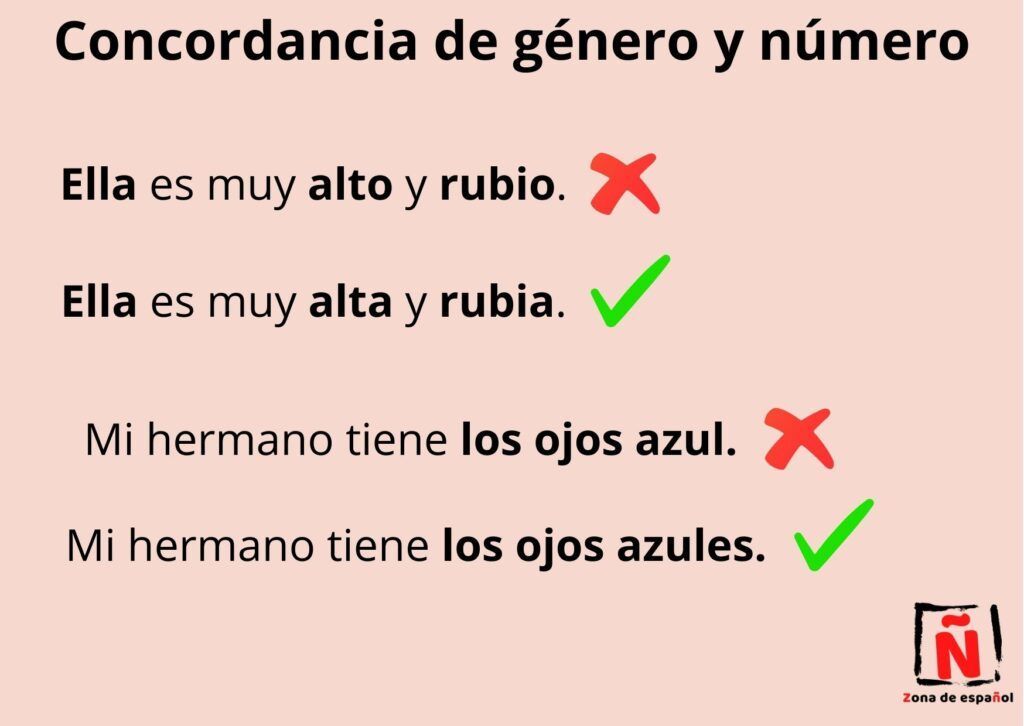
11. Matching Gender and Number
A frequent error in Spanish is forgetting to ensure that nouns, adjectives, and articles agree in gender and number.
- Wrong: La problema es grande.
- Correct: El problema es grande.
- Wrong: Las niño juega en el parque.
- Correct: Los niños juegan en el parque.
Tip: Make sure every part of your sentence is consistent — masculine or feminine, singular or plural. This agreement is essential for correct grammar in Spanish.
12. Misusing Prepositions
Some verbs require specific prepositions, and using the wrong one can result in awkward or incorrect phrasing.
- Wrong: Pensé en que vendrías.
- Correct: Pensé que vendrías.
- Wrong: Consiste en de estudiar mucho.
- Correct: Consiste en estudiar mucho.
Tip: If you’re unsure which preposition to use with a verb, check a reliable dictionary or grammar guide. Prepositions often don’t translate word-for-word between languages, so learning them in context is the tip.
Conclusion
Speaking good Spanish doesn’t mean using flashy or overly complex words — it means expressing yourself clearly, correctly, and appropriately for the context. This post called: “The Most Common Mistakes When Speaking Spanish and How to Avoid Them” is useful for avoid these common mistakes will help improve your fluency, understanding, and credibility, both in speaking and in writing.
The key lies in consistent practice, regular reading, and attentive listening. If you make mistakes, don’t worry — every error is a chance to learn. What matters most is being open to correction and committed to continual improvement. Remember: “La práctica hace al maestro” (Practice makes perfect).