

Are you planning a trip to Spain and wondering how to order food in Spanish in Spain? Knowing a few useful expressions will make eating out much easier and help you feel more confident when visiting bars and restaurants.
From asking for a table and choosing dishes from the menu to ordering tapas, explaining dietary requirements and asking for the bill, this guide will help you navigate a typical Spanish restaurant.
You’ll learn practical expressions that Spanish speakers use every day, so you can communicate more naturally and enjoy your meals without worrying about what to say.
Whether you’re a beginner or already have some knowledge of Spanish, these tips will help you feel more comfortable ordering food during your stay in Spain.
Bars, cafés and restaurants in Spain have their own everyday expressions. You might hear someone say «¿Me pones un café?» or «Para mí, una tortilla de patatas». These are perfectly natural ways to order, even if translating them word for word into English sounds a little unusual.
You don’t need to speak Spanish fluently to enjoy eating out. A handful of useful phrases, some essential vocabulary and a little knowledge of local customs will go a long way.
In this guide, we’ll explore how to order food in Spanish in Spain, from finding a table and choosing what to eat to asking for the bill. You’ll also learn some common expressions, discover a few cultural differences and find out how to explain your dietary needs.
How to Order Food in Spanish in Spain: Being Direct Doesn’t Mean Being Rude
One of the first things that may surprise Spanish learners when eating out is how people usually speak to waiters in bars and restaurants.
In English, it is common to use expressions such as “Could I have a coffee, please?” or “I would like a table for two, please.” These phrases convey politeness through indirect questions or conditional structures.
You can use similar expressions in Spanish:
- Me gustaría tomar una cerveza. (I’d like a beer.)
- Querría una ensalada, por favor. (I’d like a salad, please.)
- ¿Podría traerme la carta? (Could you bring me the menu, please?)
All of these are perfectly correct and polite. However, in everyday situations in Spain, people often use much more direct expressions:
- ¿Me pones una cerveza, por favor? (Can I have a beer, please?)
- Para mí, una ensalada. (I’ll have a salad.)
- ¿Me traes la carta? (Could you bring me the menu?)
Does this mean Spanish people are less polite? Not at all! It simply reflects different conversational habits.
In many Spanish bars and cafés, saying exactly what you want is a perfectly normal way to communicate. You don’t need to put together a long, elaborate sentence to sound respectful.
For example, if the waiter asks «¿Qué vas a tomar?» (What would you like?), you can simply reply:
— Un café con leche, por favor. (A coffee with milk, please.)
There is no need to say something as elaborate as «Me gustaría saber si sería posible que me pusieras un café con leche» (I was wondering whether it might be possible to have a coffee with milk). Although grammatically correct, this would sound rather formal in an everyday situation.
One particularly useful expression is «Para mí…» (I’ll have…), which we’ll look at in more detail later.
It’s also worth remembering that Spanish varies from one country to another. In some parts of Latin America, for instance, you may hear expressions such as «¿Me regala…?» when asking for something. In Spain, however, «¿Me pones…?», «¿Me pone…?» and «Para mí…» are especially common. You can also say «Quisiera…», which is perfectly correct in Spain but may sound a little more formal depending on the situation.
A useful tip: If you’re learning Spanish, don’t be afraid to keep things simple. Adding «por favor» (please) and «gracias» (thank you), together with a friendly tone, is usually all you need to make your request polite.
Understanding these cultural differences and learning to communicate in everyday situations are important first steps when studying Spanish, particularly at beginner level.
If you’re learning how to order food in Spanish in Spain, remember that these direct expressions are perfectly normal in bars and restaurants. You don’t need complicated sentences to sound polite: simply choose the right expression and add «por favor» when appropriate.
How to Order Food in Spanish in Spain: Getting a Table
Before you can order anything, you’ll need to find a table. In Spain, you can often turn up at a restaurant without booking in advance. However, if you’re planning to visit a popular place, especially at weekends, it’s a good idea to reserve a table beforehand.
When you arrive, a member of staff may ask you one of the following questions:
- ¿Cuántos sois? (How many of you are there?)
- ¿Tenéis reserva? (Do you have a booking?)
- ¿Para comer o para tomar algo? (Are you here for a meal or just a drink?)
- ¿Mesa para cuántos? (How many people is the table for?)
Here are some ways you can answer:
- Somos dos. (There are two of us.)
- Somos cuatro personas. (There are four of us.)
- Tenemos una reserva a nombre de María. (We have a booking under the name María.)
- No tenemos reserva. ¿Tenéis alguna mesa libre? (We don’t have a booking. Do you have a table available?)
You can also ask directly if there’s a table available:
¿Tienen mesa para dos personas? (Do you have a table for two?)
You may also want to mention where you’d prefer to sit:
- En la terraza, por favor. (Outside on the terrace, please.)
- Dentro, si es posible. (Inside, if possible.)
- En el comedor. (In the dining area.)
- Cerca de la ventana. (Near the window.)
In Spain, the word «terraza» is widely used to refer to the outdoor seating area of a bar or restaurant. If you’d rather sit indoors, you can simply say «dentro» (inside) or «en el interior» (indoors).
Knowing these basic expressions is an important part of learning how to order food in Spanish in Spain. They’ll help you when you arrive, ask for an available table and let the staff know how many people are in your party.
The Menu and the Set Lunch Menu: What’s the Difference?
This is an important distinction to understand, especially if you’re visiting Spain for the first time.
Although the words menu and à la carte may be used differently in other languages, Spanish restaurants make a clear distinction between la carta and el menú del día.
La carta is the restaurant’s full list of food and drinks, usually with prices. You can choose individual dishes from it and order exactly what you fancy.
For example:
— Perdone, ¿nos puede traer la carta? (Excuse me, could you bring us the menu, please?)
— Claro, ahora mismo. (Of course, right away.)
El menú del día, on the other hand, is a fixed-price meal deal commonly available in many Spanish restaurants, particularly at lunchtime.
It usually offers a choice of starters, main courses and desserts. Depending on the restaurant, bread and a drink may also be included.
A typical menú del día might include:
- Starter: mixed salad, lentils or soup.
- Main course: roast chicken, hake or grilled meat.
- Dessert: fresh fruit, yoghurt or cake.
The price covers the set combination, although certain dishes may come with an additional charge. It’s always worth checking exactly what’s included before ordering.
Not every restaurant offers a menú del día, and there is no general requirement for restaurants to provide one.
If you want to find out whether it’s available, you can ask:
- ¿Tenéis menú del día? (Do you have a set lunch menu?)
- ¿Qué incluye el menú? (What’s included in the set menu?)
- ¿Cuánto cuesta? (How much is it?)
- ¿La bebida está incluida? (Is a drink included?)
One final expression worth learning is «fuera de carta». This refers to special dishes available that day which aren’t listed on the restaurant’s regular menu.
You can ask:
— ¿Tenéis algo fuera de carta? (Do you have any daily specials that aren’t on the menu?)
How to Book a Table by Phone in Spain
If you’re planning to visit a popular restaurant or simply want to make sure you get a table, booking by phone is a good option.
Here are some useful expressions you can use when making a reservation:
- Quería reservar una mesa para dos personas. (I’d like to book a table for two.)
- Quería reservar para esta noche. (I’d like to book a table for this evening.)
- ¿Tenéis disponibilidad para las nueve? (Do you have any tables available at nine?)
- ¿Podría reservar una mesa para cuatro? (Could I book a table for four?)
- La reserva sería a nombre de María. (The booking would be under the name María.)
Here’s an example of a typical phone conversation:
- Customer: Buenas tardes. Quería reservar una mesa para cenar esta noche. (Good afternoon. I’d like to book a table for dinner this evening.)
- Restaurant: Buenas tardes. ¿Para cuántas personas? (Good afternoon. For how many people?)
- Customer: Para cuatro personas. (For four people.)
- Restaurant: ¿A qué hora? (What time?)
- Customer: A las nueve y media, si es posible. (At half past nine, if possible.)
- Restaurant: Sí, tenemos disponibilidad. ¿A nombre de quién? (Yes, we have a table available. Under what name?)
- Customer: A nombre de María. (Under the name María.)
- Restaurant: Perfecto. Entonces, cuatro personas a las nueve y media. (Perfect. So, that’s four people at half past nine.)
- Customer: Muchas gracias. ¡Hasta luego! (Thank you very much. Goodbye!)
Notice the expression «Quería reservar». It’s one of the most common ways to make a polite request in Spanish. Although the verb is in the imperfect tense, you’re not necessarily talking about the past. This tense is often used to make requests sound softer and more courteous.
If you’re learning how to order food in Spanish in Spain, practising these expressions will help you feel more confident when booking a table and speaking to restaurant staff.
These everyday situations are also useful when preparing for the DELE Spanish exams, which assess your ability to communicate, make requests and interact in practical contexts. You can find out more about our online DELE preparation courses.
Essential Expressions for Ordering Food Like a Spaniard
When ordering food or drinks in Spain, you’ll often hear certain verbs and expressions that might seem unusual if you’re translating directly from English. Two particularly common verbs are poner and traer. It’s also useful to know how to use para mí… when telling the waiter what you’d like.
How to Use «Poner» and «Traer» When Ordering Food in Spain
One of the first things you’ll notice in Spanish bars and restaurants is that people often use the verb poner when ordering food and drinks.
For example:
- ¿Me pones una caña, por favor? (Can I have a small draught beer, please?)
- ¿Nos pones dos cafés? (Can we have two coffees?)
- Me pones una botella de agua. (Can I have a bottle of water?)
- Para mí, una cerveza sin alcohol. (I’ll have a non-alcoholic beer.)
In these situations, poner doesn’t mean “to put” in the literal sense. It’s a very common way of asking someone to serve you something.
You can also use different verb forms depending on whom you’re addressing:
- ¿Me pones un café? (Informal, tú.)
- ¿Me pone un café? (Formal, usted.)
- ¿Nos ponéis dos cervezas? (Informal plural, vosotros.)
- ¿Nos ponen dos cervezas? (Formal plural, ustedes.)
Another useful verb is traer, which means “to bring”. It’s generally used when asking the waiter to bring something to your table, particularly something you’ve already ordered or something you need during the meal.
For example:
- ¿Me traes otro tenedor? (Could you bring me another fork?)
- ¿Nos puedes traer un poco más de pan? (Could you bring us a little more bread?)
- ¿Me trae una servilleta, por favor? (Could you bring me a napkin, please?)
- ¿Nos traes la cuenta cuando puedas? (Could you bring us the bill when you have a moment?)
As a general guide, use poner when ordering food or drinks and traer when asking the waiter to bring something to your table. However, this isn’t a strict rule: you’ll hear both verbs used in different situations.
Learning these everyday expressions will help you sound more natural when ordering in Spain. If you’d like to keep developing your communication skills, our online Spanish courses offer opportunities to practise speaking with experienced teachers.
The Handy Expression «Para mí…»
If you’re not sure how to order something in Spanish, para mí… is one of the easiest and most useful expressions to remember.
It means “for me” and is a natural way to tell the waiter what you’d like to have. You can use it to order a starter, a main course, a drink or even a dessert.
For example:
- Para mí, una ensalada. (I’ll have a salad.)
- Para mí, el secreto ibérico. (I’ll have the Iberian pork.)
- Para mí, unas croquetas. (I’ll have some croquettes.)
- Para mí, una hamburguesa sin queso. (I’ll have a burger without cheese.)
You might hear a conversation like this:
—¿Qué vais a tomar? (What would you all like?)
—Para mí, una ensalada y, de segundo, el secreto ibérico. (I’ll have a salad, followed by the Iberian pork.)
—Yo quiero unas croquetas y una hamburguesa sin queso. (I’d like some croquettes and a burger without cheese.)
You can also use yo quiero (I want) or yo voy a tomar (I’m going to have), but para mí… is particularly handy when ordering with other people, as everyone can take turns saying what they’d like.
For example:
—¿Y tú? ¿Qué vas a pedir? (And you? What are you going to order?)
—Para mí, una cerveza sin alcohol y una ración de patatas bravas. (I’ll have a non-alcoholic beer and a portion of patatas bravas.)
It’s a simple expression, but one you’ll hear and use frequently when ordering food in Spain. Learning it will make it much easier to communicate your choices naturally and confidently.
How to Order Tapas and Portions in Spain
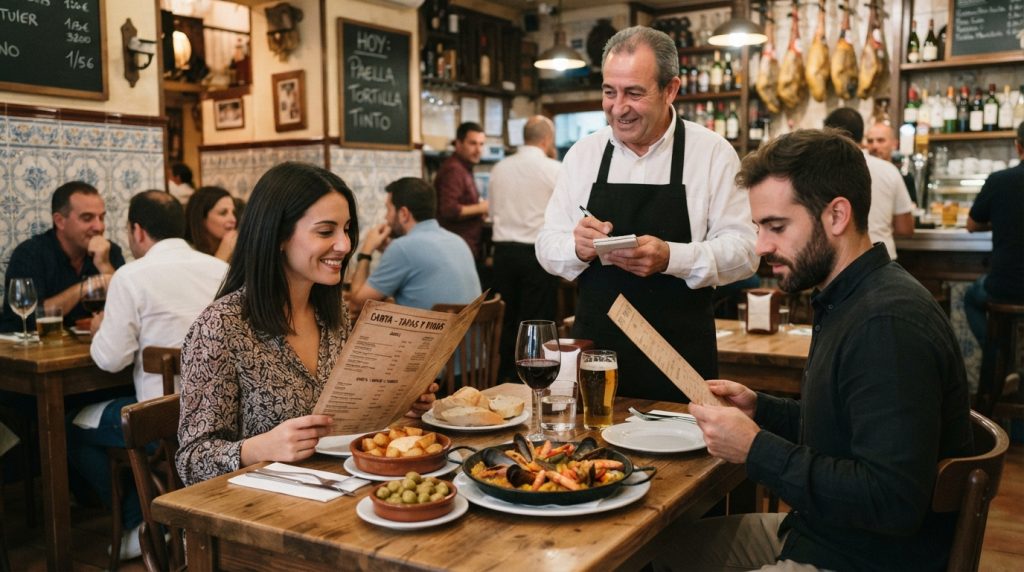
One of the best ways to experience Spanish food culture is to go out for tapas. However, if you’re not familiar with the terms used on menus, it can be difficult to judge how much food you’re actually ordering.
Bars and restaurants often serve dishes in different sizes, so it’s worth learning a few key words before you sit down. Knowing the difference between a tapa, a media ración and a ración will help you order the right amount, particularly if you plan to share several dishes, as many people in Spain do.
A tapa
A tapa is a small serving of food, traditionally brought out with a drink. It might be a little piece of Spanish omelette, some olives, ham, cheese, patatas bravas or a small portion of the bar’s speciality.
There isn’t one fixed rule throughout Spain. In some places, a tapa comes free with your drink; in others, you’ll need to order and pay for it separately. The custom also varies depending on the city, region and individual establishment.
A media ración (half portion)
As the name suggests, a media ración is a serving somewhere between a tapa and a full portion. It’s a useful choice if you’d like to sample a few different dishes without ordering too much food.
For example:
—¿Tenéis media ración de croquetas? (Do you have a half portion of croquettes?)
—Sí, tenemos media ración y ración completa. (Yes, we have half portions and full portions.)
A ración (full portion)
A ración is a larger serving commonly found on bar and restaurant menus. It’s often intended for sharing, although you can also order one for yourself.
Here are a few examples:
- Una ración de calamares. (A portion of squid.)
- Una ración de patatas bravas. (A portion of patatas bravas, potatoes served with a spicy sauce.)
- Una ración de pulpo a la gallega. (A portion of Galician-style octopus.)
Bear in mind that portions aren’t standardised. The amount of food you get can vary considerably from one restaurant or region to another.
Sharing dishes: a very common Spanish custom
Ordering several dishes for everyone to share is particularly popular when going out for tapas or eating with a group. Rather than choosing an individual main course, everyone can try a little of everything.
These expressions will come in handy:
- Es para compartir. (It’s for sharing.)
- Queremos varias raciones para compartir. (We’d like several portions to share.)
- ¿Podemos pedir tres platos para compartir? (Can we order three dishes to share?)
- ¿Nos puedes poner unos platos en el centro? (Could you put some plates in the middle of the table for us?)
Here’s how it might sound when ordering:
—¿Qué vais a tomar? (What would you all like?)
—Vamos a pedir una ración de pulpo, unas croquetas y unas patatas bravas. Es todo para compartir. (We’ll have a portion of octopus, some croquettes and some patatas bravas. It’s all for sharing.)
A useful tip: If you’re unsure how generous a portion is, simply ask:
—¿Esta ración es suficiente para dos personas? (Is this portion enough for two people?)
It’s a simple question that can help you avoid ordering far too much food – or not enough!
Ordering Food in Spanish: Dietary Requirements and Special Requests
If you have a food allergy, an intolerance or particular dietary preferences, it’s important to know how to explain them clearly in Spanish.
In Spain, restaurants and other food establishments must provide information about the allergens in the food they serve. Staff can give you this information verbally, but the restaurant must also have written or electronic records available for customers to check.
If you have an allergy, don’t simply ask whether a dish contains a particular ingredient. Explain your situation clearly and ask about the possibility of cross-contamination as well.
Here are some useful expressions:
Talking about allergies and intolerances
- Soy alérgico al marisco. (I’m allergic to shellfish.)
- Soy alérgica a los frutos secos. (I’m allergic to nuts.)
- Tengo intolerancia a la lactosa. (I’m lactose intolerant.)
- No puedo comer gluten. (I can’t eat gluten.)
- ¿Este plato contiene frutos secos? (Does this dish contain nuts?)
- ¿Lleva harina de trigo? (Does it contain wheat flour?)
- ¿Puede contener trazas de leche? (Could it contain traces of milk?)
- ¿Puede haber contaminación cruzada? (Is there a risk of cross-contamination?)
Remember that the adjective alérgico or alérgica changes depending on the gender of the person speaking.
Explaining your dietary preferences
- Soy vegetariano/a. (I’m vegetarian.)
- Soy vegano/a. (I’m vegan.)
- No como carne. (I don’t eat meat.)
- No como pescado. (I don’t eat fish.)
- Prefiero platos sin productos de origen animal. (I prefer dishes without animal products.)
Asking about ingredients
You can also ask the staff about the ingredients used in a particular dish:
- ¿Lleva carne? (Does it contain meat?)
- ¿Tiene algún ingrediente de origen animal? (Does it contain any animal-derived ingredients?)
- ¿Qué ingredientes lleva este plato? (What ingredients are in this dish?)
- ¿Podéis prepararlo sin queso? (Could you prepare it without cheese?)
- ¿Hay alguna opción vegetariana? (Are there any vegetarian options?)
What if you don’t like spicy food?
The word picante is useful when eating out in Spain, particularly if you visit a Mexican restaurant.
Although many traditional Spanish dishes aren’t especially spicy, some restaurants serve food made with chilli peppers, hot sauces or ingredients from other cuisines.
You can ask:
- ¿Es picante? (Is it spicy?)
- ¿Pica mucho? (Is it very spicy?)
- ¿La salsa es picante? (Is the sauce spicy?)
- ¿Podéis prepararlo sin picante? (Could you prepare it without anything spicy?)
For example:
—Quería pedir las patatas bravas. ¿Pican mucho? (I’d like to order the patatas bravas. Are they very spicy?)
—La salsa tiene un poquito de picante. (The sauce is slightly spicy.)
—Perfecto, gracias. (Perfect, thank you.)
An important point: If you have a food allergy, always tell the staff before ordering. Never assume a dish is safe simply because it doesn’t appear to contain the ingredient you’re allergic to. Ask them to check the ingredients and any risk of cross-contamination. If your allergy is severe, make sure you ask explicitly whether they can guarantee that the dish is safe for you.
How to Ask for the Bill When Ordering Food in Spain
You’ve finished your meal, and now it’s time to pay. This is another situation where knowing a few everyday expressions will make things much easier.
In many Spanish restaurants, the staff won’t automatically bring you the bill when you’ve finished eating. They’ll often wait for you to ask for it, as customers may want to stay at the table chatting, having a coffee or simply enjoying the sobremesa (the time spent talking together after a meal).
So don’t assume they’ve forgotten about you if you’ve been waiting for a few minutes. You can simply catch a member of staff’s attention politely.
Once you’ve finished eating, knowing how to ask for the bill, check which payment methods are accepted and split the cost between several people is also part of learning how to order food in Spanish in Spain.
Here are some expressions you’ll hear and use regularly:
- La cuenta, por favor. (The bill, please.)
- ¿Nos puedes traer la cuenta? (Could you bring us the bill?)
- ¿Me traes la cuenta cuando puedas? (Could you bring me the bill when you have a moment?)
- ¿Nos puedes cobrar cuando puedas? (Could we pay when you have a moment?)
The last expression, ¿Nos puedes cobrar cuando puedas?, is informal and is commonly used in certain bars and restaurants.
You can also say Perdone or Disculpe (Excuse me) to get the waiter’s attention before asking for the bill.
Paying: payment methods and useful expressions
In Spain, you can generally pay either by cash or card, but it’s always worth checking which methods a particular establishment accepts.
These questions will come in handy:
- ¿Se puede pagar con tarjeta? (Can I pay by card?)
- ¿Aceptáis tarjetas? (Do you accept cards?)
- ¿Puedo pagar en efectivo? (Can I pay in cash?)
- ¿Podemos pagar por separado? (Can we pay separately?)
- ¿Podemos pagar cada uno lo suyo? (Can we each pay for what we’ve had?)
You might hear these responses:
- Con tarjeta, por favor. (By card, please.)
- En efectivo. (In cash.)
- Pagamos a medias. (We’ll split the bill equally.)
- Cada uno paga lo suyo. (We’ll each pay for our own.)
Here’s a short example of how the conversation might go:
—Perdone, ¿nos trae la cuenta cuando pueda? (Excuse me, could you bring us the bill when you have a moment?)
—Claro, ahora mismo. (Of course, right away.)
—¿Se puede pagar con tarjeta? (Can we pay by card?)
—Sí, por supuesto. (Yes, of course.)
—Perfecto. Muchas gracias. (Perfect. Thank you very much.)
One final cultural point: should you leave a tip?
In Spain, tipping isn’t compulsory. Some people leave a little extra when they’re happy with the service, but there is no fixed percentage that you’re expected to add to the bill.
Socialising at a Restaurant: From Sobremesa to Compliments
Eating out in Spain is about more than just the food. It’s also an opportunity to spend time with friends and family, enjoy a relaxed conversation and appreciate the atmosphere.
In Spain, a meal doesn’t always end when the last dish is cleared. Quite often, people stay at the table for a while afterwards, chatting and enjoying each other’s company.
This is where a particularly Spanish word comes in: sobremesa.
It refers to the time spent sitting around the table after a meal, usually talking with friends or family. It might last just a few minutes or stretch on for much longer, especially during weekend lunches and celebrations.
For Spanish learners, it’s a great opportunity to practise spontaneous conversation in a relaxed setting. Understanding the tradition of sobremesa will also give you a better insight into how people in Spain enjoy sharing a meal.
Here are some questions and conversation starters you might find useful:
- ¿Qué tal te ha parecido la comida? (What did you think of the food?)
- ¿Habías probado este plato antes? (Had you tried this dish before?)
- ¿Cuál es tu comida española favorita? (What’s your favourite Spanish food?)
- ¿Conoces algún otro restaurante por aquí? (Do you know any other restaurants around here?)
- ¿Qué planes tienes para esta tarde? (What are your plans for this afternoon?)
You can also use a few expressions to let the restaurant staff know how much you’ve enjoyed your meal.
Complimenting the restaurant or its staff
- ¡Estaba todo buenísimo! (Everything was delicious!)
- ¡Qué rico estaba! (That was really tasty!)
- Me ha encantado el postre. (I absolutely loved the dessert.)
- El pescado estaba delicioso. (The fish was delicious.)
- ¡Felicidades al cocinero! (Compliments to the chef!)
- Hemos comido muy bien. (We’ve had a lovely meal.)
For example:
—¿Qué tal estaba el pulpo? (How was the octopus?)
—¡Buenísimo! Hacía mucho tiempo que no comía uno tan rico. (Delicious! I hadn’t had one that good in a long time.)
—Me alegro de que os haya gustado. (I’m glad you enjoyed it.)
If you’d like to stay a little longer and have something else after your meal, you can ask:
- ¿Nos traes un café? (Could you bring us a coffee?)
- ¿Me pones un cortado? (Can I have a cortado, an espresso with a dash of milk?)
- ¿Tenéis infusiones? (Do you have herbal teas?)
- ¿Nos quedamos un rato más? (Shall we stay a little longer?)
And if you’re with friends, you could simply suggest:
—¿Tomamos un café antes de irnos? (Shall we have a coffee before we leave?)
Sobremesa is a wonderful opportunity to pick up everyday expressions, hear different Spanish accents and become more confident speaking the language. If you’re already an advanced learner, a Spanish course at C level can help you develop these skills and take part in more detailed, natural conversations.
How to Order Food in Spanish in Spain: Conclusion
Ordering food in Spanish in Spain becomes much easier once you know a few everyday expressions and understand the customs you may encounter in bars and restaurants.
You don’t need perfect Spanish to enjoy eating out. A simple greeting, a polite request and a few useful questions will help you communicate with the staff and feel more comfortable throughout the meal.
Remember these key points:
- Use ¿Me pones…? or ¿Me traes…? when ordering food and drinks or asking for something at the table.
- Learn the difference between tapa, media ración and ración so you can choose the right amount of food.
- Explain any allergies or dietary requirements clearly before ordering.
- Ask for the bill when you’re ready to pay; in Spain, it won’t necessarily arrive automatically.
- Take your time and enjoy the sobremesa: sharing a meal is also about spending time together.
The best way to become more confident is to put these expressions into practice. Don’t worry about making mistakes: every conversation is an opportunity to learn something new.
Want to keep improving your Spanish?
At Zona de Español, we offer live online Spanish courses for adults and children, from beginner to advanced level (A1–C2).
Our lessons are taught by qualified, experienced teachers and focus on communication, interaction and practical language use. You’ll have plenty of opportunities to practise speaking Spanish in a friendly, supportive environment.
Explore our online Spanish courses for adults, discover our Spanish courses for children or prepare for an official exam with our DELE preparation courses.
Whichever your goals, we’re here to help you make progress and enjoy learning Spanish.
Aprende español con nuestros cursos y clases
- Cursos de español online MCER
Curso de Español Online para Principiantes – Nivel A1.1
110,00€ Select options This product has multiple variants. The options may be chosen on the product page - Cursos de español online MCER
Curso de Español Nivel A1.2
110,00€ Select options This product has multiple variants. The options may be chosen on the product page - Cursos de español online MCER
Curso básico de español online – Nivel A2.1
110,00€ Select options This product has multiple variants. The options may be chosen on the product page




About the author
María J. Balado Nodar
CEO of Zona de Español. Primary Education teacher and specialist in Spanish for foreigners. She has taught Spanish to adults, teenagers, children and company workers, and she is a DELE examiner of all levels accredited by the Cervantes Institute.