

How Do You Write the Date in Spanish is a useful question to ask when learning the language, as dates are part of everyday communication. Whether you need to complete a form, send an email, organise an appointment or discuss future plans, knowing how to write dates correctly will help you communicate more naturally. The rules are relatively simple, although some differences between Spanish and English are important to remember.
In Spanish, dates usually follow the order day, month and year, moving from the smallest unit to the largest. This format is familiar to British English speakers, but learners accustomed to American English may find it less intuitive, as the month typically comes before the day in American date notation. Understanding this distinction will help you avoid confusion when reading and writing dates in Spanish.
Throughout this guide, you will discover how to express dates using both words and numbers, which prepositions to use in different contexts and how to avoid common errors. You will also learn how to write dates in formal documents and find practical expressions for asking and talking about dates in everyday conversations.
Learning how to write dates is an essential part of learning Spanish. Whether you are filling in a form, writing an email, arranging a meeting or simply talking about your plans, you will need to know how to express dates correctly. Although the basic rules are straightforward, there are a few differences between Spanish and English that are worth understanding.
If you have ever wondered how do you write the date in Spanish, the good news is that you only need to learn a few basic rules to get started. In Spanish, dates generally follow an order that goes from the smallest unit to the largest: day, month and year. This is different from the usual written date format in British English, where the day also comes before the month, but it can be confusing if you are familiar with American English.
In this guide, you will learn how to write dates in Spanish using words and numbers, how to use the correct prepositions, which mistakes to avoid and how to write dates in formal situations. You will also discover useful expressions for asking about the date in everyday conversations.
If you are just starting to learn Spanish, mastering these basic structures is a great first step. You can practise other essential language skills in our A-level Spanish courses, designed to help you build your knowledge from the very beginning.
How Do You Write the Date in Spanish? The Basic Structure
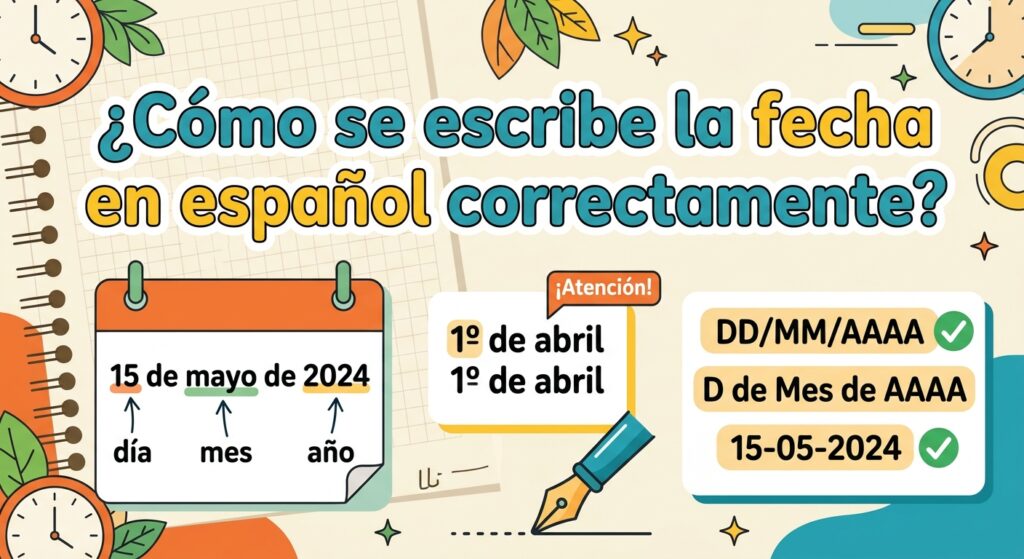
The standard way to write a date in Spanish is to put the day first, followed by the month and then the year. When writing the date in full, you normally use the following structure:
day + de + month + de + year
For example:
- 24 de octubre de 2026 [24 October 2026]
- 15 de marzo de 2025 [15 March 2025]
- 8 de junio de 2024 [8 June 2024]
Notice that the word de appears twice: once between the day and the month, and again between the month and the year. This is an important part of the structure, so make sure you do not leave it out when writing a complete date.
Compare these examples:
- Correct: 12 de abril de 2026 [12 April 2026]
- Incorrect: 12 abril 2026
When you understand this pattern, you will know how do you write the date in Spanish in most everyday and formal situations.
Do You Use Cardinal or Ordinal Numbers in Spanish Dates?
In Spanish, cardinal numbers are normally used when writing dates. Cardinal numbers are the numbers we use for counting, such as uno (one), dos (two), tres (three) and veinticuatro (twenty-four).
For example:
- 2 de febrero [2 February]
- 10 de agosto [10 August]
- 24 de octubre [24 October]
When you read these dates aloud, you normally say dos de febrero, diez de agosto and veinticuatro de octubre.
This differs from the English convention of using ordinal numbers in spoken dates, such as “the second of February” or “the twenty-fourth of October”. In Spanish, you do not usually need to add an ordinal ending to the number.
How Do You Write the First Day of the Month in Spanish?
The first day of a month is a small detail that can cause confusion. In Spanish, you may hear both el uno de mayo [the first of May] and el primero de mayo [the first of May].
The form primero is used in some varieties of Spanish, particularly in Latin America. In Spain, el uno de mayo is common. When writing the date numerically, however, you simply use the number 1.
For example:
- 1 de enero [1 January]
- 1 de mayo [1 May]
- 1 de diciembre [1 December]
You do not need to write primero in a numerical date. The important thing is to recognise both forms when you hear them and to use the form that fits your context.
Essential Vocabulary: Months and Days of the Week in Spanish
To understand how do you write the date in Spanish, you need to know the names of the months and days of the week. Fortunately, these are easy to learn with a little practice.
The Twelve Months of the Year in Spanish
Here are the months of the year in Spanish, together with their English equivalents.
- enero [January]
- febrero [February]
- marzo [March]
- abril [April]
- mayo [May]
- junio [June]
- julio [July]
- agosto [August]
- septiembre [September]
- octubre [October]
- noviembre [November]
- diciembre [December]
One important rule is that months are written in lower case in Spanish, unless they appear at the beginning of a sentence or in another context that requires a capital letter.
For example:
- Correct: Mi cumpleaños es en octubre. [My birthday is in October.]
- Incorrect: Mi cumpleaños es en Octubre.
This is different from English, where the names of months always begin with a capital letter. Remembering this distinction will help you avoid a common mistake when writing in Spanish.
The Days of the Week in Spanish
The days of the week are also essential when talking about dates and making plans.
- lunes [Monday]
- martes [Tuesday]
- miércoles [Wednesday]
- jueves [Thursday]
- viernes [Friday]
- sábado [Saturday]
- domingo [Sunday]
As with the months, the days of the week are normally written in lower case in Spanish.
For example:
- La reunión es el lunes. [The meeting is on Monday.]
- El curso empieza el martes. [The course starts on Tuesday.]
- Nos vemos el viernes. [See you on Friday.]
Unlike English, Spanish does not normally capitalise the names of days or months. Also, when talking about a regular weekly activity, the singular or plural form of the day can change the meaning.
For example:
- Trabajo el sábado. [I work on Saturday.]
- Trabajo los sábados. [I work on Saturdays.]
The first sentence refers to a particular Saturday, while the second describes a regular activity.
When Should You Use El and En with Dates in Spanish?
Another important part of learning how do you write the date in Spanish is understanding when to use the prepositions el and en. Both can be used when talking about time, but they do not have the same function.
Use En to Talk About Months and Years
In Spanish, the preposition en is generally used when referring to a month or a year without specifying a particular day.
For example:
- Nací en junio. [I was born in June.]
- Empezamos el curso en septiembre. [We start the course in September.]
- Vivo en España desde 2022. [I have lived in Spain since 2022.]
Notice that en is followed directly by the month or year. You do not normally add el before the month in these sentences.
Use El to Refer to a Specific Date
When you mention a particular day or date, you generally use el.
For example:
- Mi examen es el 15 de noviembre. [My exam is on 15 November.]
- La clase es el lunes. [The class is on Monday.]
- Llegamos el 3 de agosto de 2026. [We arrive on 3 August 2026.]
In English, we often use the preposition “on” before a day or date. In Spanish, the corresponding expression is usually el, rather than a direct translation of “on”.
Compare these sentences:
- The meeting is on Friday.
- La reunión es el viernes.
Avoid translating every word directly from English. Learning these expressions as complete phrases will help you use Spanish more naturally.
How to Write Dates in Spanish Using Numbers: DD/MM/YYYY
In addition to writing dates in full, Spanish speakers frequently use numbers, particularly in forms, calendars, invoices, bookings and administrative documents.
The usual numerical format in Spain is:
DD/MM/YYYY
The letters stand for day, month and year. For example:
- 24/10/2026 [24 October 2026]
- 08/06/2024 [8 June 2024]
- 15/03/2025 [15 March 2025]
The day and month are often written with two digits, adding a zero in front of numbers from 1 to 9. The year is normally written with four digits.
If you want to understand how do you write the date in Spanish on a form or official document, remembering this order is particularly useful.
Spanish and American Date Formats: What Is the Difference?
One of the most common sources of confusion is the difference between Spanish and American numerical dates.
In Spain, the day comes before the month. In the United States, the month usually comes before the day.
For example, the date 04/07/2026 means:
- In Spain: 4 July 2026.
- In the United States: 7 April 2026.
This difference can lead to misunderstandings, especially when arranging appointments, booking accommodation or completing documents online.
British English generally uses the day-month-year order, as does Spanish. However, it is still worth checking the format whenever you are dealing with an international form or website.
Which Separators Are Used When Writing Dates in Spanish?
Dates in Spanish are commonly written using forward slashes, full stops or hyphens, depending on the document or system.
Examples include:
- 24/10/2026
- 24.10.2026
- 24-10-2026
The forward slash is particularly common in everyday use in Spain. In formal documents, the format may depend on the institution or the software being used.
When writing the date in full, however, you should use the word de between the day, month and year:
- 24 de octubre de 2026 [24 October 2026]
Avoid mixing the numerical format with the written format unnecessarily. Choose the style that best suits the document and use it consistently.
How to Ask for and Say the Date in Spanish
Knowing how to write a date is useful, but you will also need to ask about dates in conversations. There are several common expressions you can use in everyday situations.
How Do You Ask “What Is Today’s Date?” in Spanish?
The most common question is:
¿Qué fecha es hoy? [What is today’s date?]
You can answer by giving the day, month and, if necessary, the year.
For example:
— ¿Qué fecha es hoy? [What is today’s date?]
— Hoy es 24 de octubre de 2026. [Today is 24 October 2026.]
You can also ask:
¿A qué fecha estamos? [What is the date today?]
In Spain, you may hear the informal question ¿A qué estamos hoy? [What date is it today?]. This is a colloquial expression used in everyday conversation.
How Do You Ask “What Day Is It Today?” in Spanish?
If you want to know the day of the week rather than the numerical date, use:
¿Qué día es hoy? [What day is it today?]
For example:
— ¿Qué día es hoy? [What day is it today?]
— Hoy es sábado. [Today is Saturday.]
Be careful not to confuse ¿Qué fecha es hoy? with ¿Qué día es hoy?. The first question asks for the date, while the second usually asks for the day of the week.
Both expressions are common and useful for learners at beginner level.
¿A qué estamos hoy? (What Date Is It Today?)
The expression ¿A qué estamos hoy? is used in some varieties of Spanish to ask what the date is. You may also hear ¿A cuántos estamos hoy? in certain countries and regions.
For example:
— ¿A qué estamos hoy? (What’s the date today?)
— Estamos a 24 de octubre. (It’s the 24th of October.)
These expressions vary depending on the region, so it is useful to become familiar with the forms commonly used in the variety of Spanish you are learning.
If you prefer an expression that is widely understood across different Spanish-speaking countries, you can use ¿Qué fecha es hoy? or ¿Cuál es la fecha de hoy? (What is today’s date?).
How to Write the Date in Spanish in Formal Contexts and DELE Exams
Writing dates correctly is important not only in everyday conversations but also in formal communication and Spanish examinations. Using the right format helps make your writing clearer and more professional.
How to Write the Date in a Formal Letter or Email in Spanish
When writing a formal letter or email, you may want to include the place and date at the beginning of the document.
A common format is: city, day + de + month + de + year
A Coruña, 24 de octubre de 2026
In English, this would be “A Coruña, 24 October 2026”.
Notice that the date follows the place, separated by a comma. When the date is written in this format, the article el is not usually included.
For example:
- Madrid, 15 de marzo de 2026
- Valencia, 8 de junio de 2026
- Sevilla, 2 de noviembre de 2026
This format is useful for formal letters and certain administrative documents. In emails, you do not always need to write the date manually because the email service usually records it automatically.
Why Dates Matter in the DELE Exam
If you are preparing for the DELE exam, knowing how to write dates in Spanish can help you produce more accurate written work. The exam assesses your ability to communicate in Spanish, and correct spelling, grammar and punctuation all contribute to the overall quality of your writing.
You might need to mention a date when writing a formal email, describing an event, arranging a meeting or explaining when something happened.
For example:
Le escribo para confirmar que la reunión tendrá lugar el 12 de noviembre. [I am writing to confirm that the meeting will take place on 12 November.]
Practising dates alongside other everyday expressions will help you feel more confident when completing writing tasks. If you would like structured preparation, you can explore our DELE exam preparation courses.
Common Mistakes When Writing Dates in Spanish
Now that you know the basic rules, let’s look at some mistakes learners often make and how to avoid them.
A Checklist for Writing Dates Correctly in Spanish
Before submitting a piece of writing, check the following points:
- Use the correct order. Write the day first, followed by the month and year.
- Include de. When writing a complete date in words, remember the prepositions: 24 de octubre de 2026.
- Use lower case for months. Write octubre, not Octubre, unless the word begins a sentence.
- Use lower case for days. Write lunes, not Lunes, in ordinary sentences.
- Choose the correct preposition. Use en for months and years in expressions such as en mayo [in May], and el for specific days and dates, as in el 5 de mayo [on 5 May].
- Check the numerical format. In Spain, the usual order is DD/MM/YYYY.
- Do not translate English expressions word for word. Spanish uses its own grammatical structures when expressing dates.
The more you practise these rules in real situations, the easier they will become.
How Do You Read Years in Spanish?
Years are generally read as whole numbers in Spanish. You do not normally need to separate the year into two parts, as is sometimes done in English.
For example:
- 1999: mil novecientos noventa y nueve [nineteen ninety-nine]
- 2000: dos mil [two thousand]
- 2010: dos mil diez [two thousand and ten]
- 2026: dos mil veintiséis [two thousand and twenty-six]
When you write a date, the year usually appears as a four-digit number. When speaking, you say the year in words.
For example:
Hoy es 24 de octubre de 2026. [Today is 24 October 2026.]
Practise reading years aloud alongside complete dates. This will help you recognise dates when listening to Spanish and express them confidently in conversation.
Take Your Spanish to the Next Level
Learning how to write dates correctly is a small but important step towards communicating more confidently in Spanish. Once you understand the order of the day, month and year, remember to use de between the elements of a written date and know when to use el or en, you will be able to handle most everyday situations with ease.
The key is to practise these structures regularly. Try writing today’s date in Spanish, keeping a diary, noting appointments in a calendar or including dates in short emails. These simple activities will help you remember the rules and use them naturally.
At Zona de Español, we offer online Spanish courses for learners at different levels, from complete beginners to advanced students. Our live lessons with qualified teachers help you practise Spanish through communication and practical activities.
Explore our Spanish courses for beginners, intermediate Spanish courses or advanced Spanish courses and take the next step in your learning journey.
You can also explore our other Spanish courses if you are looking for more specialised training.
At Zona de Español, you will find live online classes with teachers, small groups and learning materials tailored to your level. Keep learning, practise regularly and build your confidence to use Spanish in everyday situations.
Aprende español con nuestros cursos y clases
- Cursos de español online MCER
Curso de Español Online para Principiantes – Nivel A1.1
110,00€ Select options This product has multiple variants. The options may be chosen on the product page - Cursos de español online MCER
Curso de Español Nivel A1.2
110,00€ Select options This product has multiple variants. The options may be chosen on the product page - Cursos de español online MCER
Curso básico de español online – Nivel A2.1
110,00€ Select options This product has multiple variants. The options may be chosen on the product page