

In this article, we’ll take a close look at what todavía means in Spanish, how and when it is used, and we’ll provide plenty of practical examples to help you master this word and sound more like a native speaker. Whether you’re learning Spanish or teaching Spanish online, you’ll find this guide extremely useful.
Learning Spanish can be a fascinating journey, especially when we come across small words that carry a surprising amount of meaning. One such word is this adverb, widely used in everyday Spanish and capable of expressing continuity, contrast, or even surprise, depending on the context.
1. What it is and what it means
Let’s begin with the basics: what is it?
Todavía is a Spanish adverb of time that indicates that an action is continuing in the present or has not finished at the moment of speaking.
In other words, we use this expression when something is still happening, has not changed, or has not come to an end.
Examples:
- Todavía vivo en Madrid. (= I still live in Madrid; I haven’t moved.)
- Todavía está lloviendo. (= It’s still raining; the rain hasn’t stopped.)
- ¿Estás todavía en la oficina? (= You haven’t left; you’re still there.)
So, the core meaning of todavía is linked to the continuity of a situation over time.
2. Etymology and origin
The word derives from the Old Castilian expression toda vía, which literally meant “the whole way” or “all along the way”. With time, its meaning shifted and it came to be used with a temporal sense.
In this sense, it began to convey the idea of something that continues along the passage of time — something that has neither paused nor changed.
Knowing this origin makes it easier to recall its modern meaning: something that remains unchanged or is still ongoing.
Understanding this origin makes it easier to remember its current meaning: something that remains unchanged or is still ongoing.
3. Main uses in Spanish
Although this word has a basic meaning, its use adapts to different contexts. Below, you’ll find the main ways this adverb is used, along with clear examples.
3.1. Expressing continuity over time
This is its most common use. It indicates that an action or situation has not changed and is still true at the present moment.
Examples:
- Todavía no he terminado mi tarea.
I still haven’t finished my homework. - Ella todavía vive con sus padres.
She still lives with her parents. - ¿Todavía estás enfadado?
Are you still upset? - Mis amigos todavía no han llegado.
My friends still haven’t arrived. - Todavía hace calor en octubre.
It’s still warm in October.
In these cases, it works much like aún, another word with a very similar meaning (though with small nuances we’ll explore later).
3.2. In negative sentences: something hasn’t happened yet (but is expected to happen)
In negative statements, it suggests that something has not yet occurred, but is expected to take place at some point.
Examples:
- No he comido todavía.
I haven’t eaten yet. - El tren no ha llegado todavía.
The train hasn’t arrived yet. - No lo sé todavía, pero te avisaré.
I don’t know yet, but I’ll let you know. - No hemos decidido la fecha todavía.
We haven’t decided on the date yet.
Here, it communicates an expectation that something will change or happen soon.
3.3. Expressing contrast or surprise
It can also convey contrast or surprise, especially when something happens despite what one might expect.
Examples:
- ¡Todavía tiene energía para seguir trabajando!
He still has the energy to carry on working! - ¡Todavía estás aquí! Pensé que ya te habías ido.
You’re still here! I thought you’d already gone. - Todavía cree en los cuentos de hadas.
She still believes in fairy tales. - Todavía confías en él, después de todo lo que pasó.
You still trust him, after everything that happened.
In these contexts, it introduces an emotional tone, often one of disbelief or admiration.
3.4. In comparisons: todavía más, todavía mejor, todavía peor
Another frequent use is as a comparative intensifier, indicating a greater degree or increase.
Examples:
- Este libro es todavía más interesante que el anterior.
This book is even more interesting than the last one. - Hoy hace todavía más frío que ayer.
It’s even colder today than it was yesterday. - Su español es todavía mejor que el de su profesor.
His Spanish is even better than his teacher’s. - El tráfico está todavía peor que la semana pasada.
The traffic is even worse than it was last week.
Here, it strengthens the adjective or adverb, adding emphasis.
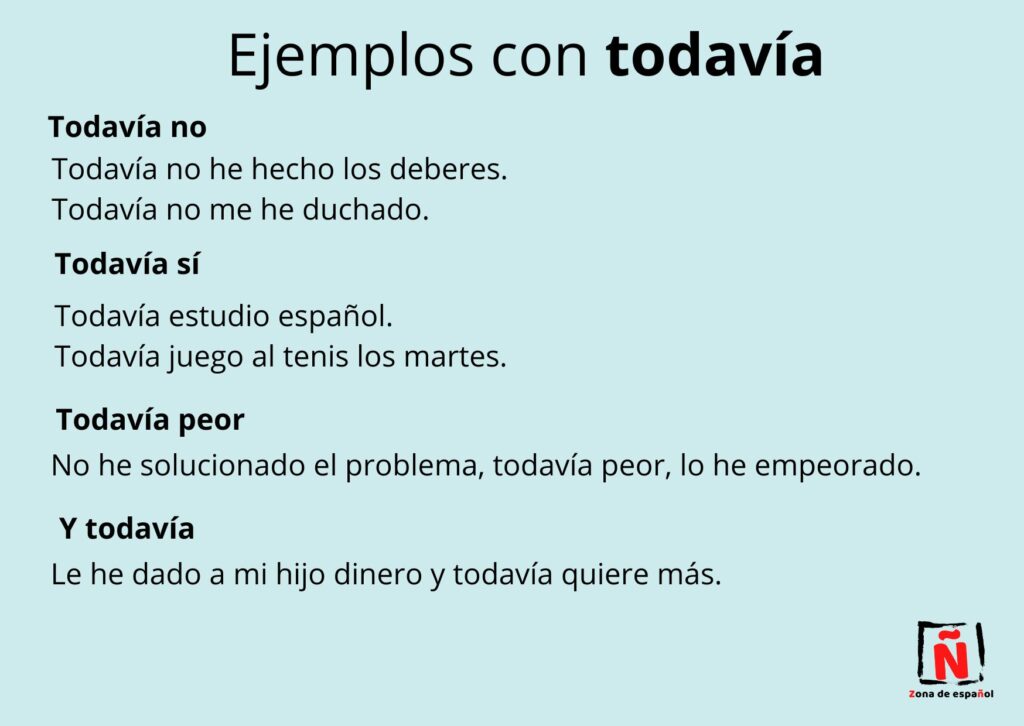
3.5.Todavía in everyday expressions and idiomatic phrases
In day-to-day speech, todavía appears in a number of familiar expressions:
| Expression | Meaning | Example |
| Todavía no | Something hasn’t happened yet, but is expected to | Todavía no he comido. → I haven’t eaten yet. |
| Todavía sí | Confirms that something is still the case | ¿Vives en Valencia? —Sí, todavía sí. → Do you live in Valencia? —Yes, I still do. |
| Aún/todavía peor | Something gets worse or becomes more serious | Perdió el tren y, todavía peor, su móvil. → He missed the train and, even worse, lost his phone. |
| Y todavía… | Expresses surprise or irritation | Le hice un favour y todavía se queja. → I did him a favour and he still complains. |
4. Differences between todavía and aún
Many learners of Spanish often ask:
Do todavía and aún mean the same thing?
The short answer is: almost always, yes. However, there are subtle differences in nuance and style that are worth noting, which we’ll explore below.
4.1. Generally interchangeable
Both words are used to indicate that an action continues or a situation persists.
Examples:
- Todavía no he terminado. = Aún no he terminado.
I haven’t finished yet. - Todavía vive aquí. = Aún vive aquí.
He/she still lives here.
In these cases, the difference in meaning is minimal.
4.2. Differences in tone and usage
Todavía is more common in everyday spoken Spanish.
Aún tends to sound more formal or literary and is often found in written texts or more refined contexts.
Example:
- Todavía te quiero. → More natural in conversation: I still love you.
- Aún te quiero. → More poetic or emotional: I still love you.
4.3. In comparative structures
When used as an intensifier, only todavía is correct:
✅ Es todavía más fácil de lo que parece.
It’s still easier than it seems.
❌ Es aún más fácil de lo que parece.
This form can be heard, but it sounds less natural.
So, when learning Spanish, it’s useful to know both adverbs, but remember that todavía is generally more flexible and sounds more natural in most contexts.
5. Word position in a sentence
The placement of todavía can vary, although it usually comes before the main verb.
Common examples:
- Todavía estudio español. → I’m still studying Spanish.
- Todavía no he ido al gimnasio. → I haven’t gone to the gym yet.
- Todavía estoy pensando qué hacer. → I’m still thinking about what to do.
It can also appear at the end of a sentence for emphasis:
- No ha llegado todavía. → He/she hasn’t arrived yet.
- ¿Estás aquí todavía? → Are you still here?
When placed at the end, it often sounds more casual and conversational.
6. Common mistakes
Many Spanish learners make small but frequent errors when using this word. Here are some of the most typical:
❌ 1. Using it when there’s no continuity
Incorrect: Todavía terminé la tarea ayer.
✅ Correct: Ya terminé la tarea ayer.
(Todavía doesn’t work with actions that were already completed in the past.)
❌ 2. Leaving out “no” in negative sentences
Incorrect: He comido todavía.
✅ Correct: No he comido todavía.
❌ 3. Translating “still” directly from English without context
In English, “still” and “yet” are used differently. In Spanish, todavía can correspond to either, but context matters:
- I’m still here → Todavía estoy aquí.
- I haven’t eaten yet → Todavía no he comido.
For this reason, when learning Spanish it’s important to focus on the temporal meaning of todavía, rather than translating word for word.
7. Using todavía with different verb tenses
Todavía can be used with various verb tenses, provided the action or situation conveys a sense of ongoing continuity.
| Verb tense | Example | Meaning |
|---|---|---|
| Present | Todavía vivo en Roma. | I’m still living there. |
| Present perfect | Todavía no he terminado. | The action hasn’t been completed yet. |
| Imperfect | Todavía trabajaba cuando llegaste. | I was still working at that moment. |
| Future | Mañana todavía estaré aquí. | I will still be in the same place tomorrow. |
8. Cultural insights
In the Spanish-speaking world, todavía is an incredibly expressive word. Depending on the tone and context, it can convey emotion, surprise, reproach, or hope.
Examples:
- Affectionate tone: Todavía te acuerdas de mí. → You still remember me.
- Reproachful tone: ¿Todavía estás viendo la televisión? → Are you still watching TV?
- Admiring tone: ¡Todavía corre maratones a los 80 años! → He/she is still running marathons at 80!
Additionally, todavía often appears in songs and movie titles. A well-known example is the song “Todavía” by the Panamanian group La Factoría, where the adverb conveys nostalgia and the enduring feeling of love:
“Todavía siento tu cuerpo vibrando junto a mí…” → I can still feel your body vibrating next to me…
This emotional richness makes todavía a vibrant and living part of Hispanic culture.
9. Mastering todavía to speak Spanish naturally
By now, you know what todavía means in Spanish, how to use it in different contexts, and its key nuances.
Keep in mind:
- Todavía indicates continuity or persistence.
- It can appear in affirmative statements, negatives, and comparisons.
- It can convey surprise, contrast, or emphasis.
- It is similar in meaning to aún, but is more common in everyday speech.
- It’s essential to distinguish it from ya, its natural opposite.
Mastering this adverb is a crucial step toward speaking Spanish more naturally, fluently, and accurately.
If you want to keep expanding your knowledge of similar expressions, consider joining our online Spanish courses. In our lessons, you’ll learn how to use these words in real-life situations, guided by native teachers and supported with interactive materials.
Learning Spanish online has never been easier, or more enjoyable. Discover our courses and start speaking Spanish confidently today.